
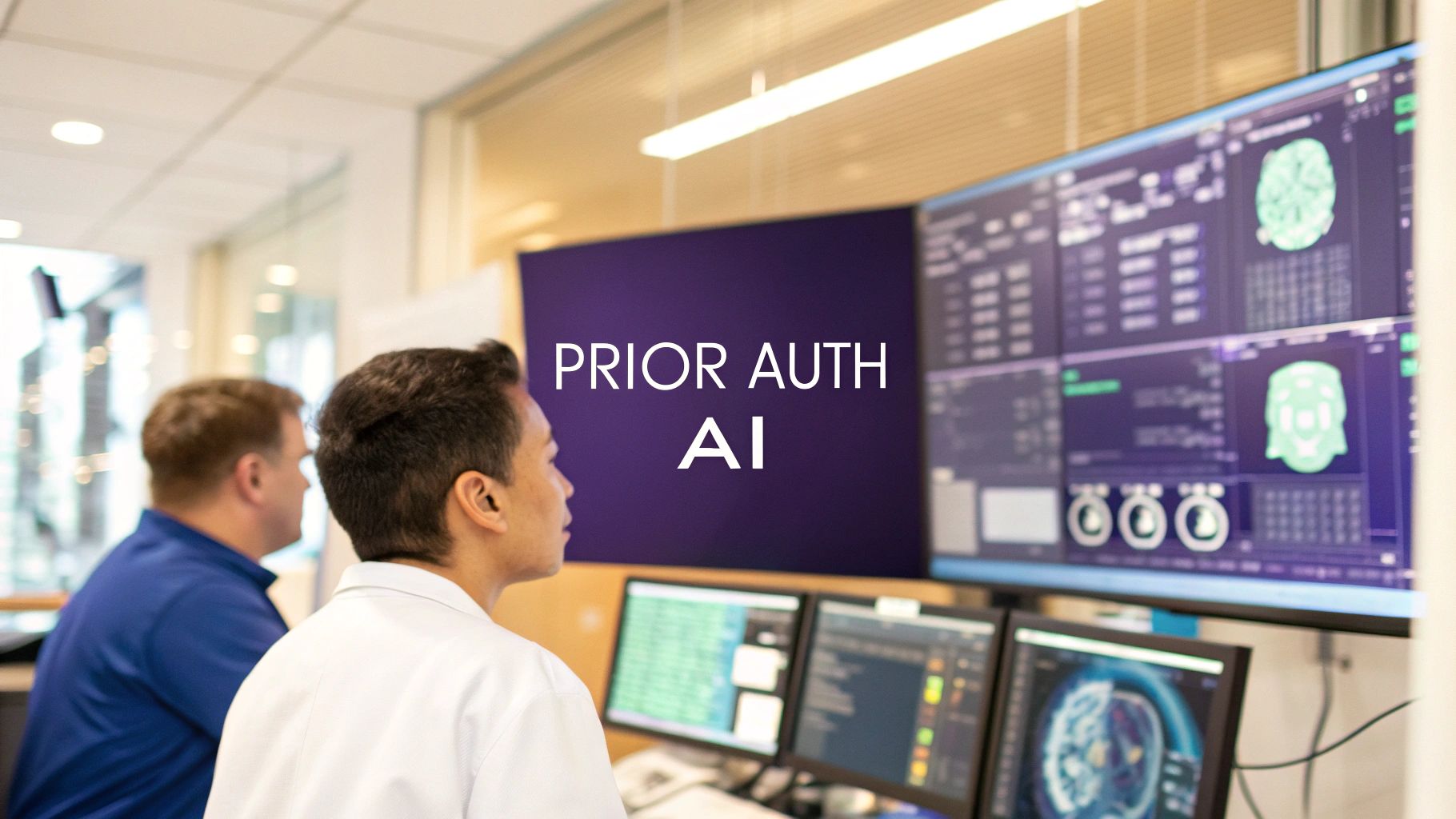
Prior authorization AI is, simply put, a smart system that takes over the entire pre-approval process. It’s designed to handle everything from digging up the right clinical data to shooting the request off to the insurance company, freeing your staff from the slow, manual tasks that create bottlenecks. The goal? Faster approvals and a massive cut in administrative waste.
Why Manual Prior Authorizations Are Draining Your Practice
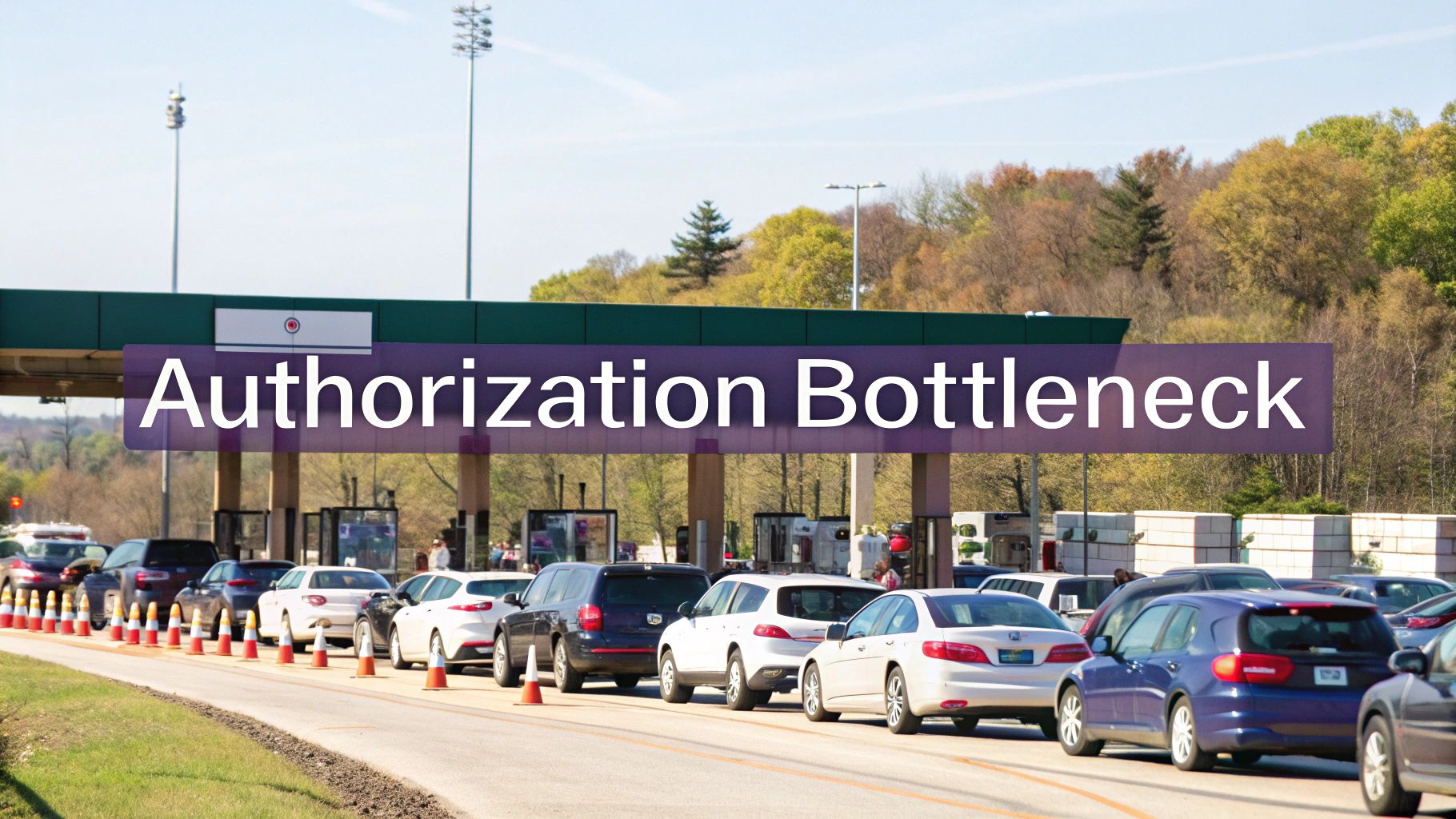
Picture the path to patient care as a major highway. Now, imagine a surprise toll booth popping up at every single exit ramp, creating a miles-long traffic jam. That's exactly what manual prior authorization feels like in a healthcare setting. It's not just a clever analogy; it's the frustrating reality for medical teams everywhere.
This old-school process is a huge source of friction, a critical bottleneck that messes with everything from patient health to staff burnout. It’s a broken system bogged down by repetitive, soul-crushing manual work that actively harms both providers and the people they serve.
The Daily Grind of Manual Work
For your administrative staff, the prior authorization workflow is a miserable loop of phone calls, faxes, and endless paperwork. Every single request is a meticulous, multi-step headache that drains time and morale, pulling skilled professionals away from patient-facing tasks.
- The Info Hunt: Team members have to manually dive into the Electronic Medical Record (EMR) to pull out patient histories, specific clinical notes, and lab results. This isn't a quick search; it's often a painstaking process of sifting through years of data to find the exact justification a payer requires.
- Portal Pandemonium: Every insurance company has its own quirky portal and unique submission rules. This forces your staff to become experts on dozens of different, clunky systems, each with its own login, password, and formatting requirements. A single mistake can lead to an immediate denial.
- The Waiting Game: So much time is wasted on hold with payers, just trying to get a status update or clarify a tiny detail. It ties up phone lines and people who could be doing much more valuable work, like helping patients navigate their care plans or financial responsibilities.
- The Endless Follow-Up: A submitted request is rarely the end of the story. Staff must manually track the status of each authorization, often calling payers repeatedly or checking portals daily, hoping for an update that may never come without persistent prodding.
This constant back-and-forth isn't just inefficient—it’s exhausting. It turns skilled professionals into paper-pushers, pulling their attention away from what they should be doing: helping patients. For a deeper dive into how this all works, take a look at our guide on https://www.simbie.ai/what-is-prior-authorization-in-healthcare/.
The Staggering Financial and Clinical Cost
The price tag for sticking with manual prior authorization is eye-watering. The process costs the U.S. healthcare system somewhere between $41.4 billion and $55.8 billion every single year. This isn't just an abstract national figure; it translates directly to financial strain on individual practices and health systems.
And it gets more personal. The American Medical Association found that doctors and their teams spend about 13 hours a week wrestling with an average of 39 prior authorizations per physician. It’s gotten so bad that 40% of medical practices now hire people whose only job is to handle these requests. This represents a significant and often unsustainable administrative overhead.
But the numbers on the balance sheet are only half the story. The impact on patient care is even more alarming.
The same data paints a grim picture: 93% of physicians say that prior authorizations delay patient care. Even worse, a staggering 82% report that these hurdles cause patients to give up on their recommended treatment entirely.
These aren't just minor inconveniences. Delays can lead to worsening health problems, increased patient anxiety, and much poorer outcomes for the people you’re trying to help. To really get why this is such a big deal, it's helpful to zoom out and start understanding healthcare's technological needs and the infrastructure needed to fix these deep-rooted problems.
The manual system is simply broken. It creates a constant state of friction that burns out staff, frustrates patients, and puts a financial chokehold on practices. This "before" picture makes it painfully clear why a change is so desperately needed—and why prior authorization AI is the way forward.
How AI Tackles Prior Authorization
Think of AI for prior authorization not as a far-off concept, but as a dedicated, hyper-efficient team member who never sleeps. This isn't about replacing people; it's about getting rid of the soul-crushing administrative work that bogs them down. Instead of staff spending hours digging through patient charts and navigating clunky payer portals, the AI system takes over the entire workflow.
What was once a slow, manual grind becomes a quick, automated process. It’s not magic—it's just smart technology working in concert to connect the dots between clinical necessity and payer requirements.

At its heart, this AI acts like a brilliant translator and a seasoned detective all in one. It can read a doctor's complex clinical notes and, in the next breath, decipher an insurance company's labyrinth of rules. This is the secret sauce that lets it cut through the red tape and prevent the kinds of errors that cause needless delays for patients.
The Brains Behind the Operation
So what’s really going on under the hood? Two key pieces of technology drive most prior authorization AI: Natural Language Processing (NLP) and Machine Learning (ML). Getting a handle on these two concepts makes it clear why this approach is so effective.
-
Natural Language Processing (NLP): This is what gives the AI its reading comprehension. Think of it scanning a patient's entire record in your EMR—clinical notes, lab results, specialist reports. NLP can actually understand the context and pull out the critical details, like specific diagnoses, symptoms, and the treatments being ordered. It transforms unstructured text into structured, usable data that the system can act upon.
-
Machine Learning (ML): This is the "experience" part of the equation. The AI learns from analyzing tens of thousands of previous authorization cases. It starts to recognize patterns, figuring out exactly what clinical evidence Aetna needs for a knee MRI versus what Cigna requires for a specialty drug. It gets smarter with every submission, adapting to changing payer preferences and improving its accuracy over time.
These two technologies are a powerful duo. NLP pulls the right clinical puzzle pieces from the EMR, and ML knows exactly how to assemble them to fit each payer's specific requirements. It’s a complete shift from the old "submit and pray" method to an intelligent, data-driven approach.
The Automated Workflow in Action
How does this actually play out day-to-day in a busy clinic or hospital? The process is refreshingly straightforward and consistent, designed to get it right the first time.
- The Trigger: It all starts the moment a provider orders a procedure, test, or medication that needs pre-approval. The AI, which is integrated with the EMR, immediately flags it.
- Evidence Gathering: Forget having a nurse or MA spend 20 minutes clicking through a patient's chart. The AI instantly scans the record. Using NLP, it grabs all the relevant notes, lab values, and other data needed to justify the request. It can intelligently locate the most relevant clinical documentation, even if it’s buried deep within the patient's history.
- Payer Rule Matching: This is where the magic happens. The AI checks the information it gathered against a massive, constantly updated database of payer rules. It knows that Payer A requires a 6-week history of physical therapy for a certain back surgery, while Payer B just needs an MRI report. It ensures the submission aligns perfectly with current policies, not outdated ones.
- Submission: The AI then assembles all this information into the precise format the payer wants and submits the complete package through their electronic portal. The whole thing can take just a couple of minutes, eliminating hours of manual data entry and form-filling.
- Follow-Up: The AI doesn’t just submit and walk away. It continuously pings the payer's system, checking for a status update. The second a determination is made—approved or denied—it notifies your team. This proactive monitoring replaces the endless cycle of manual phone calls and portal checks.
This entire sequence unfolds with almost no hands-on effort from your staff.
By automating these steps, the AI system essentially builds the "perfect" prior authorization request every single time. It ensures every box is checked and all required evidence is included, dramatically cutting the risk of those initial denials that come from simple administrative mistakes. It’s a fundamental change from manual drudgery to intelligent automation.
Why Providers Are Finally Starting to Trust AI
Let’s be honest: bringing new technology into a clinical setting always comes down to trust. For a long time, the thought of an algorithm making decisions about patient care was a non-starter for most clinicians. And that skepticism was healthy. But things are changing, and it's not because of marketing hype.
Healthcare providers are now seeing prior authorization AI as a practical, reliable tool that’s already handling millions of requests successfully. The confidence is growing because these systems are proving to be remarkably consistent—and frankly, better at the tedious parts of the job than manual processes ever were.
From Healthy Skepticism to Widespread Confidence
The proof is in the numbers. A recent National Provider Survey on Prior Authorization painted a clear picture of this shift. An overwhelming 99% of clinicians said they were confident in approvals handled by prior authorization AI. It’s not just the doctors, either; 96% of office administrators felt the same way.
When you see numbers that high, it tells you something important: the people in the trenches, the ones dealing with this process every day, see AI as a genuine ally.
This trust didn't come out of nowhere. It's built on seeing real results. Providers are finding that AI catches the simple human errors—a missing form, a misread payer rule—that used to cause so many needless denials. It brings a level of precision and consistency that’s tough to achieve when you’re managing everything by hand, especially in a high-volume practice.
The reason for this trust is simple: AI does what it says it will do. It brings a predictable, rules-based logic to a process that always felt chaotic and subjective.
The Foundation of AI's Reliability
So, what is it about these systems that’s winning everyone over? Trust in prior authorization AI comes from its ability to solve the most nagging problems in the old manual workflow. It’s not just about getting things done faster; it’s about getting them done right.
Three core capabilities are the real game-changers:
- Fewer Errors, Better Accuracy: AI systems are built to be detail-oriented. They automatically check clinical notes against the specific payer's rulebook, making sure every submission is complete before it goes out the door. This simple step catches the administrative mistakes that cause most initial rejections, leading to higher first-pass approval rates.
- Keeping Up With Changing Rules: Payer rules are constantly in flux. A guideline that was valid last month might be obsolete today. Good AI platforms keep a live, updated database of these policies for you, so every request is submitted against the latest criteria. This takes a huge compliance burden off your staff and ensures you're never working with outdated information.
- Knowing Where Things Stand—Instantly: One of the worst parts of the old system was the "send and pray" approach. You’d fax a form and have no idea what happened to it. AI gives you a real-time dashboard, so your team can see the status of every request at a glance, from the moment it’s submitted to the final decision. This transparency eliminates guesswork and empowers staff to manage their workload effectively.
When providers see fewer rejections, quicker turnaround times, and a clear view of the entire process, trust just naturally follows. They can finally count on the administrative side to run smoothly, letting them put their focus back where it belongs: on their patients.
So, What Are the Real Benefits of Using AI for Prior Authorizations?
Let's move past the theory. When you actually bring prior authorization AI into your practice, you see real, measurable results that change how your day works. These aren't just buzzwords; they're concrete improvements to your finances, your operations, and most importantly, your patients' care.
The value really breaks down into three key areas, and together, they make a powerful case for leaving the old manual process behind.

We can look at these advantages as financial wins, operational gains, and clinical advancements. Each one tackles a core problem that anyone who's ever dealt with a manual prior auth knows all too well.
Financial Wins That Boost Your Bottom Line
The first thing you’ll notice when you automate prior authorizations is the financial relief. By swapping out slow, mistake-prone manual work for a precise AI system, practices can finally plug major revenue leaks and cut down on wasted spending.
This is more than just saving a few bucks here and there. It's about fundamentally strengthening your entire revenue cycle.
Here’s how the money side of things improves:
- Reduced Administrative Costs: Just think about the sheer number of hours your staff spends on hold with payers or filling out the same forms over and over. AI takes that off their plate. You can either reduce overhead or, even better, reassign your talented people to high-value roles that directly help patients. It’s a direct line to significant labor cost savings.
- Lower Denial Rates: Most initial denials aren't even about the clinical need—they're caused by simple administrative mistakes, like a missing piece of information or a wrong code. AI systems are designed to get it right the first time. They check everything against payer rules to make sure every submission is complete and correct, which means less time and money wasted on frustrating appeals.
- A Faster Revenue Cycle: When an approval comes through in minutes instead of weeks, you can bill for that service almost immediately. This shrinks the gap between providing care and getting paid, giving your practice’s cash flow and financial health a massive boost. This accelerated process reduces accounts receivable days and improves overall financial stability.
Operational Gains That Empower Your Staff
Beyond the spreadsheets and bank accounts, prior authorization AI completely changes the vibe of your practice. It gets rid of the administrative headaches that cause burnout and inefficiency, making the entire workplace run smoother.
This shift helps your team go from feeling like reactive paper-pushers to proactive patient advocates.
By automating the most repetitive and frustrating parts of prior authorization, you give your team back their most valuable resource: their time. This one change creates a ripple effect, improving morale and making your whole operation more efficient.
The result? A team that’s more focused and less stressed. Instead of dreading the endless cycle of faxes and phone tag, your staff can focus on work that needs a human touch—like helping a patient understand their financial options or coordinating complex care. This doesn’t just make for happier employees; it leads directly to a better patient experience. You'll likely see a reduction in staff turnover as job satisfaction improves, which further reduces costs associated with hiring and training.
Clinical Impact That Improves Patient Outcomes
At the end of the day, the most important benefit is the one that touches your patients. By getting rid of administrative delays, prior authorization AI ensures people get the care they need, right when they need it. The clinical advantages are huge.
Key Clinical Improvements:
- Quicker Access to Treatment: A delay in care isn't just an inconvenience; it can cause a patient's condition to get worse. With AI-driven approvals, a patient can get their MRI, start a critical medication, or have a procedure scheduled without waiting weeks for an insurer’s green light. This speed is crucial for time-sensitive conditions.
- Reduced Treatment Abandonment: When faced with long waits and uncertainty, it's not surprising that some patients just give up. It’s a massive problem—studies show 82% of physicians report that manual prior auths lead to patients abandoning their treatment plan. Faster, clearer approvals dramatically lower this risk.
- Better Health Outcomes: Timely care is simply better care. By making sure patients get the treatments they need without pointless delays, AI helps improve the overall quality of care and leads to better health in the long run. It closes care gaps and ensures that provider recommendations are acted upon promptly.
By tackling the financial, operational, and clinical frustrations of the old system, prior authorization AI delivers value across the board, making every part of your medical practice stronger.
A Practical Guide to Integrating AI Into Your Practice
Bringing new technology into your practice can feel daunting, but it doesn't have to be a headache. Folding prior authorization AI into your workflow is much more manageable when you break it down into a few clear steps. Think of this as your roadmap to modernizing your process without overwhelming your team.

This isn't about a massive, disruptive overhaul. The idea is to plug in a smart tool that works with your existing systems, not against them. A little planning goes a long way in making the transition feel like a welcome upgrade rather than a forced change.
Start With a Clear Assessment
Before you can even think about picking an AI tool, you need to know exactly what you're trying to fix. This first step is all about getting a brutally honest look at the bottlenecks and pain points in your current prior authorization process.
Start by asking some basic questions:
- How many hours is your team really spending on prior authorizations each week?
- What’s your denial rate on the first try? Be honest.
- What is the average time between submitting a request and receiving a final determination?
- Which specific procedures or payers always seem to cause the biggest headaches?
- What is the financial impact of delayed or denied services on your revenue cycle?
Nailing down this data is non-negotiable. It gives you a starting point—a baseline—so you can actually measure whether the new tool is working. This way, you know you're solving the right problems from day one.
Choosing the Right AI Partner
Let's be clear: not all prior authorization AI platforms are the same. Your mission is to find a partner whose tech fits your practice like a glove, especially when it comes to your Electronic Medical Record (EMR) system.
Look for a solution that promises seamless EMR integration and can back it up. The AI needs to pull clinical data automatically, without forcing your staff to copy and paste information from one screen to another. That right there is the key to real automation.
When you're talking to vendors, insist on a live demo. Make them show you exactly how their platform talks to an EMR like yours. A good partner will be completely transparent about their integration process, security, and the kind of tech support you can expect.
Don’t forget to consider their background. A company that lives and breathes healthcare will have built a far more intuitive and effective tool than a generic software firm. You can learn more about how automated prior authorization is designed specifically for medical practices to help you make a smarter choice. Ask for case studies and references from practices similar to yours.
Implementing and Training Your Team
Okay, you've picked your partner. Now comes the important part: getting the system up and running and making sure your team is ready for it. A smooth rollout is all about good change management.
The implementation process usually breaks down into three phases:
- Technical Setup: Your AI partner’s tech team will work with yours to connect the platform to your EMR. This is their job, not yours, and it should be a well-defined process that minimizes the technical lift for your practice.
- Workflow Configuration: Next, you’ll work with them to customize the AI's rules so they match your most common procedures and payer requirements. This ensures the system is tailored to your specific operational needs from the outset.
- Staff Training: The vendor absolutely must provide solid, hands-on training for everyone who will touch the new system. People need to feel confident and understand exactly how their roles will shift in the new, automated workflow. Designate a "super-user" within your team to be a champion for the new technology.
At the end of the day, successful adoption is about people, not just software. Frame this change as a tool that gets rid of the most frustrating parts of their job, freeing them up to focus on patient care. When you involve your team early and give them great training, the AI becomes a trusted helper, not just another program they have to learn.
Measuring the ROI of Your AI Investment
Any time you bring new technology into your practice, you have to be able to answer one simple question: "Is it worth it?" Putting AI to work on your prior authorizations is no exception. The great thing is, its value isn't some fuzzy, hard-to-pin-down concept. You can prove it with cold, hard data.
Calculating the return on investment (ROI) is how you build a solid business case. It shows everyone, from the front office to the C-suite, exactly how automation is helping the practice’s financial and operational health. You just need to know what to look for.
Quantifying the Tangible Returns
The easiest place to start is with the numbers you can actually count. These are the direct financial wins that come from automating your prior auth workflow. Honestly, this is where you'll see the impact almost immediately.
Focus on tracking a few core metrics:
- Approval Turnaround Time: What was your average approval time before AI? And what is it after? Cutting this down from weeks to days means you get paid faster. It’s that simple.
- First-Pass Approval Rate: How many submissions sail through on the very first try? AI is built to submit clean, complete requests, so you should see this number jump significantly.
- Reduced Denial Rates: Keep an eye on the overall drop in denials. Every denial avoided saves you from the headache and expense of a lengthy appeal process.
- Staff Time Reallocation: Track the reduction in hours your team spends on manual PA tasks. This represents significant productivity gains.
But the biggest, most impactful number? The time you give back to your staff.
Think about it this way: Multiply the hours your team used to spend on prior auths each week by their average hourly wage. That number is the direct labor cost you're either saving or, better yet, putting back into patient care.
Let's say two staff members spent a combined 25 hours per week wrestling with prior auths. At a loaded wage of $30/hour, you’re freeing up $750 in productivity every single week. That's $39,000 a year that can be used for things that actually move the needle for your patients. When you're ready to look at different platforms, make sure you choose a comprehensive prior authorization software that gives you the reporting tools to track these numbers easily.
Accounting for the Intangible Benefits
Of course, not everything that matters can be neatly plugged into a spreadsheet. The "softer" benefits of prior authorization AI often have a huge effect on your practice's culture and your relationship with patients.
These are the positive ripple effects that create a much healthier work environment:
- Improved Staff Morale: When you remove the single most frustrating, soul-crushing task from your team's plate, it's a game-changer. People who aren't burned out from battling payer portals are happier, more focused, and far less likely to quit.
- Higher Patient Satisfaction: Getting a fast "yes" on a needed procedure is a massive relief for patients. They see your practice as efficient and on their side, which is how you build real loyalty and trust. This can directly translate to higher patient retention rates and positive online reviews.
- Reduced Clinician Burnout: Physicians are also deeply affected by PA burdens. By streamlining the process, you reduce their administrative workload and allow them to practice at the top of their license, focusing on clinical decision-making rather than paperwork.
You can't put a price tag on a less-stressed employee or a patient who feels genuinely cared for. But these things are absolutely critical to the long-term health of your practice. They lower turnover costs, boost your reputation, and help you deliver better care. A true ROI calculation understands that the real value is found in both the financial and the human impact.
Got Questions About AI for Prior Authorizations? We Have Answers.
It’s completely normal to have questions when you’re thinking about bringing a new system into your practice. Getting clear, straightforward answers is the best way to figure out if prior authorization AI is the right move. Let's tackle some of the most common concerns we hear from providers just like you.
Is This AI System Actually Secure and HIPAA Compliant?
Yes, absolutely. Patient data security isn't just a feature; it's the foundation of any worthwhile healthcare AI platform. These systems are designed specifically for the healthcare world, meaning they are built to be 100% HIPAA compliant. They use bank-level encryption and secure cloud environments to keep patient information locked down tight.
In fact, think about your current manual process—unsecured faxes, emails flying back and forth, sensitive details shared over the phone. An automated system is often more secure because it eliminates the potential for human error and keeps everything inside a protected digital space with a clear audit trail.
Will This AI Put My Staff Out of a Job?
Not at all. The entire point of prior authorization AI is to empower your staff, not replace them. It’s a tool that takes over the soul-crushing, repetitive tasks that nobody likes doing—like filling out endless forms, chasing down information, and sitting on hold for what feels like an eternity.
By handing off the administrative grunt work to the AI, you free up your skilled team to focus on what humans do best: interacting with patients.
Imagine reassigning your best people to high-touch roles like patient advocacy, care coordination, or complex billing issues. The AI handles the paperwork, so your people can care for your patients. It transforms their roles from administrative clerks to high-value patient navigators.
How Long Will It Take to Train My Team on This?
You’ll be surprised how quickly they pick it up. Modern AI tools are built to be incredibly intuitive, with clean, simple interfaces. Most teams feel confident using the system after just a couple of training sessions. Plus, any good AI partner will provide full onboarding support to make the transition seamless.
The best part is that these systems plug right into your existing EMR. It doesn't feel like learning a whole new, complicated piece of software. It feels like a helpful upgrade to the workflow your team already knows, designed to make their jobs easier from the get-go. The goal is adoption, and reputable vendors design their platforms for rapid and easy integration into daily routines.
Ready to see how much time and money your practice could save? Simbie AI eliminates the administrative burden of prior authorizations, reduces denial rates, and helps your staff focus on what truly matters—your patients. Book a demo today and discover the future of practice management.