
As an occupational therapist, your documentation is the backbone of your practice. The SOAP note—which stands for Subjective, Objective, Assessment, and Plan—is the universally recognized format for telling a patient's story, justifying your skilled services, and getting paid for your work.
Think of it as the gold standard for clinical reasoning. It’s how we communicate with other providers and create a clear, defensible record of care.
Why SOAP Notes Are Essential in Occupational Therapy
Mastering the art of writing a solid SOAP note isn't just about checking a box—it's one of the most fundamental skills you'll use every single day. Each note you write captures a snapshot of your patient's journey, building a clear narrative of their progress and the skilled interventions you provided.
This structure is powerful because it helps you connect the dots. You can easily see how what the client tells you lines up with what you observe, which sharpens your clinical assessment and guides your next steps.
The Foundation of Professional Practice
There’s a reason the SOAP note has been a fixture in OT since the 1970s. It’s the framework that ensures our skilled services are recognized and, crucially, reimbursable.
The industry has definitely taken notice. A 2023 AOTA survey revealed that 92% of therapists now use the SOAP format daily. That's a huge jump from just 65% in 2010, and it’s largely driven by increasingly strict requirements from payers. You can find more details on current OT documentation standards at patientnotes.ai.
But it's about more than just appeasing insurance companies. A well-crafted note validates your expertise and serves several critical functions:
- Creates a Legal Record: It’s a chronological account of the care you provided, protecting both you and your patient.
- Facilitates Communication: It lets other providers, from PTs to physicians, quickly get up to speed on a patient's status and your plan.
- Guides Clinical Reasoning: The act of writing a SOAP note forces you to pause, analyze the session, and think critically about what comes next.
- Demonstrates Medical Necessity: It clearly answers why the patient needs the unique skills of an OT, which is the key to getting services authorized.
At its core, a SOAP note is your professional narrative. It articulates the why behind your interventions, justifying your role and showcasing the tangible impact you have on a patient's functional independence.
To help you get started, here's a quick breakdown of how the four components work together.
The Four Pillars of a SOAP Note
| Section | Purpose | What to Include |
|---|---|---|
| Subjective | To capture the patient's perspective and self-report. | Direct quotes from the patient or caregiver, reports of pain, fatigue, goals, or feelings about their progress. |
| Objective | To document measurable, quantifiable, and observable data from the session. | Measurements, test results, and skilled observations of the patient's performance during specific tasks. |
| Assessment | To analyze the S and O sections and show your clinical reasoning. | Your professional interpretation of the data, progress towards goals, and justification for continued OT services. |
| Plan | To outline the next steps for the patient's treatment. | The frequency and duration of future sessions, specific interventions planned, and any referrals or consultations needed. |
Each of these sections—Subjective, Objective, Assessment, and Plan—builds on the last, creating a complete and defensible picture of your patient's care. Mastering this structure is the first step toward writing notes that not only meet compliance standards but truly reflect the value of your work.
Capturing the Patient's Story in the Subjective Section
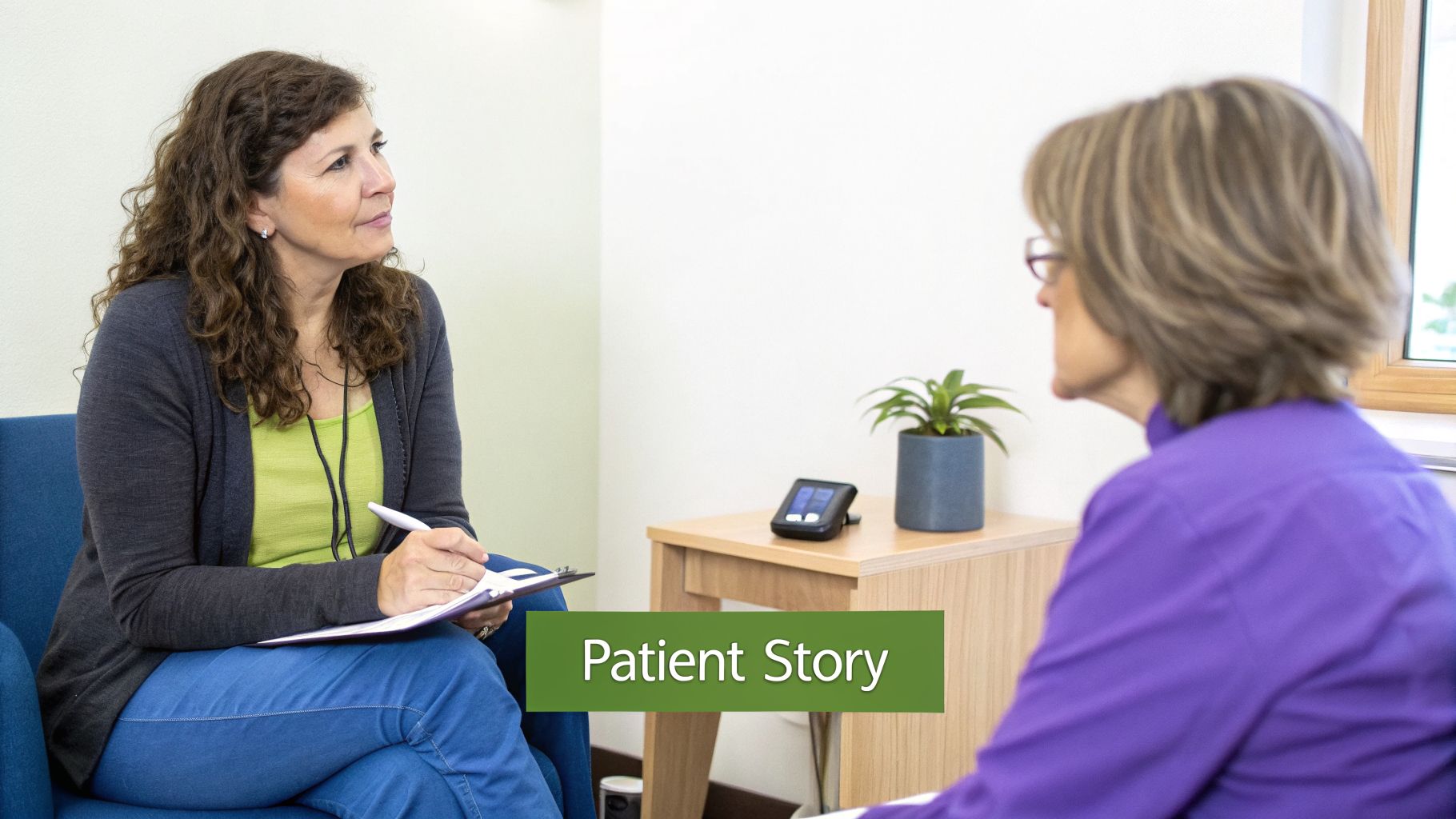
The "S" in your occupational therapy SOAP notes is where the patient’s voice comes through. This section is all about their personal story—what they’re experiencing, what’s challenging them, and what they hope to accomplish. This is your opportunity to capture their perspective directly, which sets the entire tone for the note and provides the crucial "why" behind your skilled intervention.
Think of it as the opening scene. What is the patient or their caregiver telling you? This isn't just filler; it's the information that directly links your therapy to their real-life experience, which is absolutely essential for justifying your services. You're not just writing down a quote; you're capturing the functional impact of their condition from their point of view.
What to Listen For
The details you include will change with every patient and setting, but the goal is always to gather information that’s relevant to their occupational performance and your therapy plan.
Some of the most powerful subjective information includes:
- Direct Quotes: Using their exact words can paint a vivid picture. A parent might say, "He gets so frustrated with his shoelaces that he just gives up and cries every morning."
- Pain and Symptom Reports: Go beyond the basics. Document their description of the pain, its location, intensity, and triggers. For example, "reports a sharp, 7/10 pain in her wrist when typing."
- Updates on Home Life: How are they managing with daily activities? A patient might tell you, "I haven't been able to cook a full meal since my surgery because I can't lift the pots."
- Their Goals and Worries: This is what matters most. A statement like, "My main goal is to be able to garden again without my back hurting," gives you a clear, patient-centered target to work toward.
Getting this information right from the start is key, much like having a well-designed new patient intake form. You can learn more about optimizing patient intake to ensure you’re starting off on the right foot.
Tailoring Your Note to the Patient
Of course, how you capture this information will look very different depending on who you're treating. Your note needs to reflect the unique context of a child in a school setting, an adult recovering from a workplace injury, or an older adult working to stay safe at home.
The subjective section humanizes the patient. It bridges the gap between clinical data and the real-world impact of their condition, making your documentation more compelling and patient-centered.
Let's look at a few different scenarios:
Pediatrics Example (from a parent):
"Parent reports that Leo has been having more frequent meltdowns after school, stating, 'He seems completely overwhelmed by the time he gets home.' Parent also notes that he is avoiding tasks involving writing and is having difficulty using scissors to complete homework assignments."
Geriatrics Example:
"Patient reports increased fear of falling since being discharged from the hospital. States, 'I feel unsteady on my feet, especially in the bathroom.' She expressed frustration with her inability to independently prepare her morning tea, reporting that her 'hands feel too weak to hold the kettle safely.'"
Outpatient Hand Therapy Example:
"Patient states, 'The tingling in my fingers is gone, but I still have a deep ache in my palm when I try to open a jar.' Reports he was able to use his computer for 20 minutes yesterday before the pain level reached a 5/10, an improvement from 10 minutes last week."
In every one of these examples, the subjective data provides a clear problem from the patient's perspective. It highlights specific functional deficits—meltdowns, fear of falling, limited computer use—that occupational therapy is perfectly positioned to address. This information doesn't just start your note; it builds the entire foundation for your plan of care.
Translating Observations into Objective Data

This is where the rubber meets the road. The Objective section of your occupational therapy SOAP notes is where you lay out the hard facts—the quantifiable, observable, and reproducible data from your session. If the Subjective section is the patient's story, the "O" section is your clinical evidence.
Think of it this way: this is the data that backs up your clinical judgment, justifies your plan, and proves to payers that your skilled services are essential. Your goal should be to write it so clearly that another therapist could pick it up and know exactly what happened during the session.
Moving Beyond Vague Descriptions
One of the quickest ways for a note to lose its impact is by using vague, non-specific language. We've all seen them: notes that say a "patient participated in dressing practice" or "worked on meal prep." These phrases don't really tell us anything. They fail to communicate the patient's actual performance or the skill involved.
The "O" section demands precision. You need to paint a picture with numbers, measurements, and concrete descriptions of function.
Instead of: "Assisted with dressing."
Try this: "Patient required moderate physical assistance to thread left arm into shirt sleeve due to decreased shoulder flexion and minimal verbal cues for sequencing."
Instead of: "Practiced kitchen tasks."
Try this: "Patient completed a cold meal prep activity (making a sandwich) in 12 minutes, requiring three verbal cues for safety awareness when using a knife."
That shift from general to specific is what gives your documentation its power. It leaves no room for guessing what happened or how much support the patient truly needed.
Documenting Standardized Measures
Your "O" section is the perfect home for all the data from your standardized assessments and clinical measures. These numbers give you a solid baseline and are absolutely critical for tracking progress over time.
Consider these the vital signs of a patient's occupational performance. They are objective, respected, and easily understood by other healthcare pros and insurance reviewers.
Common Metrics to Include:
- Range of Motion (ROM): Get specific with goniometric measurements (e.g., "R shoulder flexion AROM: 0-110 degrees").
- Manual Muscle Testing (MMT): Note the grade for relevant muscle groups (e.g., "R wrist extensor MMT: 3/5").
- Grip and Pinch Strength: Include the exact readings from your dynamometer and pinch gauge (e.g., "R hand grip strength: 45 lbs").
- Standardized Test Scores: Record the results from assessments like the 9-Hole Peg Test, Box and Blocks Test, or FIM scores.
Metrics like these are your proof of progress. For example, showing a steady improvement in grip strength and ROM can be the key to justifying continued therapy for a post-surgical hand patient. In fact, solid data from rehab settings shows that FIM scores for ADLs can improve from 3-4/7 to 5-6/7 with skilled OT, which contributes to a 35% increase in a patient's independence at discharge. You can find more strategies for documenting quantifiable progress in occupational therapy from HealthOrbit.ai.
Describing Functional Performance
Beyond the formal tests, your skilled observation of how a patient performs a meaningful task is the true heart of the "O" section. Here, you need to detail the performance itself. To do it well, I find it helps to mentally break down the observation into a few key parts.
Key Components for Functional Observation:
- The Task: What was the activity? Be specific (e.g., lower body dressing, transferring from bed to wheelchair).
- Assistance Level: Exactly how much help was required? Stick to standard terms: Independent, Modified Independent, Supervision, Contact Guard (CGA), Minimal (Min A), Moderate (Mod A), or Maximal (Max A).
- Cueing Required: What kind of cues did you provide? Specify whether they were verbal, visual, or tactile.
- Time and Duration: How long did the task take? How long could they sustain the effort?
- Quality of Movement: Describe what you saw. Note things like ataxia, tremors, poor motor control, or postural instability.
The most defensible Objective data always connects a specific impairment to a clear functional limitation. It answers not just what the patient did, but how they did it and what support was necessary to get it done.
Let's look at a common scenario with a post-stroke patient.
Post-Stroke Scenario Example:
- Weak Example: "Patient worked on grooming."
- Strong Example: "Patient completed morning grooming tasks at sink side in 15 minutes while seated in w/c. Required Mod A to manage toothpaste and toothbrush with non-dominant L hand. Required 2 verbal cues for midline orientation and to attend to L side of face when washing."
The second example is packed with objective information. It tells us the setting, duration, assistance level, the specific fine motor challenge, and the cognitive/perceptual cues needed. This is the level of detail payers are looking for. It clearly demonstrates that the therapist wasn't just supervising—they were actively providing skilled intervention to address the specific deficits holding the patient back.
Demonstrating Your Clinical Reasoning in the Assessment
This is where your clinical brain really gets to work. The Assessment section of your occupational therapy SOAP notes is so much more than a simple summary; it's your professional synthesis of the entire session. You’re taking what the patient reported in the "S" and what you measured in the "O" and explaining what it all means for their ability to function in their daily life.
Think of the "A" as the core of your argument for skilled OT. It’s where you interpret the data, pinpoint the underlying problems, celebrate the wins, and build a solid case for why the patient still needs you. A well-written Assessment is what separates a basic, check-the-box note from a powerful document that truly shows your value.
Of course, your reasoning is only as good as your data. A deep dive into effective occupational therapy evaluations is always a good starting point for gathering the right information.
Crafting a Problem Statement
I find it helps to kick off the Assessment with a strong, clear problem statement. This isn't just a list of diagnoses; it connects the client’s core functional limitations to the underlying factors causing them. It’s the "headline" of your clinical analysis.
Here’s what that might look like in practice:
- Client demonstrates deficits in fine motor coordination and grip strength, which directly limit their independence with dressing, particularly buttoning and zippering.
See how that one sentence links the impairment (poor coordination) to the functional problem (getting dressed)? It immediately tells anyone reading the note—a doctor, an insurer, another therapist—exactly why these deficits are a big deal for the client.
Analyzing Progress and Identifying Barriers
With the main problem established, you can dig into the session's details. You're essentially interpreting your own objective data through the lens of the patient's goals. Ask yourself a few key questions as you write.
- Did they make progress? Always highlight improvements, even small ones. Crucially, tie that progress back to what you did in the session. Show that your skilled intervention is what's making the difference.
- What's getting in the way? Pinpoint the specific barriers. Is it pain? Edema? Maybe it’s a cognitive issue like poor sequencing or even something in their environment. Be specific.
- What's the story behind the numbers? Don't just list data; explain what it implies. For example, a drop in grip strength over several reps might tell you that muscle fatigue is a major barrier to completing a full task.
The Assessment is your opportunity to show your thinking. It proves you're not just a passive observer running through exercises. You are actively analyzing, problem-solving, and adapting your plan based on how the patient responds.
The level of detail you provide here can make or break reimbursement. A 2022 CMS audit of 10,000 OT claims found that notes with detailed, well-reasoned Assessments had a 62% approval rate. In contrast, notes with weak or generic Assessments were approved only 41% of the time. That difference really highlights how much a strong analysis matters.
Justifying the Need for Skilled OT
Everything in your Assessment should build toward one final point: justifying the continued need for your unique skills as an occupational therapist. This is where you connect the dots and state plainly why the problems you’ve identified require professional intervention. It’s also a great place to comment on the patient’s rehab potential.
A few phrases can help you frame this justification:
- "Patient requires skilled instruction in energy conservation techniques to manage fatigue during ADLs."
- "These deficits in visual-motor integration continue to impact handwriting legibility, warranting skilled OT to implement compensatory strategies."
- "Client demonstrates good rehab potential and is motivated to participate, indicating a high likelihood of success with continued therapy."
Your Assessment is the clinical engine that drives the entire note forward. By clearly analyzing the data and tying it all back to function, you build an undeniable case for your patient's care. For those who want to take their documentation to the next level, our guide on clinical documentation improvement offers even more strategies.
Creating a Clear and Actionable Plan
The Plan, or "P" section of your occupational therapy SOAP notes, is where the rubber meets the road. It’s your chance to turn all the great insights from your Assessment into a concrete game plan for your client's care. Think of it as the roadmap for what comes next.
This section does more than just guide your own sessions; it clearly communicates your strategy to the entire care team—physicians, other therapists, and even insurance payers. A solid plan shows you're not just reacting session by session but proactively guiding the client toward their goals. It's what justifies your continued care.
Stating Frequency, Duration, and Focus
First things first, let's get the logistics down. Anyone reading your note should instantly understand the basic schedule for therapy. Vague notes like "continue with therapy" just don't cut it and can cause problems down the line. You have to be specific.
Start by laying out the schedule and the main purpose for the next block of sessions. This simple step adds structure and sets clear expectations for everyone involved.
- Frequency: How often are you seeing the client? (e.g., "Continue OT 3x/week…")
- Duration: How long will this schedule last? (e.g., "…for the next 2 weeks…")
- Focus: What’s the big-picture goal for this period? (e.g., "…to address deficits in upper body dressing and grooming.")
This simple formula—frequency, duration, and focus—is the foundation of a strong plan and leaves no room for confusion.
Detailing Specific Interventions
Once you've set the schedule, it's time to get into the what and why of your upcoming sessions. This is where you connect your planned interventions directly to the client's goals and the problems you identified in your Assessment. Your plan should read like a blueprint for what you're actually going to do.
Your Plan isn't set in stone. It’s a living document that should change as your client makes progress. It’s a direct reflection of your clinical reasoning and needs to adapt to their evolving needs.
Here are a few examples of how to write about specific interventions:
- "Introduce adaptive equipment, including a button hook and sock aid, to increase independence with dressing."
- "Begin graded strengthening exercises for R hand grip, using therapy putty and hand grippers, to improve ability to manage meal prep tasks."
- "Provide skilled instruction in joint protection techniques for use during household chores to reduce pain and prevent further deformity."
See how each statement is action-oriented? It links a specific treatment directly to a functional outcome. This is the kind of detail that shows you have a thoughtful, skilled strategy in place.
Education, Referrals, and Goal Modifications
Finally, the Plan is the perfect place to wrap up any other loose ends. This is your spot to document any client education, referrals you need to make, or updates to the goals based on what happened in the session.
- Patient/Family Education: Jot down any specific training you provided. For example, "Educated patient and spouse on proper use of a tub bench for safe bathing."
- Referrals: Note any consultations you're making. For instance, "Will consult with PT regarding wheelchair positioning and mobility."
- Goal Updates: If your assessment shows a goal was met or is no longer the right fit, make a note of it here. Something like, "Short-term goal #2 (donning a shirt with Min A) has been met. Will establish a new goal next session to address shoe tying."
By creating a comprehensive and actionable Plan, you close the loop on your SOAP note and build a clear, justifiable path for every future visit.
Optimizing Your Documentation Workflow with Technology
Let’s be honest—the paperwork can be overwhelming. In a busy clinic, every minute you spend wrestling with documentation is a minute you’re not spending with a client. Thankfully, we have some great tech at our fingertips that can help us get our occupational therapy soap notes done faster and more accurately.
The trick is to first get the most out of the tools you probably already have. Most Electronic Medical Record (EMR) systems have built-in features that are seriously underused but can save you a ton of time.
Getting the Most Out of Your EMR
Think of your EMR as more than just a place to store notes. It’s a powerful assistant, especially if you set it up right. Start by creating custom templates for your most common evaluations and treatment sessions. This lets you pre-populate notes with standard text, so you’re just filling in the patient-specific details each time.
Another real game-changer is building your own library of "smart phrases" or text expanders. These are little shortcuts that blow up into full sentences or paragraphs when you type a short code.
- .romwnl: This could automatically become, "Active and passive range of motion is within normal limits for all upper extremity joints."
- .modadressing: This could expand to, "Patient required moderate physical assistance to manage fasteners and orient clothing during upper body dressing."
Using these consistently can easily shave minutes off every single note. That adds up to hours saved by the end of the week, giving you more time for what really matters: hands-on patient care.
Embracing technology isn't about replacing your clinical judgment; it's about eliminating the administrative friction that gets in the way of it. The goal is to automate the routine so you can focus on the unique needs of each patient.
The Next Wave: AI in OT Documentation
Beyond what’s standard in EMRs, a new generation of artificial intelligence tools is changing the documentation game entirely. AI-powered scribes and notetakers can listen in on your sessions and generate structured, relevant notes automatically.
If you’re ready to take a bigger leap, look into integrating advanced AI Notetaker features into your workflow. These tools can capture a client's subjective reports during an evaluation, transcribe the conversation, and even pull out key objective data points. The AI then drafts a solid first version of your SOAP note, leaving you to simply review, edit, and sign off.
This is a huge time-saver, but more importantly, it helps ensure you don't miss crucial details from your conversation. It lets you stay fully present and engaged with your patients, confident that the documentation is being handled in the background.
To give you a clearer picture, here's how the workflow changes:
Traditional vs. AI-Assisted Documentation Workflow
| Task | Traditional Method | AI-Assisted Method |
|---|---|---|
| Data Capture | Manually typing or handwriting notes during or after the session. | AI actively listens and transcribes the session in real-time. |
| Note Drafting | Recalling details from memory and typing out each SOAP section from scratch. | AI auto-generates a structured draft of the SOAP note. |
| Review & Edit | Spending significant time proofreading and structuring the entire note. | Quickly reviewing and refining the AI-generated draft for accuracy. |
| Time Spent | 10-15 minutes per note. | 2-5 minutes per note. |
The efficiency gains are obvious. This technology frees you up from the keyboard so you can focus on building rapport and providing care.
If you want to dig deeper, learning more about the role of a medical scribe AI can offer great insight into how these systems are making healthcare more efficient and accurate. By adopting these modern tools, you can lighten the paperwork load and pour that energy back into your patients.
Common Questions About OT SOAP Notes
No matter how long you've been an OT, documentation questions always seem to pop up. Let's tackle some of the most common hurdles therapists face when it comes to writing great occupational therapy SOAP notes.
How Detailed Should My Notes Be?
This is the classic question, and the answer is a balancing act. Your notes need to be detailed enough to tell a clear story to three very different audiences: another therapist taking over the case, an insurance reviewer, and potentially, a lawyer.
Think of it this way: your note must justify why the client needs you, allow for seamless continuity of care, and hold up as a legal record. The key is to be concise yet comprehensive. Ditch the long, narrative fluff and focus on the specific, measurable data that truly shows what happened in the session and why it matters.
What Are the Most Common Mistakes to Avoid?
I see the same few trip-ups time and time again, and they almost always stem from a disconnect between the SOAP sections. A note falls apart when the pieces don't logically connect.
Be on the lookout for these common errors:
- Vague language. Phrases like “patient tolerated well” don't tell us anything. Did they complete the task with verbal cues? Did their heart rate remain stable? Get specific.
- A disconnected Assessment. Your 'A' section must be a direct analysis of the 'S' and 'O' data you just presented. Don't introduce new information here.
- A stale Plan. Forgetting to update goals, change the frequency, or modify the treatment plan is a major red flag for auditors.
- Confusing abbreviations. Stick to the universally approved list for OT or the specific list for your facility. When in doubt, write it out.
The most critical mistake I see? An Assessment that doesn't explicitly answer the question: Why does this person require the skilled service of an occupational therapist? Always link their deficits directly to the need for your expertise.
How Can I Write Notes Faster?
Getting faster without sacrificing quality isn't about cutting corners; it's about having a solid process and the right tools. The single best habit you can build is documenting immediately after a session. The details are fresh, the specifics are clear, and you'll spend far less time trying to recall what happened.
Beyond that, get smart with your tools. Really learn your EMR's shortcuts and build out your own smart phrases or text expanders for things you type constantly. And don't overlook newer tech. AI assistants can create a solid first draft of your note from your conversation, which can be a massive time-saver.
Ready to cut your documentation time and get back to what matters most? Simbie AI can handle patient intake, scheduling, and other admin tasks, freeing you up to focus on your clients. Find out how our clinically-trained voice agents can help your practice at https://www.simbie.ai.