
Nursing narrative notes are where the real story of patient care lives. Think of them as the detailed, chronological account that fills in the gaps left by checkboxes and flowsheets. They're your chance to document what you saw, what you did, and how your patient responded, all in your own words. Mastering this skill is fundamental to providing safe, effective, and legally sound patient care. This guide will walk you through the essential components, frameworks, and modern tools that can help you write excellent narrative notes without sacrificing precious time at the bedside.
Why Your Narrative Notes Are More Critical Than Ever
In today's fast-paced healthcare world, getting your narrative notes nursing right isn't just a box to check—it's absolutely essential. These notes are the storytelling backbone of patient care. They provide the rich, human context that sterile data fields and dropdown menus just can't convey. It's how you communicate the full picture of your patient's journey to the rest of the team, ensuring continuity and preventing critical information from falling through the cracks during shift changes.
Let's be honest, though: documentation often feels like a crushing weight. The constant charting is a well-known contributor to nurse burnout and staffing headaches. It can feel like an endless administrative task that pulls you away from direct patient interaction. But it’s so much more than just an administrative chore; it has real, tangible consequences for patient safety, legal protection, and overall quality of care.
The Real-World Impact of Your Charting
Well-written narrative notes are your best tool for ensuring patient safety and protecting your practice. They get everyone on the same page, heading off dangerous miscommunications and potential medical errors before they happen. When a physician or specialist reviews a chart, it's often the narrative note that provides the crucial context needed to make an informed decision.
Ultimately, your documentation serves three vital functions:
- Keeps Care Consistent: Your notes are the bridge to the next shift. They let the oncoming nurse or physician quickly grasp the patient’s current state and understand the "why" behind your actions, which is key for a safe and smooth handover. A detailed narrative prevents the next caregiver from having to reinvent the wheel, allowing them to build upon the care you've already provided.
- Provides Legal Protection: If a legal issue ever arises, your narrative notes are a primary piece of evidence. Clear, objective, and detailed documentation is your strongest defense. It provides a timestamped record of your assessments, interventions, and the patient's response. The old saying holds true: "If it wasn't charted, it wasn't done."
- Drives Better Patient Outcomes: By painting a complete clinical picture, your notes help the entire care team make smarter, more informed decisions. This collaborative understanding directly leads to better results for your patients. When everyone has access to the full story, care plans can be adjusted more quickly and effectively.
The sheer volume of these notes speaks to their importance, especially with complex patients. A massive analysis of over 135 million electronic nursing notes revealed that patients aged 70 and older had a median of 30.2 narratives documented per day. For patients receiving end-of-life care, that number skyrocketed to a median of 59.1 narratives daily. This shows just how crucial detailed storytelling becomes during the most critical times in a patient's journey.
A great narrative note is more than a record; it’s a professional safeguard and a clinical asset. It tells a story that protects your patient, your license, and your peace of mind.
To truly elevate care, nurses must understand how to improve patient experience with every interaction, and that includes what’s documented. This guide will give you practical steps for writing better notes without spending your whole shift glued to a screen. The good news is, new tools are finally available to help nurses win back valuable time from the keyboard.
How to Build a Clear and Effective Narrative Note
Think of every narrative note as a story you’re telling. Another clinician—someone who’s never even met your patient—should be able to pick it up and instantly understand what’s going on, what you did about it, and how the patient responded. It’s not creative writing; it’s about clear, structured communication that keeps care moving smoothly and safely.
To get that clarity, we rely on proven frameworks. Don't think of them as rigid rules, but as helpful guides to make sure you’ve covered all your bases. They help turn a jumble of thoughts into a logical, professional record that stands up to scrutiny. The best narrative notes nursing documentation always follows a clear, defensible pattern. These structures ensure you don't miss crucial elements and that your clinical reasoning is evident to anyone reading the note.
Common Frameworks That Bring Structure to Your Story
While every facility has its own preferences and specific charting requirements, a few core frameworks pop up everywhere because, frankly, they just work. Learning them helps you organize your thoughts on the fly, which is crucial when your shift gets chaotic and you have multiple patients to document on.
Two of the most common and effective structures are SOAP and PIE. Each one walks you through the documentation process logically, making sure you connect your observations directly to the care you’re providing.
- SOAP (Subjective, Objective, Assessment, Plan): This one is a classic for a reason. It neatly separates what the patient tells you (subjective) from what you can see and measure (objective), which then leads directly to your clinical assessment and the subsequent plan of care. It's comprehensive and widely understood across different healthcare disciplines.
- PIE (Problem, Intervention, Evaluation): This format gets straight to the point. It’s incredibly action-oriented, focusing on a specific patient problem, what you did about it (intervention), and how it turned out (evaluation). It's excellent for documenting specific events or for ongoing problem-focused charting.
The situation often dictates which one to use. SOAP is fantastic for initial assessments, comprehensive daily notes, or complex issues with a lot of data points. PIE, on the other hand, is perfect for documenting a single event, like responding to a sudden change in a patient’s condition or tracking progress on an existing problem from the care plan.
Putting Frameworks into Practice with Real Scenarios
Okay, enough with the definitions. Let's see how these frameworks actually look in real-world clinical situations. This is where theory meets the reality of the bedside, and where a structured approach can make your documentation both faster and more effective.
Scenario 1: Post-Op Pain Management Using SOAP
Your patient, Mr. Henderson, is two hours out from a knee replacement and hits the call light. He is clearly in distress.
- S (Subjective): He states, "My knee is throbbing. The pain is a sharp 8 out of 10." Using a direct quote is powerful—it gives a voice to the patient’s experience in a way a number alone can't. It also documents the patient's own description of the pain quality.
- O (Objective): You see him grimacing and guarding his right leg. Vitals show HR 98 and BP 145/90. You check the surgical site: the dressing is clean, dry, and intact, with no drainage or bleeding noted. The skin around the dressing is warm, with no signs of pallor or cyanosis.
- A (Assessment): He is experiencing acute post-operative pain, which is an expected finding following his procedure. The current pain level is interfering with his ability to rest comfortably.
- P (Plan): Administered IV morphine 2mg as ordered. Provided patient education on expected effects, including potential for drowsiness. Stated you will return in 30 minutes to reassess his pain level and check vital signs. Encouraged use of non-pharmacological methods such as deep breathing.
This SOAP note tells a complete story. It captures the patient's perspective, your objective findings, your clinical judgment, and your immediate plan of action, including the crucial follow-up.
Your narrative note should always connect the dots. An observation is just data until you link it to an assessment and an action. This shows your clinical reasoning and justifies the care provided.
Scenario 2: Sudden Hypoglycemia Using PIE
Now, picture Mrs. Davis, a patient with type 1 diabetes, who suddenly becomes lethargic mid-morning. You enter the room and find her clammy and slow to respond.
- P (Problem): Patient became diaphoretic and difficult to arouse. Unable to answer orientation questions correctly.
- I (Intervention): Fingerstick blood glucose check was 45 mg/dL. Administered 15g of glucose gel buccally per hypoglycemia protocol. Physician notified of event and intervention. Stayed with patient at bedside for continuous monitoring.
- E (Evaluation): After 15 minutes, patient is more alert and oriented to person, place, and time. Repeat blood glucose is 88 mg/dL. Patient now able to tolerate juice and crackers. Will continue to monitor blood glucose levels before meals and as needed.
The PIE format here is perfect—it’s direct, problem-focused, and clearly shows that your intervention worked. That kind of efficiency is vital when you're documenting urgent events where clarity and speed are everything.
If you’re looking for more ways to organize your documentation, this handy progress note template can be adapted for all sorts of clinical settings.
Writing Notes That Protect You and Your Patients
Your narrative notes are so much more than clinical updates—they are legal documents. Every single entry you make in a patient's chart becomes a permanent, legal record of the care you provided. In the high-stakes world of healthcare, that means your documentation has to be both clinically on-point and legally solid.
The hard truth is that a poorly worded note can create dangerous ambiguity, leading to medical errors or leaving you exposed in a legal dispute. On the flip side, a well-written note is your best defense. It provides a clear, objective account of your actions and clinical judgment. Let's walk through how to create nursing notes that stand up to scrutiny, both in a clinical review and in a courtroom.
The Dos and Don'ts of Legally Sound Charting
To keep yourself and your patients safe, some documentation habits are simply non-negotiable. It all comes down to being precise, timely, and professional with every entry. Think of these principles as the guardrails that keep your charting on the right track.
A quick mental checklist can make a world of difference:
- Do chart promptly. The closer you document to the time of care, the more accurate your note will be. Memory is a funny thing, and delayed charting is a recipe for omissions and errors. Real-time charting is the gold standard.
- Don't chart speculatively. Never guess or make assumptions. Stick to the cold, hard facts—what you can see, hear, and measure. Instead of "Patient seems anxious," describe the behavior: "Patient is pacing in the room, wringing hands, and states, 'I'm worried about the test results.'"
- Do use approved abbreviations only. This is a huge one. Unapproved shorthand is a notorious source of medical errors. When in doubt, just write it out. Clarity is always the safest bet. Your facility should have a list of approved abbreviations; stick to it religiously.
- Do be objective. Avoid using judgmental or biased language. Words like "demanding," "difficult," or "lazy" have no place in a professional record. Describe the behavior, not your opinion of it.
- Do document changes. Any change in the patient's condition, whether positive or negative, requires a note. This includes documenting any notifications made to the physician or other team members and their response.
Making these core rules a consistent habit builds a foundation of trust and reliability in your documentation. That's invaluable for patient safety and your own professional peace of mind.
In the legal world of healthcare, the rule is simple and absolute: If it wasn't documented, it wasn't done. Your narrative notes are your primary evidence of the excellent care you delivered.
Handling Tricky Charting Situations
Nursing is rarely straightforward, and your documentation has to reflect that reality. Knowing how to correctly handle late entries, fix mistakes, or chart a patient's refusal of care is absolutely critical.
Correcting an Error
Never, ever use white-out or just delete an entry in an electronic record. The correct way is to draw a single line through the mistaken entry, write "mistaken entry" or "error," and add your initials and credentials. Then, you can add the correct information. This maintains the integrity of the record, showing you aren't trying to hide anything. Most EHR systems have a specific function for amending an entry that preserves the original text.
Making a Late Entry
It happens. If you have to chart after the fact, clearly label it as a "late entry." You'll need to include the current date and time of your documentation, as well as the date and time the actual event or care took place. Just stick to the facts without adding any new interpretations or trying to fill in memory gaps. Be honest and transparent.
Documenting Refusal of Care
This is a major area for legal protection. Your note needs to be detailed and completely objective.
- Start by documenting the specific treatment or medication the patient refused.
- Record that you explained the potential risks and consequences of their refusal in terms they could understand. Document that the patient verbalized understanding of these risks.
- If you can, quote the patient's reason for refusal. For example, "Patient states, 'I don't want the blood pressure pill because it makes me dizzy.'"
- Finally, note who you notified about the refusal, like the charge nurse and the physician, and any further instructions you received.
Common Documentation Pitfalls and How to Avoid Them
Even the most seasoned nurses can fall into common charting traps. Vague language, subjective opinions, or making assumptions can seriously weaken your documentation and create unnecessary risk. The key is to always be specific, objective, and factual.
Here’s a quick look at some common missteps and how to steer clear of them.
| Common Mistake | Example of Poor Wording | Correct Approach | Example of Good Wording |
|---|---|---|---|
| Vague Language | "Patient had a good day." | Use specific, measurable data to describe the patient's condition. | "Patient ambulated 100 feet in hallway with steady gait. Denied pain and reported feeling 'much better.' Consumed 100% of lunch." |
| Making Assumptions | "Patient appears to be non-compliant with diet." | Describe the objective behaviors you observed without assigning judgment. | "Patient's lunch tray from an outside visitor observed at bedside with high-sodium foods, contrary to prescribed cardiac diet. Patient education on dietary restrictions reinforced." |
| Using Unapproved Acronyms | "Pt c/o SOB, O2 applied." | Write out terms in full or use only facility-approved abbreviations. | "Patient complained of shortness of breath. Oxygen applied at 2L via nasal cannula as ordered." |
| Charting for Others | "Jane Smith, RN, gave the 0900 meds." | Each nurse must document their own actions. Never chart for a colleague. | You should only chart actions you personally performed. Jane Smith must document her own medication administration under her own login. |
| Leaving Blanks | Leaving a section of a note or flowsheet empty. | Fill in all relevant fields. If a section is not applicable, use "N/A" per facility policy. | "Bowel sounds: N/A – patient is NPO post-op." |
Thinking through these examples helps train your brain to spot weak phrasing in your own charting. A little bit of mindfulness goes a long way in creating notes that are clear, defensible, and truly reflect the quality of your care.
Making Your EHR Work for You, Not Against You
Electronic Health Records (EHRs) were supposed to make our lives easier, but let’s be honest—many of us feel like we spend more time fighting clunky interfaces and clicking through endless menus than we do with our patients. The EHR often feels more like a barrier than a tool, contributing significantly to documentation fatigue.
It’s time to flip that script.
With a few smart strategies, you can make the system work for you. This isn't about cutting corners; it's about being more efficient so your narrative notes nursing documentation stays a powerful, human part of the patient’s story, rather than just a series of clicks.
The amount of digital charting is staggering. One analysis of 135 million notes revealed that older patients average 30.2 notes per day, while those in long-term care can hit 34.6. That’s a mountain of data to create and sift through, and efficiency is paramount.
Mastering Templates and Smart Phrases
Templates and smart phrases are your secret weapon for getting time back, but there’s a right way and a wrong way to use them. The goal is to be fast without sounding like a robot. Think of them as a framework, not a finished product. Misused templates can lead to "note bloat" and carry-forward errors, where outdated information is copied into new notes.
Here are a few tips I've picked up over the years for using them effectively:
- Build Your Own Library: Forget the generic, out-of-the-box templates. Create your own smart phrases for the things you document all the time—patient education, wound care, or admission assessments. Tailor them to your specific patient population and workflow.
- Use Placeholder Prompts: Make your smart phrases interactive. Instead of a generic pain note, create one like:
Patient reports [TYPE] pain in [LOCATION], rated [X]/10. Non-verbal signs include [OBSERVATION]. Intervention: [ACTION].This forces you to fill in the specific, crucial details for each patient, ensuring the note remains individualized. - Review and Refine: Your workflow changes. Protocols get updated. Take a few minutes every few months to review your smart phrases and toss out what isn’t working anymore. Keep them current to ensure they remain a time-saving tool and not a source of outdated information.
- Proofread Before Signing: Never blindly accept what a template populates. Always read through the final note to ensure it accurately reflects the patient's current situation and that all placeholders have been correctly filled.
The best templates automate the repetitive stuff. This frees up your brainpower to focus on what makes your patient’s situation unique. Your final note should always be customized, never just a copy-paste.
Smart Workflow Hacks for Faster Charting
Beyond just templates, small tweaks in your daily routine can make a huge difference. Sometimes, getting through a shift with a clunky EHR is just about finding the path of least resistance. If you want to really dig into fine-tuning your system, our guide on Electronic Health Record optimization has some great pointers.
One powerful method is charting by exception, but you have to be careful. With this approach, you only document significant findings or changes from the established norm. It's incredibly efficient, but it only works if your baseline assessments are rock-solid and thoroughly documented first. For example, if your initial note says "respirations unlabored, lung sounds clear," you only need to add a new narrative if something changes, such as the onset of crackles or shortness of breath.
Ultimately, you want the technology to handle the predictable tasks so you can apply your expertise where it counts. Exploring tools for business process automation can help offload some of those repetitive administrative clicks, giving you more time to focus on the patient’s clinical picture and less on navigating the system.
How AI Is Finally Cutting Down Charting Time
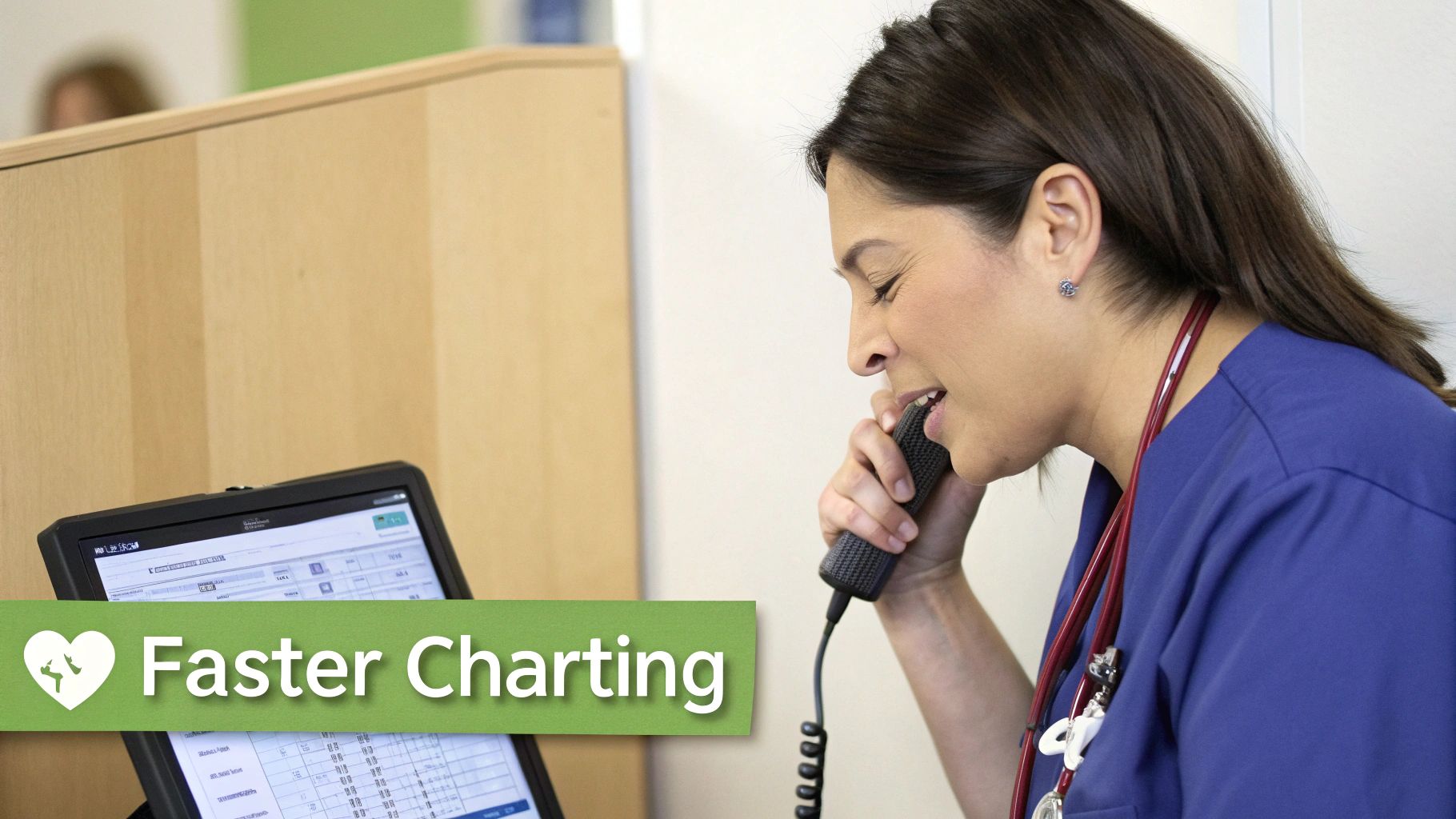
The administrative burden of charting is one of the biggest reasons nurses feel burned out. For years, we were promised that technology would make our lives easier, but it often just added more clicks and complicated workflows. Now, voice-based AI is actually starting to change the game. This isn't some futuristic fantasy—it's a practical tool that nurses are using today to get their time back.
Think about it. You finish a patient assessment, and instead of hunting down a computer to type everything out, you simply speak your findings. That’s the new reality. AI tools let you dictate your narrative notes nursing documentation in a natural, conversational way, either during the encounter or right after you leave the room.
This process captures your immediate clinical thoughts with a level of detail that’s easily lost when you’re trying to remember everything hours later. The technology is smart enough to understand clinical language, so it can accurately turn your spoken words into a professional, structured note. It can differentiate between medical terminology and conversational filler, ensuring the final output is clean and professional.
From Spoken Words to Structured Notes
But the real magic here isn’t just basic transcription. A simple voice-to-text app might get the words down, but clinical AI understands the context. It knows how to organize your dictated thoughts into a note that’s coherent and compliant with healthcare standards.
This means you can speak conversationally, and the AI takes care of the rest. It will:
- Identify Key Sections: The system automatically picks out subjective patient statements, your objective findings, the assessment, and the care plan from your continuous speech.
- Structure the Narrative: It then populates that information into the right fields for a SOAP note or whatever template your EHR requires, ensuring consistency and completeness.
- Slash Manual Entry: By putting the data directly into the record, it dramatically cuts down on typing, clicking, and navigating confusing menus. This single change can save hours over the course of a week.
For any healthcare provider, this means less time staring at a screen and more time actually talking to patients. The benefit isn't just about speed; it's about accuracy. Notes dictated in the moment are fresher, more detailed, and less likely to have the errors that crop up with delayed charting.
For smaller practices especially, the hours lost to manual charting are a huge operational drain. Modern AI solutions can automate this, and studies have shown this can cut administrative costs by up to 60%. With telehealth now being used 38 times more than before the pandemic, integrating AI ensures your documentation is both HIPAA-compliant and accurate in real-time, whether the consultation is in person or virtual.
A Practical Tool for Reducing Burnout
The connection between the charting burden and burnout is impossible to ignore. When a huge chunk of your shift is spent on administrative tasks, you end up feeling frustrated, exhausted, and disconnected from why you became a nurse in the first place. AI-powered charting hits this problem head-on.
By removing a major source of administrative friction, AI frees up a nurse’s most valuable resources—time and mental energy. This allows for a renewed focus on clinical reasoning and patient interaction, which is the heart of nursing.
Instead of feeling like a data entry clerk, you can finally practice at the top of your license. The technology handles the clerical side of things, letting you concentrate on critical thinking and compassionate care. Our guide to AI clinical documentation dives deeper into how these tools are becoming essential in modern healthcare.
This shift creates a positive ripple effect. When nurses aren't so bogged down, they’re more satisfied with their jobs, which can lead to lower turnover and improved morale. For patients, it means their nurse is more present and attentive. This is how technology, when used the right way, can bring the human element back to healthcare. AI is no longer just a buzzword; it’s a real tool helping build a more sustainable and fulfilling nursing practice.
Answering Your Top Questions About Narrative Notes
Even seasoned nurses have moments where they pause and second-guess their charting. You're not alone. Let's clear up some of the most common questions that pop up when it comes to narrative documentation.
Think of this as your go-to cheat sheet for handling those tricky situations with confidence, making sure your narrative notes nursing documentation is always on point.
How Often Should I Write a Narrative Note During a Shift?
The honest answer? It depends. There's no single magic number. The right frequency is a mix of your facility's policy, how stable your patient is, and what happens during your shift. Sure, policy might say "at least once per shift," but that's just the starting line. A stable patient might only need one comprehensive note, while a critical patient needs ongoing updates.
You’ll always need to write a narrative note when something significant happens. We're talking about situations like:
- A noticeable change in your patient's condition, whether for the better or worse.
- The patient's response to a key treatment, like how they handled a new medication or their first time up with physical therapy.
- Anytime you provide patient or family education, including their level of understanding.
- An incident or anything unexpected, like a fall or a medication error.
- Important conversations with doctors or other members of the care team, including any new orders received.
- Patient transfer to another unit or facility, or upon discharge.
For a patient in critical condition, you might be charting every hour or even more frequently. The guiding principle is simple: your notes need to tell the complete, accurate story of the patient's journey on your watch.
What Is the Real Difference Between a Narrative Note and Flowsheet Charting?
This is a great question because it gets right to the heart of smart, efficient charting. Flowsheets and narratives aren't competitors; they're partners designed to work together to create a comprehensive medical record.
Here’s an easy way to think about it: flowsheets handle the structured, black-and-white data—the "what." They're perfect for tracking vital signs, intake and output, or when a medication was given. That grid format makes it incredibly easy to see trends at a glance over hours or days.
Narrative notes, on the other hand, provide the "why" and "how." They add the story and context that the numbers can't. You use a narrative to describe a complex wound, explain your clinical reasoning for an intervention, document a sensitive conversation with a family member that just won't fit in a checkbox, or detail the context behind an abnormal vital sign.
Flowsheets give you the data points; narratives paint the full clinical picture. One without the other leaves the story incomplete. A great nurse knows how to use both to tell the whole story.
For example, your flowsheet shows a drop in blood pressure. Your narrative note explains why: "Patient reported feeling dizzy upon standing. Assisted back to bed. BP 88/50. Physician notified; received and administered order for IV fluid bolus of 500mL Normal Saline." Together, they create a clear, complete picture of the event.
Can I Use Abbreviations in My Narrative Notes?
Yes, but you have to be extremely careful. You should only use abbreviations officially approved by your facility. Making up your own shorthand is a recipe for disaster and a leading cause of preventable medical errors. There is simply no room for confusion in our documentation.
There's a reason The Joint Commission has an official "Do Not Use" list. Certain abbreviations are notoriously easy to misread. "U" for "unit" can look like a zero or a four, potentially leading to a massive overdose. "Q.D." (once daily) can easily be mistaken for "Q.I.D." (four times daily). These are forbidden in many institutions for a good reason. Always refer to your facility's policy.
When in doubt, write it out. It takes a few extra seconds, but it’s always the safest and most professional choice. This guarantees that anyone on the care team, from the pharmacist to the physical therapist, will understand your note perfectly without any guesswork.
How Can AI Tools Actually Improve My Note Quality?
I get the skepticism, but the benefits here are very real and go beyond just saving time. AI tools can make your notes better by letting you focus on your clinical thinking instead of the mechanics of typing.
When you dictate your notes right after a patient encounter, the details are still fresh in your mind. You capture a more accurate and complete picture without the risk of forgetting something important later in a hectic shift. This process also cuts down on typos and the common errors that happen when you're rushing to type.
And modern clinical AI is much more than a simple voice-to-text tool. It can take your spoken thoughts and automatically structure them into a compliant format like SOAP, making sure you don't miss any key components. Some systems can even prompt you if you forget a section. This means you spend less time fussing with the format and more time making sure the clinical story is solid. Ultimately, it cuts down on that administrative burden, which helps prevent burnout and frees you up to focus on what matters most—your patients.
Ready to cut your charting time and focus more on your patients? Simbie AI offers clinically-trained voice agents that automate documentation directly into your EMR, reducing errors and administrative burden. Discover how Simbie AI works.