
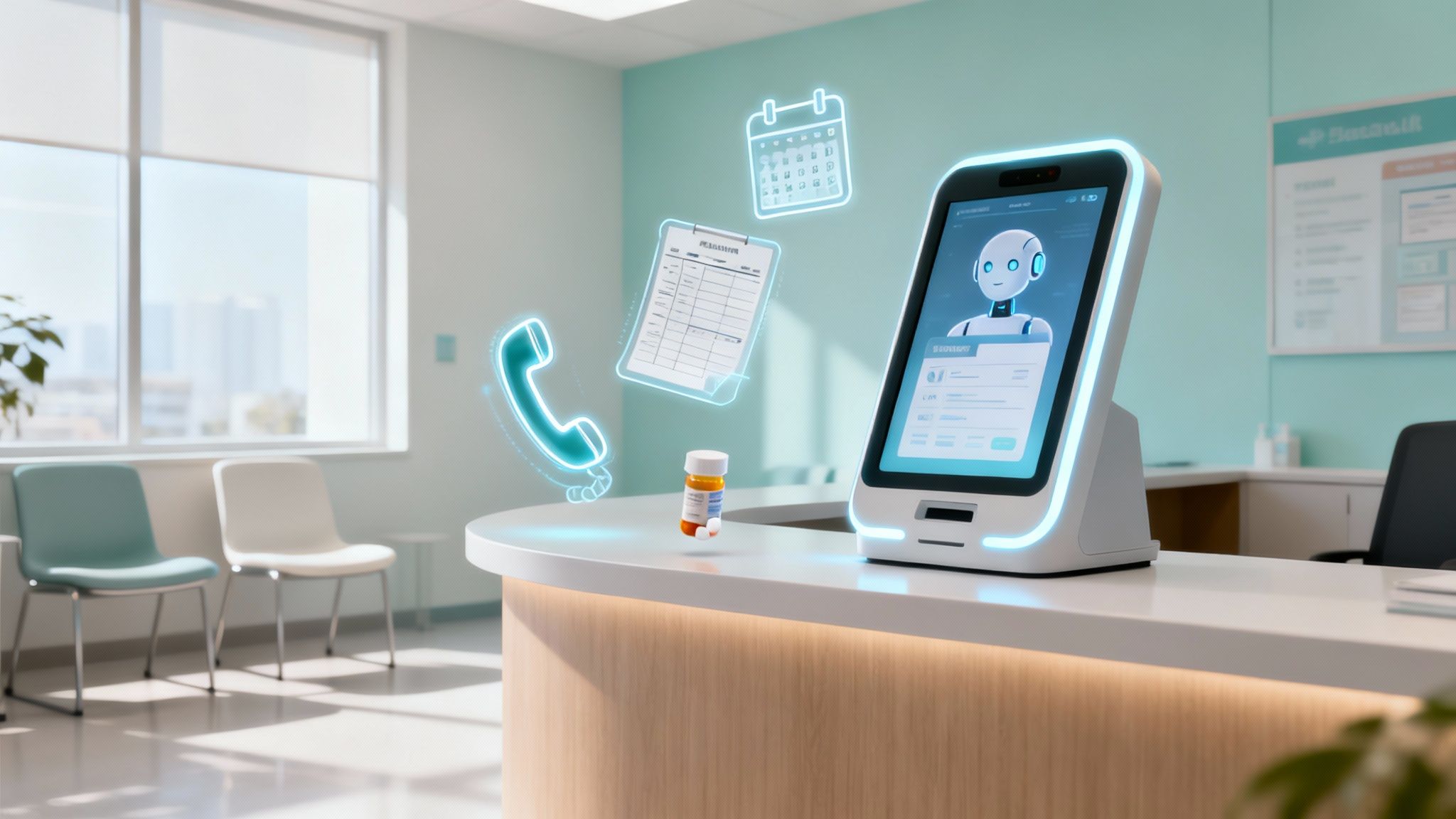
What exactly is a medical office virtual receptionist? In short, it’s a specialized remote service, often powered by advanced AI and supported by human agents, that handles all your patient communications—from phone calls and appointment scheduling to prescription refills and new patient intake—24 hours a day, 7 days a week. It's far more than a basic answering service; think of it as the intelligent, ever-present digital front door to your practice, designed to enhance efficiency and patient satisfaction.
This sophisticated setup ensures no patient call ever goes unanswered or gets lost in a voicemail abyss. More importantly, it liberates your in-house staff, allowing them to give their full, undivided attention to the patients physically present in your office. It's the optimal blend of skilled professionals and smart technology, all working in concert to provide seamless, professional support that elevates your entire practice. By automating routine tasks and streamlining workflows, a virtual receptionist doesn't just manage calls—it transforms your operational efficiency.
Your Practice's Digital Front Door: More Than Just an Answering Service
The front desk is the undisputed nerve center of any busy medical practice. On any given day, phones ring incessantly, patients queue up to check in, and the mountain of administrative paperwork grows ever higher. Attempting to juggle these competing priorities inevitably leads to long hold times, frustrating phone tag, missed calls, and a perpetually stressed-out team. A medical office virtual receptionist service is engineered specifically to solve this core problem, acting as a dedicated, highly efficient, off-site extension of your front office.
But this service accomplishes far more than just taking messages. It integrates deeply into your practice's existing workflow to manage a wide array of critical administrative duties. Imagine every single incoming call being answered instantly by a professional, intelligent system that understands medical terminology, respects patient privacy, and can handle requests with precision. That is how you guarantee every patient interaction is positive, helpful, and efficient from the very first hello, setting a new standard for patient access and care.
More Than Just Answering Calls
While answering the phone is a foundational part of the job, today's advanced virtual receptionists are capable of so much more. They are trained and technologically equipped to manage a whole suite of tasks that make your practice run smoother, improve patient outcomes, and keep your patient population happy and engaged.
Some of their key responsibilities include:
- 24/7 Call Answering: Patients can always reach your practice, whether it’s in the middle of the night, on a weekend, or during a major holiday. This round-the-clock availability is crucial for patient peace of mind and capturing new business.
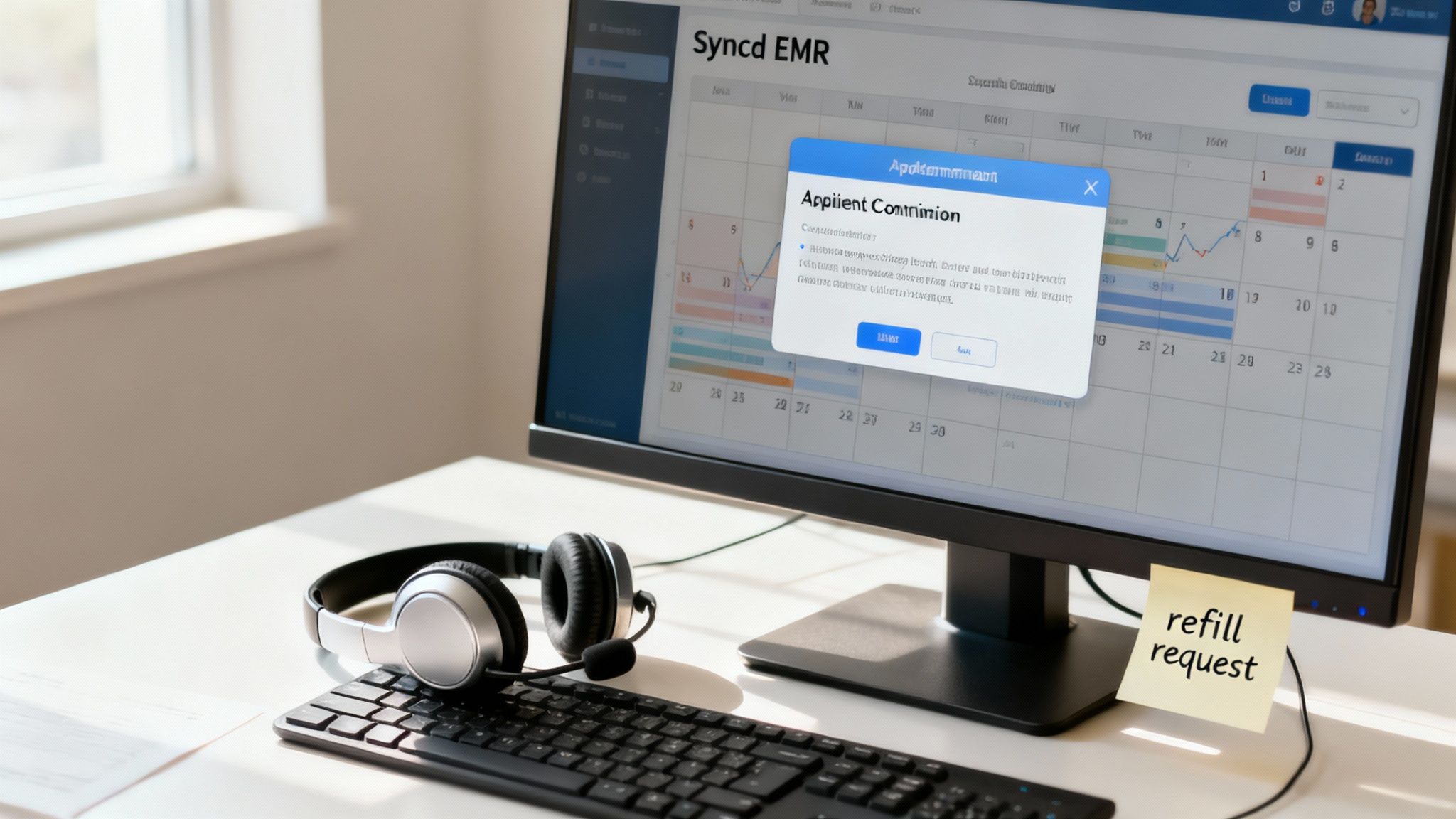
- Appointment Management: They can schedule, confirm, reschedule, and cancel appointments directly in your practice’s EMR calendar, eliminating the risk of double-booking and ensuring your schedule remains optimized.
- New Patient Intake: They expertly guide new patients through the entire registration process, systematically collecting all the necessary demographic, insurance, and medical history details required for their first visit.
- Urgent Call Routing: Following your practice's specific protocols, they can identify urgent calls based on keywords or patient responses and immediately route them to the appropriate on-call doctor, nurse, or department, ensuring critical situations are handled swiftly.
This level of comprehensive, automated support takes a massive administrative weight off your on-site team. By expertly managing the relentless flow of calls and inquiries, a medical office virtual receptionist frees up your staff to dedicate their undivided attention to the patients standing right in front of them, improving both the employee and patient experience.
A study from the American Medical Association found that doctors spend an average of 10 hours per week on administrative tasks, which includes handling phone calls. A virtual receptionist directly tackles this problem, giving that precious time back for actual patient care.
Ultimately, a medical virtual receptionist is a reliable, secure, and professional way to manage patient communications as your practice grows and patient expectations evolve. It guarantees every patient feels heard, understood, and cared for—the first and most important step in building lasting trust and loyalty in a competitive healthcare landscape.
What Can a Virtual Receptionist Actually Do for Your Practice?
When you hear "virtual receptionist," it's easy to picture a basic, impersonal answering service from a decade ago. But modern solutions designed for medical offices are a different breed entirely. Think of it less as a remote message-taker and more as a smart, integrated, HIPAA-compliant extension of your front-desk team.
These powerful tools are designed specifically for the unique demands of the healthcare environment, built to handle the repetitive, time-consuming, and often mundane tasks that bog down your staff and get in the way of providing excellent patient care. They slot seamlessly into your daily operations, working around the clock to manage patient communications with a level of accuracy, consistency, and efficiency that’s incredibly difficult to achieve manually.
Intelligent Call Handling and Routing
One of the biggest game-changers offered by a modern medical office virtual receptionist is intelligent call handling. A standard answering service just takes a name and number, creating more work for your staff. A virtual receptionist, on the other hand, can actually understand the reason for the call using natural language processing.
It can instantly tell the difference between a patient asking for directions and another describing symptoms that require immediate clinical attention. You establish the rules and protocols. For instance, a call about insurance verification might be directed to your website's FAQ page or have an informational text sent, while a call mentioning specific, urgent keywords like "chest pain" or "severe bleeding" gets routed straight to the on-call nurse's cell phone or a 911 directive. No delays, no manual switchboard, just instant, appropriate action.
Some of the more advanced systems even use Conversation Intelligence to transcribe and analyze calls, giving you powerful, actionable data on what your patients are asking for most often, peak call times, and potential areas for service improvement.
Automated Appointment and Intake Management
Think about how much collective time your staff spends on the phone just scheduling, rescheduling, and confirming appointments. A virtual receptionist takes that entire administrative burden off their plate, automating the process from start to finish.
Here's what that looks like in practice:
- 24/7 Scheduling: Patients can book, change, or cancel appointments whenever it's most convenient for them—even at 2 a.m. on a Sunday—without needing to speak to a human.
- EMR Integration: The system communicates directly with your EMR calendar in real-time, so there are no double-bookings or scheduling mix-ups. Every appointment is logged instantly and accurately within your single source of truth.
- Automated Reminders: It intelligently sends appointment confirmations and reminders via text or email, a simple step that has been proven to reduce costly no-shows by over 25%.
- New Patient Intake: The system can automatically send digital intake forms to new patients ahead of their visit. They can complete the paperwork on their own device, so they arrive ready to be seen instead of spending 20 minutes in the waiting room with a clipboard.
By automating these critical tasks, a virtual receptionist ensures you never miss an opportunity to book an appointment, whether your office is open or closed. It effectively turns your phone line into a round-the-clock, revenue-generating booking engine.
Streamlining Prescription Refills and Patient Messages
Prescription refill requests are another constant source of phone traffic and a major administrative drain. A virtual receptionist can manage this entire workflow cleanly, efficiently, and with a high degree of accuracy.
When a patient calls for a refill, the system gathers all the key information—patient name, date of birth, medication, dosage, and pharmacy details. It then packages this into a structured, easy-to-read digital request that gets sent directly to the right clinical staff member for approval within the EMR.
This simple, automated process gets rid of messy, incomplete voicemails and eliminates the risk of someone writing down the wrong pharmacy number or medication details. Every request is documented and tracked, creating a clear audit trail that is better for your staff and significantly safer for your patients.
Virtual Receptionist vs. Traditional Answering Service
It’s crucial to understand how a modern medical virtual receptionist differs from the answering services of the past. One is an integrated administrative tool that resolves issues in real-time, while the other is a simple message-taking service that often creates more work.
| Feature | Medical Virtual Receptionist | Traditional Answering Service |
|---|---|---|
| Call Handling | Intelligent routing based on keywords, intent, and custom protocols. | Basic message taking and manual call forwarding. |
| Scheduling | Fully automated booking, integrated with the EMR calendar. | Takes a message for staff to call back and schedule later. |
| EMR/EHR Integration | Deep, real-time, bidirectional integration with patient records. | No integration; operates as a completely separate system. |
| Patient Intake | Automates the sending and collecting of digital forms into the EMR. | Not a feature; the manual, paper-based process remains. |
| Refill Requests | Structured, automated workflow for submitting and tracking refill requests. | Relays a simple verbal message for staff to process manually. |
| HIPAA Compliance | Designed with BAA and robust security protocols for HIPAA as a core feature. | May or may not be HIPAA compliant; often an afterthought. |
| Patient Experience | Seamless, on-demand, self-service options available 24/7. | Can be a frustrating dead-end for patients requiring immediate action. |
Ultimately, a traditional answering service creates a backlog of tasks for your team by leaving them a long list of people to call back. A modern medical office virtual receptionist resolves patient needs on the spot, freeing up your valuable staff to focus on higher-value tasks and the patients right in front of them.
How to Ensure HIPAA Compliance and Data Security
Whenever you introduce a new piece of technology or a third-party vendor into a medical practice, the first questions are always—and should always be—about security and patient privacy. With a virtual receptionist, those concerns are front and center. Reputable services don't treat security as an optional add-on; they build their entire system from the ground up with HIPAA compliance in mind to meticulously safeguard protected health information (PHI) at every touchpoint.
It all starts with implementing rock-solid technical measures. Every conversation, whether it's a voice call, a text message, or a data transfer, must be shielded by end-to-end encryption. Think of it as a sealed, tamper-proof digital envelope, making sure sensitive patient details are completely unreadable to anyone but the intended authorized recipient. On top of that, the data itself is stored in secure, SOC 2-compliant data centers with strict access controls, multi-factor authentication, and regular third-party security audits.
The Business Associate Agreement Is Non-Negotiable
Beyond the technology, the legal framework is just as critical. Any virtual receptionist vendor you are even thinking about partnering with must be willing and able to sign a Business Associate Agreement (BAA). This isn't just a formality; it's a legally binding contract that holds the vendor directly accountable for protecting your patients' PHI according to HIPAA’s strict rules and regulations.
A BAA accomplishes several essential things:
- Defines Permitted Uses: It explicitly spells out exactly how the service is allowed to access, use, and handle your patient data.
- Requires Safeguards: It contractually obligates the vendor to implement and maintain specific administrative, physical, and technical security measures to prevent data breaches before they happen.
- Establishes Liability: It makes the vendor legally and financially on the hook for any security breach or HIPAA violation that occurs on their watch, protecting your practice.
Without a signed BAA in place, your practice is left holding the entire legal and financial bag for any data breach caused by your vendor. If a company hesitates or refuses to sign one, that's an immediate, unequivocal deal-breaker.
Maintaining Clinical Accuracy
Security is only half the battle. Clinical accuracy is the other, equally important half. A virtual receptionist has to be more than just a secure message-taker—it has to be a reliable one. A simple miscommunication, a transcribed error, or a dropped detail can lead to a significant delay in care or even a serious clinical error.
This is why the best-in-class services rely on structured, pre-defined protocols and workflows. It effectively removes the guesswork and human error from the equation. When a patient calls for a prescription refill, the system is programmed to methodically collect the patient's full name, date of birth, medication, dosage, and preferred pharmacy—every single time, without fail. If it's an urgent clinical question, it follows a specific, provider-approved script to gather symptoms and route the message to the right on-call provider without any deviation. This systematic approach gets rid of the inconsistencies and human errors that can easily creep in when staff members are rushed, multitasking, and taking notes by hand.
As you explore your options, it's a good idea to look into the different HIPAA-compliant AI tools on the market to see how they tackle the dual challenges of robust security and clinical accuracy. By making these two elements your top priority, you can bring in a virtual receptionist that truly supports and enhances your practice's high standards of care.
Integrating a Virtual Receptionist with Your EMR
A medical office virtual receptionist is a great start, but its real transformative power is unleashed when it plugs directly into your practice’s core systems. A standalone service can answer phones and take messages, sure. But an integrated one becomes a true, seamless extension of your team, capable of executing complex tasks in real-time.
Think of it as creating a central nervous system for your front office operations, with your Electronic Medical Record (EMR) or Electronic Health Record (EHR) system acting as the brain and single source of truth.
This direct, bidirectional connection is what allows the virtual receptionist to handle tasks autonomously with total accuracy. When a patient calls to book an appointment, the system doesn't just take a message for your staff to deal with later. It actively queries your EMR calendar, identifies an open slot that works for both the patient and the provider's template, and books the visit right then and there. No more phone tag. No chance of double-booking. The entire process is completed in a single interaction.

Creating a Single Source of Truth
The biggest and most impactful win from EMR integration is the complete elimination of manual data entry. Every single piece of information your virtual receptionist collects—from a new phone number to a detailed medical history form—is automatically and instantly sent to the correct place inside your EMR.
Here's what that looks like in your day-to-day operations:
- New Patient Registration: A new patient calls to get established with your practice. The virtual receptionist gathers all their demographic and insurance information, and poof—a new patient chart is instantly and accurately created in the EMR.
- Automated Form Handling: The system can text or email a link to digital intake forms to the patient. As soon as they complete them on their phone or computer, the signed documents automatically attach themselves to the correct EMR chart, ready for the provider to review.
- Updating Patient Information: A current patient calls to update their address or insurance provider. The change is made directly in the EMR in real-time, ensuring your billing and clinical records are always accurate and up-to-date.
This seamless, automated data flow saves your staff countless hours of tedious, repetitive work. Even better, it dramatically cuts down on the risk of human error. We all know how a single typo in an insurance ID number can lead to a denied claim, a rejected prescription, and a massive billing headache. Direct EMR integration is your best defense against those small but incredibly costly mistakes.
How the Connection Works
This isn't magic—it’s technology, usually built on an Application Programming Interface (API). You can think of an API as a secure, digital bridge that allows two different software programs to talk to each other and exchange data based on a pre-defined set of rules and permissions. In this case, it’s the virtual receptionist platform and your EMR system, sharing specific, relevant information without ever compromising the security of the overall system.
By connecting these systems, you ensure your EMR remains the definitive, up-to-date record for all patient information. The virtual receptionist becomes a reliable conduit for data, not another siloed system your team has to log into and manage separately.
It's this direct, real-time link that elevates a helpful answering service into an indispensable tool you can’t imagine running your practice without. If you want to get into the technical nitty-gritty, you can learn more about our specific approach to EMR system integration and see how it works with different practice management and EMR setups.
The Real-World Benefits for Your Medical Practice
While the features of a medical office virtual receptionist are impressive, the real value is in the tangible, measurable results it brings to your practice's health—both financially and operationally. It's one thing to talk about capabilities, but let's break down the actual return on investment you can expect from day one.
The most immediate and obvious impact is on your bottom line. Hiring a full-time, in-house receptionist isn't just a salary—it's benefits, health insurance, payroll taxes, paid time off, training, and overhead for physical space and equipment. A virtual service provides comprehensive, 24/7 coverage for a fraction of that cost, often saving practices tens of thousands of dollars every single year.
Drastically Lower Operational Costs
A virtual receptionist isn't just a cheaper option; it's a fundamentally more efficient one. Think about it: you get round-the-clock coverage without paying for overtime, holiday hours, or sick days. This flexible model allows your practice to scale support up or down based on actual call volume, so you’re only paying for exactly what you need, when you need it.
This isn't just about handling calls more efficiently. A virtual receptionist service can dramatically cut your overall operational expenses. The technology behind these services is a big part of the savings. You can learn more about the cost-saving benefits of a Hosted VirtualPBX system, which is the technical foundation for many of these advanced, cost-effective solutions.
Increased Revenue by Capturing Every Opportunity
How many calls does your front desk miss during a chaotic morning, over the lunch hour, or after 5 p.m.? Every one of those missed calls represents a potential new appointment—and lost revenue. A virtual receptionist ensures that 100% of calls are answered, turning what used to be a missed opportunity into a scheduled, revenue-generating visit.
- Never Miss a New Patient: You can capture every single new patient inquiry, day or night, which is absolutely crucial for growing your practice in a competitive market.
- Reduce No-Shows: Automated appointment reminders, delivered via text or voice, can cut down your no-show rates by over 25%, which keeps your schedule full, productive, and profitable.
- Fill Last-Minute Cancellations: When a slot opens up unexpectedly, the system can instantly and automatically offer it to patients on your waitlist, making sure your providers' valuable time is never wasted.
This isn't just a niche solution; it's a rapidly growing trend that is reshaping healthcare administration. The market for health intelligent virtual assistants hit USD 513.91 million in 2024 and is expected to balloon to USD 4,680.01 million by 2034. Healthcare providers are leading the charge in adoption, which clearly shows just how much demand there is for tools that make operations smoother, more efficient, and less expensive.
A Happier Team and More Satisfied Patients
Administrative overload is one of the biggest factors contributing to staff burnout in medical offices. When you offload repetitive, high-volume tasks like scheduling, intake forms, and prescription refills, your on-site team is freed to focus on more complex and valuable work. They can give their full, compassionate attention to the patients in your office, handle complex billing issues without constant interruptions, and engage in proactive patient outreach. This simple change can do wonders for team morale, reduce turnover, and help you keep your best people.
When your team isn't constantly pulled away by a ringing phone, they can provide a better, more focused, and more empathetic experience for the patients right in front of them. This elevates the quality of care and boosts job satisfaction simultaneously.
At the same time, your patients get instant, professional, and consistent service whenever they reach out. No more being stuck on hold for ten minutes, getting lost in a frustrating phone tree, or leaving a voicemail that never gets a response. This immediate access and efficiency lead directly to happier, more engaged patients, better online reviews, and stronger, long-term loyalty. You can explore our patient access solutions to see how streamlined communication can truly transform your practice's reputation and bottom line.
Choosing the Right Virtual Receptionist Service
Picking a partner to handle your patient communications is a big decision with significant consequences. The right virtual receptionist service feels like a natural, indispensable part of your team, making life easier for your staff and your patients. The wrong one, however, can be a constant source of frustration, errors, and complaints. To get this right, you need a solid, systematic game plan for evaluating your options.
Start with the absolute must-haves: security and compliance. Don't be shy about asking direct, pointed questions about their security protocols and HIPAA compliance. You need to see their Business Associate Agreement (BAA) before signing any contract and get a clear, satisfactory explanation of how and where they store sensitive patient information. Any hesitation or vague answers here is a serious red flag.
Key Questions for Potential Vendors
Once you've covered the non-negotiable compliance basics, it's time to dig into the practicalities of how their service actually works. You're looking for a partner whose technology and processes will fit neatly and effectively into your practice's unique day-to-day operations.
Here are a few critical questions to ask every vendor you talk to:
- EMR Integration: Which EMR systems do you currently integrate with? Let's get specific—can your system book appointments, update patient demographics, and add clinical notes directly into our charts in real-time? What does the implementation process look like?
- Customization: How much can we customize your scripts and call-handling protocols? We need different workflows for new patient calls versus urgent clinical calls from existing patients. Can we define our own escalation paths?
- Agent Training & AI Quality: If human agents are involved, what kind of training do they receive? Are they familiar with medical terminology and trained on patient privacy? If it's an AI-driven service, can we hear a demo of the voice quality and conversational ability?
- Reporting and Analytics: What kind of data and reporting can we access? We want to see our call volume, average call duration, peak call times, call outcomes, and what our patients are calling about most often. This data is key to improving our operations.
Understanding Pricing Models
Finally, let’s talk money. You need to get a crystal-clear, transparent understanding of their pricing structure. Some services bill by the minute, which might sound appealing if your phones are quiet, but costs can skyrocket unpredictably when things get busy. Others offer a flat monthly fee for a certain number of calls, minutes, or a tiered feature set.
Choose a model that makes sense for your practice's call flow and budget. A predictable, flat monthly fee often gives you better budget control and peace of mind. You shouldn't have to worry about a surprise bill just because you had a busy month. Be wary of hidden fees for setup, integration, or after-hours support.
Your Questions, Answered
If you're a practice manager or physician-owner looking into a medical office virtual receptionist, you probably have a few practical questions. Let's tackle the ones that come up most often, so you can get a clear, confident picture of what this solution looks like for your practice.
Is It Really Cheaper Than Hiring More Staff?
For the vast majority of practices, the answer is a resounding yes. Think about the fully-loaded cost of a full-time employee—it’s not just their salary. You have to add in benefits like health insurance and retirement plans, payroll taxes, paid time off, workers' compensation, training costs, and other overhead.
A virtual receptionist service eliminates all of that. You get the coverage you need, often 24/7/365, for a predictable monthly fee that is typically a fraction of the cost of one W-2 employee. It's a smart, scalable way to manage your budget, especially when call volume fluctuates throughout the year.
But Will My Patients Actually Like It?
This is a big one, and it’s a valid concern. The good news is that today's best-in-class virtual receptionists are built to be professional, empathetic, and surprisingly human-like in their interactions.
The best systems use natural, conversational language and advanced AI, so patients don't feel like they're talking to a clunky, robotic machine. For routine, transactional tasks like confirming an appointment time, asking for directions, or paying a bill, many patients actually prefer the convenience of getting an instant, automated answer instead of being stuck on hold waiting for a human. The key is to ensure urgent or complex issues are seamlessly escalated to a live person.
How Much Say Do I Get in How It Works?
You're in the driver's seat. A good provider won't force you into a one-size-fits-all solution. Instead, you'll work together during an implementation process to build custom scripts, call flows, and workflows that perfectly match your practice’s unique voice, brand, and clinical procedures.
You decide exactly how different types of calls are handled, what specific questions are asked during patient intake, and how urgent issues get escalated to an on-call provider or your office manager. It truly becomes a customized extension of your front office team, operating precisely the way you want it to.
Ready to see how a clinically-trained AI voice agent can transform your practice? Simbie AI automates administrative tasks, reduces staff burnout, and enhances patient satisfaction. Learn more about Simbie AI.