

Think of medical billing AI as the most diligent, detail-oriented assistant you could ever hire—one who never gets tired, overlooks a detail, or makes a simple typo. At its core, that’s what this technology brings to the table. It’s designed specifically to automate and sharpen the incredibly complex financial side of healthcare, finally moving practices away from tedious, error-prone manual work. This intelligent automation isn't just about efficiency; it's about building a more resilient and financially stable practice.
The End of Old-School Billing With Medical Billing AI

For years, the healthcare revenue cycle has been stuck in a loop of endless paperwork, confusing coding rules, and the constant threat of human error. These issues aren't just minor annoyances; they create real headaches like frustrating claim denials, delayed payments, and administrative costs that eat into the budget for patient care. Traditional billing is almost entirely reactive, leaving staff to clean up messes after they’ve already hurt the bottom line. This reactive cycle keeps practices in a constant state of financial catch-up, unable to get ahead.
Medical billing AI completely flips that script. It’s not just another program to learn; it’s an intelligent layer that works with your existing systems. It gets ahead of problems by scrubbing claims for mistakes, flagging potential denials before a claim is even sent, and taking over the repetitive tasks that drain your team’s time and energy. This isn't some far-off concept—it's a practical tool that’s fixing real problems in healthcare today, creating a proactive financial environment where issues are prevented, not just fixed.
A Necessary Shift to Automation
The whole point of this technology is to inject some much-needed efficiency and accuracy into the billing process. By automating the grunt work and offering sharp, data-backed insights, AI frees up your team to focus on the things that actually require a human touch—like handling complex cases, negotiating with payers, and improving the patient’s financial experience.
This move toward medical billing AI is part of a bigger picture of digital efficiency taking hold everywhere. To get a better sense of this shift, it helps to understand what is business process automation and its benefits. The change isn't small, and the market growth proves it. The global AI in medical billing market was valued at USD 3.73 billion in 2024 and is expected to explode to USD 36.37 billion by 2034. This staggering growth underscores the industry's confidence in AI's ability to solve long-standing financial challenges.
AI isn't here to replace skilled billers. It's here to empower them. By taking over the high-volume, mind-numbing tasks, the technology frees up your experts to tackle tricky appeals, negotiate with payers, and guide patients through their financial journey.
This partnership between human expertise and machine precision is changing what’s possible for the financial health of a practice. The table below really highlights the difference between the old way of doing things and the modern, AI-powered approach.
Traditional Billing Headaches vs. Medical Billing AI Solutions
The contrast between outdated manual processes and intelligent automation is stark. One creates bottlenecks and drains resources, while the other opens up new possibilities for efficiency and financial stability. This isn't just a minor upgrade; it's a fundamental shift in how revenue cycle management operates.
| Common Challenge in Manual Billing | How Medical Billing AI Solves It |
|---|---|
| High rates of human error from manual data entry and coding. | Automates data capture and suggests accurate codes, drastically reducing mistakes. |
| Time-consuming and repetitive tasks that lead to staff burnout. | Handles routine jobs like eligibility checks and claim status follow-ups automatically. |
| Reactive denial management after a claim is already rejected. | Predicts denial risks based on historical data and flags issues before submission. |
| Slow reimbursement cycles due to process inefficiencies and delays. | Accelerates the entire process from claim creation to payment posting for faster revenue. |
| Lack of clear insights into financial performance and revenue leaks. | Provides real-time analytics and dashboards to pinpoint and address financial weak spots. |
Ultimately, AI-driven solutions directly address the most persistent and costly problems that have plagued medical billing departments for decades, turning a reactive, frustrating process into a proactive, strategic one. This shift allows practices to finally gain control over their financial destiny.
How Does Medical Billing AI Actually Work?

To really get what medical billing AI can do, you have to look under the hood. It’s not just one magic black box. Think of it more like a highly skilled digital crew, where each member has a specific job to do, all working together to keep your revenue cycle healthy.
At its core, this technology relies on a few key components that mimic—and often surpass—what humans can do. These are the engines that turn messy clinical notes and complex rules into clean claims that get paid. Understanding these components demystifies the technology and shows its practical power.
The Smart Translator: Natural Language Processing
One of the most impressive pieces of the puzzle is Natural Language Processing (NLP). The best way to think of NLP is as a brilliant translator who's also a certified medical coder. A doctor finishes their notes, full of clinical jargon and shorthand, and the NLP engine reads and understands it all instantly.
This is the tech that pulls out the specific diagnoses, procedures, and treatments from the doctor's narrative. It then translates that unstructured text into the standardized codes that insurance companies require, like CPT and ICD-10. This direct-from-the-source translation slashes the risk of manual coding errors and makes sure the claim truly reflects the care that was given. It bridges the critical gap between clinical action and financial reimbursement.
An AI platform using NLP can chew through hundreds of pages of medical records in seconds, spotting every billable service with a speed and consistency no human team could ever match. It can turn a process that took hours into one that takes minutes.
The Pattern Spotter: Machine Learning
Next up is Machine Learning (ML). Picture ML as a veteran biller who has personally reviewed millions of claims. This digital expert has seen it all—every common mistake, every denial reason, every payer quirk. It learns from this massive amount of historical data to spot patterns that are nearly invisible to the human eye.
So, before a claim even gets sent, the ML model gives it a once-over, comparing it against all the patterns it’s learned. This allows it to predict, with surprising accuracy, whether a claim is headed for a denial.
- Flags High-Risk Claims: The system puts a red flag on any claim that looks like one that’s been denied before, giving your team a chance to fix it first.
- Learns Payer Behavior: It figures out the specific preferences and unwritten rules of each insurance company, so you can send them a claim that’s exactly how they like it.
- Gets Smarter Over Time: With every new claim that gets paid or denied, the ML model learns and refines its predictions. It’s constantly improving, becoming a more valuable asset to your team each day.
This ability to see into the future changes the game. Your billing process goes from being reactive (fixing denials) to proactive (preventing them), saving immense time and resources.
The Automated Workflow: A Step-by-Step View
So, what does this look like in practice? Let's walk through how these technologies come together in a typical day, from the moment a patient books an appointment to the day the payment comes in.
- Patient Registration and Eligibility: As soon as an appointment is scheduled, AI-powered automation gets to work. The system verifies insurance eligibility in real-time, confirming all the coverage details without anyone having to pick up the phone.
- Automated Medical Coding: After the visit, the clinician writes their notes. The NLP engine scans them, pulls out all the key medical facts, and suggests the right billing codes. We dive deeper into this in our guide on artificial intelligence in medical coding.
- Intelligent Claim Scrubbing: Before the claim goes out the door, it gets a final "scrub." The ML model checks it for common errors, missing details, and compliance issues based on that specific payer’s rules.
- Proactive Denial Management: If the AI thinks a claim has a high chance of being denied, it alerts your staff. It doesn't just flag the problem; it explains why and suggests how to fix it.
- Payment Posting and Reconciliation: Once the insurance company pays, the AI automatically posts the payment to the right patient account. It also checks the payment against what was expected and immediately flags any underpayments for follow-up. This automated reconciliation ensures no revenue is left on the table.
What AI in Your Billing Process Actually Does for You

It’s easy to get lost in the technical jargon, but the real story of medical billing AI is what it delivers in the real world. This isn't just about getting slick new software; it’s about a fundamental upgrade to your practice's financial health and day-to-day operations.
The benefits are concrete and measurable, affecting everything from your bottom line to your team's sanity. By automating the grunt work and sharpening the accuracy of your revenue cycle, AI offers a pretty compelling return. Let's break down the three biggest areas where you'll see a real difference.
Bolstering Your Financial Health and Growing Revenue
The first and most powerful impact you’ll see from medical billing AI is right in your bank account. These systems are designed to find and plug the leaks that slowly drain revenue while speeding up how quickly you get paid for your work.
Here’s how it gets done:
- Slash Your Denial Rates: Think of AI claim scrubbing as an expert proofreader that never gets tired. It catches coding errors, missing information, and payer-specific issues before a claim ever goes out the door. This drastically cuts down on frustrating denials and the hours spent on appeals.
- Get Paid Faster: Automation works around the clock. AI can run eligibility checks instantly, submit claims automatically, and post payments as soon as they arrive. A billing cycle that used to crawl along for weeks can now be compressed into just a matter of days.
- Capture Every Dollar Owed: The system is smart enough to flag underpayments by comparing what a payer sent against your contracted rates. This is a huge deal, as it stops the kind of quiet revenue leakage that often flies under the radar in a manual workflow.
The financial upside is why so many are making the switch. Recent research shows that over 70% of small to mid-sized healthcare practices have adopted cloud-based AI for billing, which has helped them achieve a 30% reduction in administrative costs. On top of that, these tools can automate up to 60% of complex billing codes, showing just how deeply they can reshape your financial operations. For a closer look at these numbers, check out the full report on the AI in medical billing market.
Making Your Team More Efficient (and Happier)
Beyond the balance sheet, medical billing AI changes the very nature of your team's workday. It takes on the tedious, repetitive tasks that cause burnout, freeing your skilled staff to focus on work that actually requires a human brain.
Instead of being stuck on hold with an insurance company or manually entering data, your team can pivot to higher-value activities. They can dedicate their time to complex claim appeals, patient financial counseling, or analyzing performance data to find new areas for improvement.
Think of AI as a force multiplier for your billing team. It crushes the high-volume, low-complexity work, letting your people become strategic problem-solvers. They can finally focus on managing tricky exceptions, negotiating with payers, and helping patients with their more complicated financial questions.
This shift doesn't just make your practice run more smoothly; it boosts morale. When your staff can use their expertise on challenges that need critical thinking, they're more effective and engaged. This leads to higher job satisfaction and lower turnover, which is a significant win in itself.
Improving the Patient's Financial Experience
A smooth, accurate billing process has a ripple effect that directly improves the patient experience. Let's be honest—financial friction is a major source of patient complaints. AI helps smooth out those bumps in the road.
With AI working behind the scenes, patients get:
- More Transparency: AI tools can help you generate much more accurate cost estimates upfront. No one likes a surprise bill, and this transparency builds a lot of trust.
- Fewer Confusing Errors: When claims are clean from the start, you send fewer incorrect or confusing statements to patients. This means fewer phone calls, disputes, and frustration for everyone.
- Clearer, More Personal Help: With the administrative burden lifted, your staff has more time to provide one-on-one support to patients who are trying to navigate their bills and payment options.
At the end of the day, a financially healthy practice is in a much better position to deliver outstanding care. By shoring up your financial foundation with AI, you create a more stable, positive environment for your team and the patients you serve.
Key AI Applications in Revenue Cycle Management
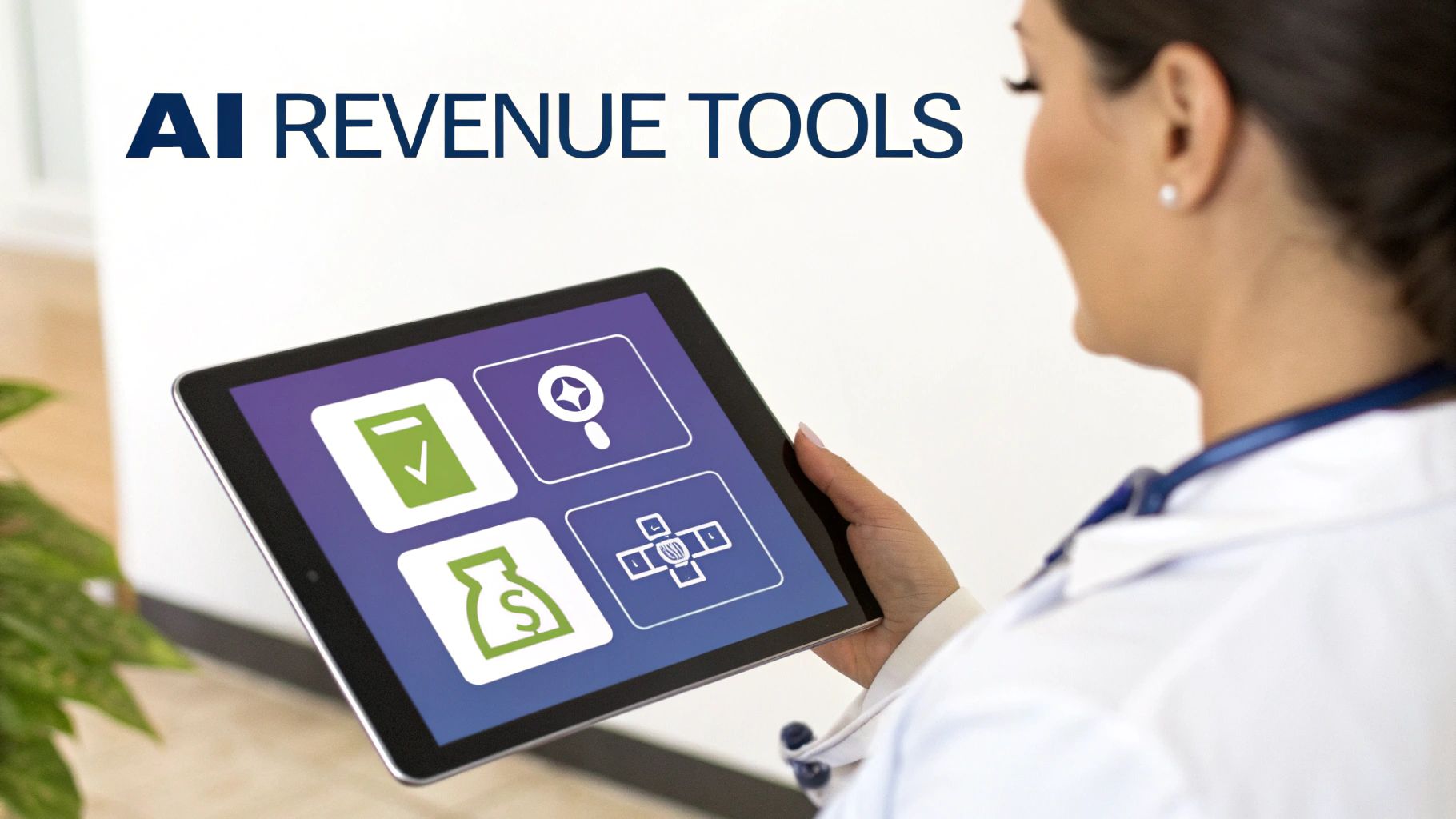
AI in medical billing isn't some single, all-in-one magic wand. Instead, think of it as a set of specialized tools, each designed to fix a specific problem spot along the patient's financial journey. If we follow that journey from the first appointment to the final payment, we can see exactly where these AI tools work their magic.
These applications don't work in isolation. They connect to create a smarter, faster, and more accurate financial workflow, turning a process full of manual work and reactive fixes into one that's proactive and predictable.
Automating Front-End Patient Tasks
The revenue cycle kicks off the moment a patient schedules an appointment—long before a claim is even a thought. This is where AI steps in to handle some of the most time-consuming administrative jobs, setting the stage for a clean claim down the line.
Here’s how AI is cleaning up the front-end:
- Prior Authorizations: Forget about staff spending hours on hold with payers. AI bots can automatically submit authorization requests by navigating payer portals and attaching the right clinical documentation. This speeds up approvals and keeps patient care on schedule.
- Eligibility Verification: AI systems can check a patient’s insurance coverage in real-time. This instant confirmation of active policies, copays, and deductibles prevents nasty billing surprises for everyone involved.
Serving as an Intelligent Coding Assistant
Accurate medical coding is the absolute bedrock of a healthy revenue cycle, but it’s also where countless errors happen. AI acts as an intelligent co-pilot for your coders, reviewing clinical documentation to make sure every code is accurate, complete, and compliant.
This is a huge step in preventing denials before they even happen. A key part of this is improving AI's role in medical record review services, which is the source material for all coding. The AI can suggest the most appropriate CPT and ICD-10 codes based on a physician’s notes, flagging any gaps or inconsistencies that would almost certainly lead to a rejection.
By using Natural Language Processing (NLP) to read and understand clinical text, AI translates what the doctor did into the precise language that payers require. This closes the gap between patient care and getting paid for it, all while reducing the risk of downcoding or compliance headaches.
This intelligent assistance helps you get paid what you've earned while staying on the right side of complex coding rules.
To see how these applications fit into the bigger picture, let’s look at how AI plugs into each stage of the revenue cycle.
AI Applications Across the Healthcare Revenue Cycle
| Revenue Cycle Stage | AI Application | Primary Benefit |
|---|---|---|
| Patient Registration & Scheduling | AI-powered eligibility verification | Prevents denials by confirming coverage upfront. |
| Prior Authorization | Automated bots for submitting requests | Speeds up care approvals and reduces staff workload. |
| Clinical Documentation & Coding | NLP-driven code suggestions (CPT, ICD-10) | Increases coding accuracy and reduces claim rejections. |
| Claim Submission & Scrubbing | Predictive algorithms for denial risk | Catches errors before claims are sent to payers. |
| Denial Management | AI-driven root cause analysis & appeal drafting | Identifies trends and automates the appeal process. |
| Payment Posting & Reconciliation | Automated remittance advice processing | Reduces manual data entry and reconciliation time. |
| Patient Billing & Collections | AI-generated payment estimates & chatbots | Improves patient experience and increases collections. |
As you can see, AI isn't just a single-point solution; it's a series of interconnected tools that strengthen the entire financial chain, from the first patient contact to the final payment.
Enabling Proactive Denial Management
In the past, denial management was always reactive. You'd submit a claim, wait for it to get denied, and then scramble to figure out why. AI completely flips this script, making proactive denial management a reality.
Before a claim even leaves your system, machine learning algorithms scan it. They compare it against historical data and a payer’s specific rules to predict the chances of a denial. If a claim gets flagged as high-risk, the system alerts your billing team with the exact reason and suggests a fix. To see how this fits into a broader strategy, check out our guide on healthcare revenue cycle optimization.
This proactive approach is a true game-changer. The market is already seeing the impact, with claims processing and adjudication grabbing a 38.51% share, mostly because AI can validate documentation against payer rules to get claims paid faster. This is where AI's ability to predict problems truly shines.
Providing Transparent Patient Payment Estimates
Finally, AI is making the financial side of healthcare less confusing for patients by providing clear and accurate cost estimates. By analyzing historical payment data and a patient’s specific insurance plan, AI tools can give a reliable estimate of their out-of-pocket costs.
This transparency is crucial. It builds trust and makes it easier to collect what's owed. When patients know what to expect financially, they're far more likely to pay their bills on time. This turns a common point of friction into a moment of good customer service, ending the revenue cycle on a high note for everyone.
A Practical Roadmap for Bringing AI into Your Practice
Adopting new technology can feel like a huge project, but the right game plan breaks it down into clear, manageable steps. Bringing AI into your medical billing isn't about flipping a switch overnight; it's a gradual, thoughtful process. The goal is a smooth transition that enhances what you already do, gets your team on board, and keeps your data completely secure.
Think of it less as a disruption and more as an evolution. With a bit of planning, you can sidestep common headaches and start seeing the benefits of smarter automation right away.
Start Small with a Pilot Project
Trying to overhaul your entire revenue cycle at once is a recipe for chaos. A much smarter way to start is with a pilot project. Think of it as a test drive. Pick one specific area that’s a constant source of frustration and let the AI prove its worth there first.
Maybe you start by using the AI to automate prior authorizations for just one department. Or you could have it scrub claims for a single, high-volume insurance payer that always gives you trouble. This focused approach minimizes risk and provides a clear measure of success.
A pilot project lets you see real results, fast. It builds momentum, gets your team excited, and offers a low-risk way to iron out any wrinkles. Most importantly, it gives you a powerful case study to justify a practice-wide rollout.
This approach keeps day-to-day operations running smoothly while you learn the ropes.
Nail the EHR Integration
Your Electronic Health Record (EHR) is the central nervous system of your practice. Any medical billing AI you choose must be able to talk to it seamlessly. If the systems can't communicate, you’ll just create more work for your team as they manually shuffle data back and forth. That defeats the whole purpose.
Before you even think about signing a contract, you have to confirm the vendor offers solid, bi-directional EHR integration. This is non-negotiable. It means clinical data flows automatically into the billing system, and billing updates flow right back into the patient's record. A seamless data exchange is the foundation of true automation.
Without that connection, you don't have true automation.
Get Your Team Ready with Great Training and Support
A tool is only as good as the person using it. Your team's buy-in is absolutely critical. The best way to get them on board is to show them how this new AI is an upgrade to their toolkit, not a replacement for their expertise. It’s here to handle the tedious, repetitive work, freeing them up for the complex problem-solving that actually requires a human brain.
A solid change management plan should include:
- Real-World Training: Your vendor needs to provide hands-on training that’s specific to the different roles on your team.
- Open Communication: Keep everyone in the loop. Be transparent about the timeline, what you’re trying to achieve, and what they can expect.
- Reliable Support: Make sure you partner with a company that has a responsive support team ready to help when you run into inevitable bumps in the road.
Define Your Wins and Measure Everything
How will you know if the AI is actually working? You have to define what "success" looks like before you even begin. By setting clear Key Performance Indicators (KPIs), you can track your progress and calculate the real return on your investment.
Focus on the metrics that matter most:
- Denial Rate: Aim to cut your denials by a specific percentage within the first 90 days.
- Days in Accounts Receivable (A/R): Watch how quickly you’re getting paid. This number should start dropping.
- Clean Claim Rate: What percentage of your claims are getting accepted on the very first try?
- Time Saved on Manual Tasks: Track the hours your team is no longer spending on things like eligibility checks or payment posting.
These numbers don't lie. They give you the hard data you need to see exactly how the AI is boosting your practice’s financial health and making your whole operation run more smoothly.
How to Choose the Right Medical Billing AI Partner
Picking a medical billing AI partner is one of the most important decisions you'll make for your practice's financial health. It’s easy to get lost in the marketing hype, but finding the right fit means looking past the flashy promises to what really matters for your team.
Think of it less like buying a piece of software and more like hiring a key strategic partner. The goal is to find a company whose technology and support feel like a natural extension of your own team.
Look for Proven Specialty Experience
Let's be clear: not all medical billing AI is built the same. A system that works wonders for a huge hospital system could be a complete disaster for a specialty clinic. The very first thing you need to vet is a vendor's experience in your specific medical field.
Every specialty has its own jungle of coding complexities and payer quirks. A partner who already knows the ins and outs of your world—be it cardiology, dermatology, or physical therapy—is going to build an AI that actually gets your claims right. Don't be shy; ask for case studies and talk to references from practices just like yours.
The right vendor speaks your language. They should understand your most common procedures, your biggest billing headaches, and the specific payers you deal with most often. This shared understanding is the foundation of a successful partnership.
Prioritize Seamless Integration Capabilities
Your EMR is the central nervous system of your practice. Any new tool you bring in has to connect with it perfectly. If a medical billing AI can't integrate smoothly with your existing systems, you'll just end up with data headaches and manual workarounds—the very things you're trying to eliminate.
Before you even think about signing a contract, confirm that the vendor provides a solid, bi-directional integration. This means data should flow effortlessly from your EMR to the AI platform and back again. This is a non-negotiable for getting your revenue cycle to run on autopilot.
Evaluate Support and Contract Terms
No matter how good the tech is, there will be bumps in the road. Your team will have questions. That’s why a vendor’s customer support is every bit as critical as their AI algorithms. Look for a partner who is responsive and knowledgeable, ready to help you from day one.
And, of course, read the fine print. Dig into the contract and pay close attention to a few key areas:
- Service-Level Agreements (SLAs): What are they promising for system uptime and how quickly will they respond when you need help?
- Transparent Pricing: Make sure the pricing is straightforward. Hidden fees can turn a good deal sour very quickly.
- Data Ownership and Security: You must retain ownership of your data, period. Also, confirm that the vendor is fully HIPAA-compliant.
Finding the right AI partner is a big step, especially for smaller clinics. Our guide on medical billing software for small practices offers more specific advice to help you cut through the noise. By asking the right questions upfront, you can find a partner that sets your practice up for long-term success.
Got Questions About Medical Billing AI? We've Got Answers.
It's natural to have questions when you're looking at a new technology, especially one that impacts your practice's bottom line. When it comes to something as important as your revenue cycle, you need clear, straightforward answers.
Let's walk through some of the most common questions healthcare professionals ask when considering AI for their medical billing.
Will Medical Billing AI Replace Our Billing Staff?
Not at all. The goal isn't to replace your people—it's to make them more effective. Think of AI as a powerful assistant that handles the tedious, repetitive tasks that bog down your team and lead to burnout.
This frees up your skilled billers to focus on the work that actually requires a human touch. Instead of manually keying in data or chasing down simple claim statuses, they can tackle complex denials, negotiate with payers, and help patients navigate their financial responsibilities. AI handles the grunt work so your team can become strategic problem-solvers. It's about elevating their roles, not eliminating them.
How Quickly Will We See a Return on Our Investment?
While every practice’s situation is unique, you’ll likely see a measurable impact much faster than you think. One of the best things about modern AI platforms is how quickly they can get up and running. Some vendors can have a system fully integrated in as little as 40 to 60 days.
You'll probably notice small wins almost right away, like fewer coding errors on outgoing claims. The bigger, more substantial results—like a real drop in your denial rate and faster payments—typically start showing up within the first 90 days. That's enough time for the system to learn your specific workflows and get a handle on your payers' quirks.
What About Patient Data and Security?
Protecting patient data is paramount—there's no room for error. Any reputable medical billing AI vendor builds their entire platform around security from day one. They are required by law to be HIPAA-compliant, meaning they follow strict federal rules for safeguarding sensitive health information.
A key thing to look for is a SOC 2 Type II certification. This isn't just a piece of paper; it’s proof from a rigorous, independent audit that a vendor's systems are designed to protect your data's security, confidentiality, and privacy. It's the gold standard in the tech world.
How Does AI Handle the Really Complicated Claims?
This is where the combination of AI and human expertise really shines. For complex claims, the AI acts as a first line of defense. It scans the claim against a massive database of payer rules and historical data, flagging potential problems before you hit submit. It might spot missing documentation or suggest a more specific code that a particular insurance company prefers.
If a claim is truly unusual or has unique circumstances, the AI doesn't just guess. It flags it and passes it over to your human billers. But it doesn't just dump the problem on them; it provides all the relevant data and context, allowing your team to use their experience and critical thinking to make the final decision. The AI does the heavy lifting, but your team always stays in the driver's seat.
Ready to see how intelligent automation can transform your revenue cycle? Simbie AI offers clinically-trained voice agents that automate everything from prior authorizations to patient intake, freeing your staff to focus on what matters most. Discover a smarter way to manage your practice.