
Think of hospital software as the central nervous system of a modern medical facility. It’s the digital backbone that connects every single department, from the front desk to the operating room, replacing the clunky and error-prone paper systems of the past. This technology is what allows for coordinated care, fewer mistakes, and a hospital that runs smoothly. This comprehensive guide will explore what this software is, its core functions, the tangible benefits it offers, and how to select the right system for your practice. We will also look at the future of hospital software, which is being shaped by advancements in AI and automation, transforming how healthcare is delivered.
What Is Hospital Software and Why Does It Matter
Picture a busy hospital trying to function without a central command center. Admissions, surgery, radiology, and billing would all be working in their own bubbles. Information would get lost, tasks would be duplicated, and patient care would inevitably suffer from dangerous delays and miscommunication. That’s the exact chaos that modern hospital software prevents.
At its heart, this software is a single, unified platform that links every part of a hospital's day-to-day operations. It makes sure that when a patient checks in, their information is instantly available to the nurses, the doctor, and the pharmacy. This seamless flow of information is the bedrock of safe and effective healthcare, providing a foundation for everything from clinical decision-making to administrative efficiency.
The Problem It Solves
Hospitals are incredibly complex environments. They juggle thousands of patient records, mind-numbing billing codes, bed availability, and intricate surgical schedules. Trying to manage all of that with manual processes or a patchwork of separate digital files isn't just inefficient—it’s a genuine risk to patient safety and the hospital's financial stability. These legacy methods are prone to error, create significant delays, and prevent the kind of coordinated care that modern medicine demands.
Hospital software tackles this head-on by automating and integrating these tangled workflows. It creates a single source of truth for patient data, administrative duties, and clinical decisions, effectively solving critical problems like:
- Data Silos: It stops vital information from being trapped within one department, ensuring that a patient's complete medical picture is accessible to all authorized caregivers.
- Manual Errors: It slashes mistakes in billing, scheduling, and patient charting by automating data entry and validating information in real-time. This reduces the risk of costly claim denials and, more importantly, clinical errors.
- Operational Inefficiencies: It automates repetitive tasks like appointment reminders, insurance verification, and report generation, freeing up staff to focus on higher-value activities like direct patient care.
- Poor Communication: It guarantees that every member of the care team is on the same page with up-to-the-minute information, from lab results to medication changes, facilitating better collaboration and safer patient handoffs.
By centralizing data and connecting disparate departments, hospital software transforms a collection of isolated functions into a cohesive, responsive healthcare organization. It’s the digital backbone that supports every clinical and administrative action.
An Overview of Core Functions
To really get a feel for its role, it helps to look at the essential tasks that modern hospital software handles. The system is designed to manage several key areas to create a much more efficient healthcare environment. It acts as an orchestrator, ensuring that the clinical, financial, and administrative aspects of the hospital work in harmony.
Here's a quick breakdown of its primary responsibilities and the direct impact they have on a medical practice.
Core Functions of Modern Hospital Software
A summary of the primary operational areas that hospital software manages to streamline healthcare delivery.
| Functional Area | Key Responsibilities | Impact on Practice |
|---|---|---|
| Patient Management | Manages patient registration, scheduling, admissions, and discharge processes. | Reduces wait times, minimizes scheduling conflicts, and creates a seamless patient journey. |
| Clinical Documentation | Secures and organizes all patient health information, including diagnoses, treatments, and lab results. | Provides instant access to accurate patient histories, supporting better clinical decisions. |
| Billing and Financials | Automates the entire revenue cycle, from generating invoices and processing claims to managing payments. | Improves billing accuracy, accelerates payment cycles, and increases revenue. |
| Departmental Integration | Connects various departments like the laboratory, pharmacy, and radiology into a unified system. | Ensures test results, prescriptions, and imaging are shared instantly with the care team. |
As you can see, each function is designed not just to digitize a task, but to create a more connected and responsive system for delivering care. The goal is to build an ecosystem where information flows freely and securely, enabling staff to perform their jobs more effectively and ultimately leading to better patient outcomes.
The Journey From Paper Files to Digital Platforms
To really get why today’s hospital software is such a big deal, you have to look at where we came from. Not so long ago, hospital records meant endless shelves overflowing with manila folders. Every single patient note, lab result, and bill was a physical piece of paper. This system wasn't just slow—it was a minefield of potential human errors that put patient care at risk. Lost files, illegible handwriting, and the sheer physical effort required to move information from one part of the hospital to another created constant friction and risk.
The first baby steps toward digital came in the 1960s and 70s. You might have seen a standalone computer in the lab or pharmacy, used for basic tracking. But these were just digital islands. They couldn’t talk to each other, so a patient’s information still had to be hand-carried or re-entered from one department to the next, reintroducing the potential for error at every step. This fragmented approach did little to solve the core problem of a disconnected healthcare system.
For decades, things moved at a snail's pace. The sheer cost and limited power of early computers meant only the biggest hospitals could even think about basic electronic systems. It took a perfect storm of events in the 2000s to finally force a change.
The Shift to Digital Mandates
The real turning point came from a mix of government pressure and the overwhelming flood of medical data. The HITECH Act, for example, dangled financial incentives in front of providers who adopted certified electronic health record (EHR) systems. That was the push many needed to finally ditch paper for pixels. This legislation created a powerful business case for digitalization, moving it from a long-term goal to an immediate strategic priority for many healthcare organizations.
At the same time, the amount of patient information was exploding. Advances in medical imaging, genomics, and diagnostics meant that a single patient record could contain gigabytes of data. Trying to manage that data deluge with paper files went from being difficult to downright impossible.
The global hospital information system (HIS) market was valued at an estimated USD 152.72 billion and is expected to rocket to USD 687.32 billion by 2033. This massive growth isn't just a number; it shows that digital systems are no longer a "nice-to-have." They are the operational engine of modern healthcare. You can explore the full research on hospital management solutions to see the data for yourself.
This move wasn't just about creating digital filing cabinets. It demanded a whole new level of communication between different systems and departments. The concept of interoperability became crucial. You can learn more about how different healthcare systems communicate by reading our guide on what interoperability in healthcare means. Getting all this software to speak the same language became the next great challenge.
From Record-Keeping to Operational Command
Fast forward to today, and the transformation is stunning. Hospital software has evolved from a simple departmental tool into the essential backbone of nearly every single task in a medical facility. It has become an intelligent platform that actively supports and enhances clinical and administrative workflows.
What started as a digital ledger is now a powerful command center, orchestrating the entire patient journey. Modern platforms manage everything from the moment someone books an appointment to the day they receive their final bill, all within a single, connected ecosystem. It's been a long road from paper folders to intelligent platforms, but it shows just how vital these systems are for providing safe and efficient care. The focus has shifted from mere data storage to data utilization, using information to drive better decisions, streamline operations, and personalize patient care.
What Are the Core Modules of Hospital Software?
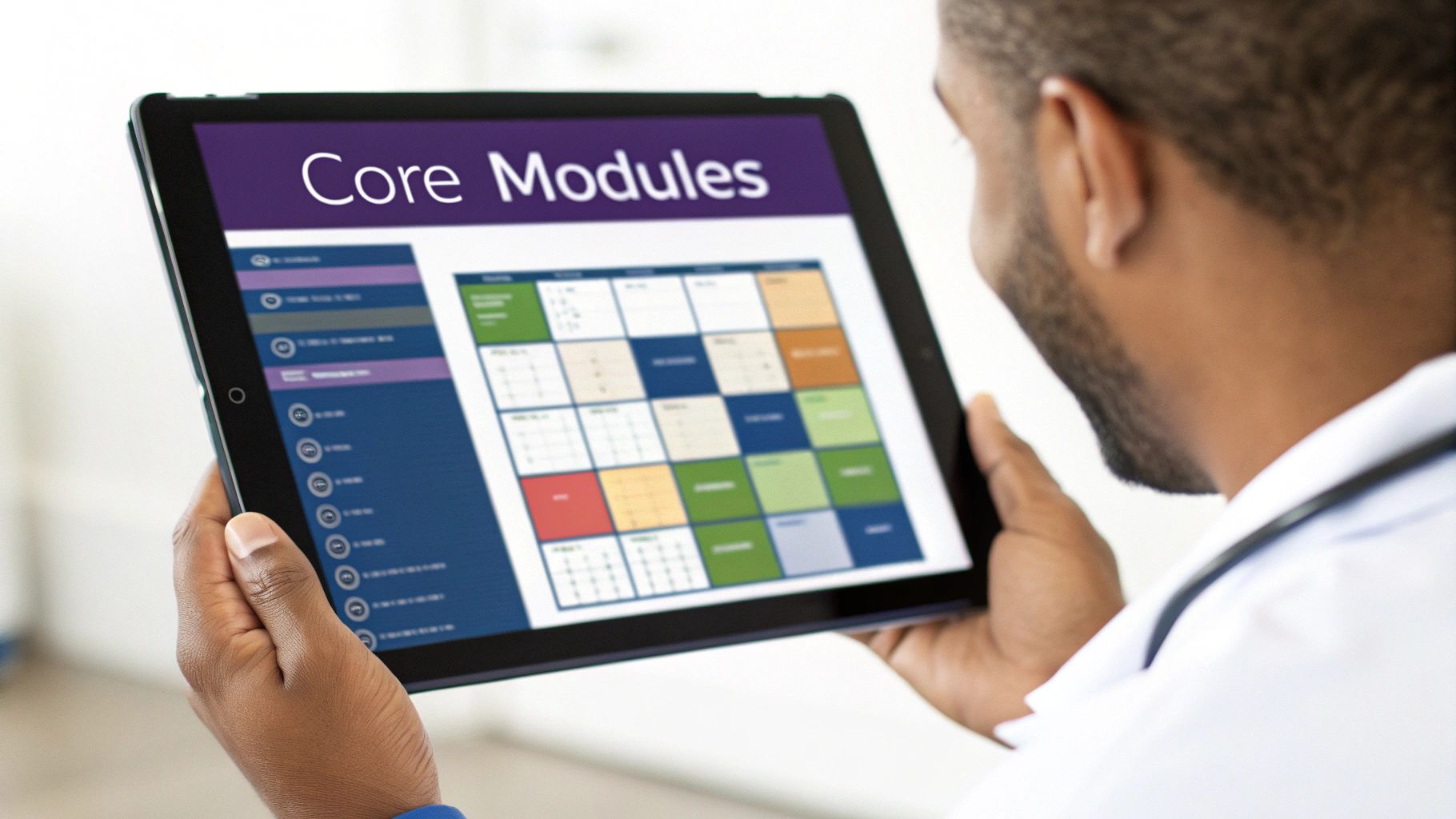
To really get a handle on hospital software, it helps to think of it not as one giant program, but as a set of specialized tools that work together. Each of these "modules" is designed for a specific job, from scheduling appointments to managing patient records, but they all connect to form a single, powerful system.
These modules are the building blocks that let a hospital manage both the clinical and business sides of its operations from one place. When they communicate seamlessly, they create a smooth flow of information that’s absolutely essential for running an efficient hospital and providing top-notch patient care. This modular architecture allows hospitals to customize their systems, implementing the functions they need most while having the flexibility to add more capabilities later.
Let's break down some of the most critical modules you'll find in nearly every hospital software suite. We've put together a simple table to give you a quick overview of what each one does and who uses it most.
Key Hospital Software Modules Explained
| Module | Primary Function | Key Users |
|---|---|---|
| Practice Management | Manages administrative tasks like scheduling, billing, and patient registration. | Front-desk staff, billing specialists |
| Electronic Records | Stores and organizes all clinical patient data, from diagnoses to lab results. | Doctors, nurses, clinical staff |
| Patient Portal | Provides patients with secure online access to their health info and services. | Patients, caregivers |
| Lab Management | Tracks lab orders, processes samples, and delivers test results electronically. | Lab technicians, physicians |
| Billing & Claims | Automates the entire revenue cycle, from creating claims to collecting payments. | Billing coders, financial managers |
This table gives you the big picture, but let's dive into a few of the most important modules to see how they really work on the ground.
The Administrative Hub: Practice Management System (PMS)
The Practice Management System (PMS) is the operational command center. Its job is to handle all the non-clinical work that keeps the lights on and the doors open. Think of it as the engine that drives the business side of the hospital. It streamlines workflows that directly impact revenue and patient flow, making it a cornerstone of an efficient practice.
For example, a PMS automates front-desk workflows like booking appointments, registering new patients, and checking insurance coverage in real time. It also takes on the entire billing cycle, creating claims and processing payments automatically. This takes a huge amount of manual work off your administrative team's plate, reducing errors and freeing them for more patient-facing roles.
- Key Functions: Appointment scheduling, patient registration, insurance verification, medical billing and coding, and financial reporting.
- Primary Users: Front-desk staff, billing specialists, and practice managers.
- Main Goal: To make daily operations more efficient and keep the hospital financially healthy.
By taking care of these critical administrative tasks, the PMS allows your staff to focus more on patients, which improves both your workflow and the patient experience.
The Clinical Core: Electronic Medical Records (EMR)
If the PMS is the business engine, the Electronic Medical Record (EMR) module is the heart of all clinical activity. This is the secure digital space where every bit of a patient's health information lives—from diagnoses and lab results to medications and treatment plans. It is the single source of clinical truth for a patient within a specific healthcare organization.
This centralized record gives doctors, nurses, and other specialists instant access to a complete and up-to-date patient history. That access is absolutely vital for making smart, safe clinical decisions. A well-implemented EMR can also provide clinical decision support, alerting clinicians to potential drug allergies or interactions. For healthcare teams wanting to get the most from their system, our guide on electronic health record optimization provides some great strategies.
A good EMR is so much more than a digital filing cabinet. It’s an active clinical partner that supports evidence-based medicine, boosts patient safety by flagging things like potential drug interactions, and ensures everyone on the care team is on the same page.
The Patient Gateway: The Patient Portal
The Patient Portal is the bridge connecting patients directly to their healthcare providers. It’s a secure online gateway that gives patients access to their own health information 24/7, empowering them to become more active partners in their own care. This tool is critical for meeting modern patient expectations for convenience and transparency.
Through the portal, patients can handle tasks that used to mean a phone call or a trip to the office. This isn’t just more convenient for them; it also cuts down on the administrative workload for your staff.
Here’s what patients can typically do through a portal:
- Manage Appointments: View, schedule, or reschedule their visits online.
- Access Health Records: Check lab results, read visit summaries, and review their medication lists.
- Send Secure Messages: Communicate directly with their care team for non-urgent questions.
- Pay Bills: View statements and settle their medical bills online.
This module has become essential for any modern healthcare organization looking to improve patient engagement and satisfaction.
The Tangible Benefits for Your Medical Practice
It’s easy to get lost in the technical jargon of hospital software, but what really matters are the concrete, day-to-day improvements you'll see in your practice. Talking about "automated workflows" is one thing. Seeing how that translates into a less chaotic front desk and happier staff is something else entirely. The real value is how this technology solves the persistent, everyday challenges in healthcare.
Think about the relentless flood of routine patient calls. An AI-powered agent built into your software can handle these common questions 24/7. This instantly frees up your team from answering the same things over and over, allowing them to focus on giving compassionate care to the patients standing right in front of them. That's a direct counter to staff burnout, a major issue in the healthcare industry.
This is where hospital software proves its worth—it turns abstract features into real-world outcomes that make your practice stronger from the ground up. These benefits ripple across the entire organization, from the waiting room to the boardroom.
Supercharging Operational Efficiency
Inefficiency is a silent killer of resources and morale. Lost paperwork, manual data entry, and endless phone tag between departments create bottlenecks that slow down care and frustrate everyone. Hospital software tackles these problems head-on by getting everyone on the same page and automating the manual, error-prone tasks that consume valuable time.
When the lab, pharmacy, and front desk all work from the same platform, information flows instantly. A doctor can order a test, and the lab gets it immediately—no phone call needed. This kind of connected ecosystem leads to some serious gains:
- Faster Patient Throughput: Patients move more quickly from check-in to treatment because their information is available to every department right away. This reduces wait times and improves the overall patient experience.
- Reduced Administrative Burden: Automating tasks like appointment reminders and insurance verification can free up hundreds of hours for your staff, allowing them to focus on more complex and patient-centric responsibilities.
- Optimized Resource Management: With real-time visibility into bed availability and operating room schedules, you can make smarter, more efficient plans, maximizing the use of your most critical assets and reducing costly downtime.
The core benefit is simple: by automating the mundane and connecting the critical, hospital software lets your clinical team spend less time on paperwork and more time on patient care. It’s about working smarter, not harder.
Bolstering Financial Health and Accuracy
Administrative errors aren't just a nuisance; they're a direct hit to your bottom line. A misplaced decimal or an incorrect billing code can get a claim denied, kicking off a chain of follow-up work that costs both time and money. Hospital software brings a level of precision to the table that manual processes just can't match, significantly improving your revenue cycle management.
By automating the billing and claims process, the software helps ensure codes are accurate and submissions are clean the first time around. This dramatically cuts down on claim denials, which are one of the biggest sources of revenue leakage in healthcare. For example, a good system can automatically verify a patient's insurance eligibility before their appointment, preventing billing headaches down the road.
The financial upside doesn't stop there. Automated reminders sent through a patient portal can slash no-show rates, directly recovering what would have been lost revenue. This one-two punch of billing accuracy and optimized scheduling builds a much stronger, more predictable financial foundation for your practice.
Enhancing Patient Satisfaction and Engagement
At the end of the day, the goal is to provide excellent care, and the patient's experience is a massive part of that. Long waits, scheduling mix-ups, and the frustration of repeating your medical history to three different people can quickly sour a patient’s perception of even the best clinical care. A negative experience can overshadow excellent medical outcomes.
Hospital software directly improves this experience by making every interaction smoother and more respectful of the patient’s time. Features like online portals empower patients to schedule their own appointments, view lab results, and pay bills whenever it's convenient for them. This not only boosts satisfaction but also fosters a stronger sense of partnership in their own health.
The global trend reflects this reality. The market for hospital information systems is projected to grow from USD 177.52 billion to USD 687.32 billion by 2033. This massive investment highlights a key truth for administrators: digitizing your operations isn't a luxury anymore; it's a mainstream strategy for running a better, more patient-focused practice. You can dive deeper into the hospital information system market trends to see just how big this shift is.
How to Choose the Right Hospital Software
Picking new hospital software is a huge decision. It's the kind of choice that will echo through your practice for years, impacting everything from your bottom line and staff sanity to the quality of care you provide. This isn't just another tech purchase; it’s a foundational investment in how your entire operation runs. Get it wrong, and you're stuck with frustrated staff, wasted money, and a system that creates more problems than it solves.
The secret is to have a solid game plan. You have to look past the slick sales pitches and really focus on what your practice needs to thrive. By figuring out your goals first and measuring vendors against them, you can find a true technology partner, not just a quick software fix. This requires a methodical approach that involves key stakeholders from across your organization.
Start with a Thorough Needs Assessment
Before you even think about scheduling a demo, you need to take a hard look in the mirror. It's time to map out your practice's specific challenges and what you want to achieve. Where are the daily headaches in your workflow? What bottlenecks are slowing everyone down and making patients antsy? What opportunities are you missing because your current systems can't support them?
Talk to everybody. Your front-desk team, the billing folks, your nurses, your doctors—each one has a unique and valuable perspective on what’s currently broken and what a new system absolutely must do better. Form a selection committee with representatives from each department to ensure all voices are heard.
Your goal here is to create a documented list of what "success" looks like. Are you hoping to:
- Slash patient wait times by making check-in a breeze?
- Cut down on claim denials with smarter billing and coding tools?
- Get patients more involved through an easy-to-use patient portal?
- Reduce the paperwork burden on your clinical team to help fight burnout?
- Improve data analytics to make better strategic decisions?
Having these concrete goals becomes your North Star for the entire process. It transforms a vague idea like "we need better software" into a focused mission to solve your specific problems.
Key Evaluation Criteria for Any Hospital Software
Once you know exactly what you need, you can start looking at potential solutions. While every practice has its own quirks, there are a few must-haves that should be on everyone’s checklist. These are the make-or-break factors that will determine if a platform becomes a trusted asset or a daily frustration.
1. Seamless EMR and Systems Integration
Your new hospital software can't be an island. It has to talk, and talk well, with your existing Electronic Medical Record (EMR) system and any other tools you depend on, like lab or imaging software. Bad integration creates information dead-ends and forces your team into mind-numbing manual data entry, which is the exact opposite of why you're upgrading. Ask vendors to show you real-world examples of how they’ve integrated with your EMR. Request case studies or references from other clients using the same EMR.
2. Scalability to Support Future Growth
The software that’s a perfect fit today might feel cramped in three to five years. A great platform is one that can grow right alongside you. Whether you’re planning to bring on more providers, open another clinic, or add new services, the software needs to handle that expansion without forcing you to start all over again. Ask about their pricing tiers, user limits, and what it takes to add new features or locations down the road. Ensure the system's architecture can support increased data volume and user load without performance degradation.
3. Robust Security and HIPAA Compliance
In healthcare, data security isn't just a nice-to-have; it's a legal and ethical obligation. The software you choose absolutely must have rock-solid, multi-layered security to protect sensitive patient data. This includes encryption at rest and in transit, strong access controls, and regular security audits. When choosing hospital software, understanding the importance of HIPAA compliant software development is paramount for safeguarding patient data and ensuring legal compliance.
Never just take a vendor's word that they are "HIPAA compliant." Dig deeper. Ask for documentation on their security protocols, how they encrypt data, and what their plan is if a breach occurs. A vendor that gets vague or defensive about security is a giant red flag. Inquire about their third-party security certifications, such as SOC 2 or HITRUST.
4. Reliable and Responsive Vendor Support
Even the most intuitive software will hit a snag eventually. When that happens, you need to know you have a dependable support team in your corner. Look closely at what they offer. Is there 24/7 help for emergencies? What are their guaranteed response times? What does the implementation and training process look like? You're looking for a partner who is genuinely invested in your success, not just a company that sold you a license. Check reviews and ask for references to gauge the quality of their customer service.
The Future of Hospital Software with AI and Automation

Hospital software isn't just a digital filing cabinet anymore. It’s quickly becoming a smart, active partner in both patient care and the business of running a hospital, thanks to two major drivers: Artificial Intelligence (AI) and the cloud. These forces are changing what we expect from our systems, turning them from static record-keepers into dynamic tools that can predict needs, handle complex jobs on their own, and help deliver better healthcare.
The most obvious change is the move toward automation. Think about all the repetitive, time-consuming tasks that bog down a hospital's staff—they're now being handed off to intelligent agents. For instance, AI-powered voice agents can answer a clinic's phones 24/7, scheduling appointments, handling prescription refills, and answering routine questions without a human ever picking up. This directly tackles common frustrations like long hold times and missed calls while easing the burden on overworked administrative teams.
The Rise of Intelligent and Accessible Systems
How this powerful hospital software gets delivered is also shifting. The old model of expensive, on-site servers is giving way to cloud-based Software-as-a-Service (SaaS) options. This change makes sophisticated tools much more affordable and within reach for healthcare practices of every size, democratizing access to cutting-edge technology. Cloud solutions also offer superior accessibility, allowing authorized users to access data from anywhere, on any device.
And this isn't just a small trend—it's a massive market movement. The global healthcare SaaS market is currently valued at USD 38.50 billion and is expected to explode to around USD 102.98 billion by 2035. This incredible growth shows that cloud-based, AI-driven software is fast becoming the new normal for running a modern healthcare facility.
As we look ahead, AI offers real, tangible solutions for improving how hospitals work, from automating daily tasks to making sense of complicated patient data. AI algorithms can analyze vast datasets to identify patterns, predict patient outcomes, and support clinical decision-making. For anyone wanting to dig deeper, there are great resources for unlocking growth with artificial intelligence business solutions.
AI Agents Transforming the Patient Experience
The true magic of this technology comes to life where it matters most: in the day-to-day interactions with patients. AI is no longer some far-off idea. It's here now, being used in practical ways that boost both efficiency and the quality of care. These AI agents are not replacing human staff but augmenting them, handling routine communications to allow humans to focus on more complex, empathetic interactions.
By automating routine administrative workflows, AI-driven hospital software frees up highly skilled clinical and administrative staff to focus on what they do best: providing compassionate, high-quality patient care.
Here are a few ways AI is already making a real difference:
- Automated Patient Intake: Instead of filling out clipboards, new patients can be guided through the entire registration process by an AI agent over the phone. It collects all the necessary demographic info, insurance details, and medical history before the patient even walks through the door.
- Intelligent Appointment Scheduling: An AI scheduler can juggle complex calendars, find the perfect appointment slot based on the doctor's availability and the reason for the visit, and automatically send reminders to help cut down on no-shows.
- 24/7 Prescription Refill Management: Patients can call anytime, day or night, to request a refill. An AI agent can verify their identity, confirm the medication, and push the request straight to the pharmacy and into the patient's EMR.
These examples clearly show where things are headed. The integration of AI into hospital software is creating a more proactive, personalized, and efficient healthcare system. It's worth learning more about how AI agents in healthcare are building a more responsive and patient-focused future for everyone.
Frequently Asked Questions About Hospital Software
Diving into the world of hospital software always brings up a lot of questions. If you're feeling a bit overwhelmed, you're not alone. The complexity of these systems and the high stakes of implementation mean it's crucial to have all your questions answered. We've compiled some of the most common questions we hear from healthcare leaders and clinicians to give you clear, practical answers and help you move forward with confidence.
How Long Does It Take to Implement New Hospital Software?
That really depends on the scale of your operation and the software you choose. A smaller clinic adopting a straightforward, cloud-based system might be up and running in just a few weeks or a couple of months. The disruption is minimal, and staff can get trained pretty quickly. These agile implementations often focus on core functionalities first, with additional features rolled out in phases.
On the other hand, if you're a large hospital system needing to migrate years of data and build custom connections to your EMR, you should brace for a longer haul. These projects typically take anywhere from six months to a full year, and sometimes even longer for multi-site deployments. The timeline is really dictated by three things: how good your vendor's support is, the state of your current IT setup, and how much training your team will need to truly master the new system. A well-defined project plan with clear milestones is essential for a successful, on-time implementation.
Can Hospital Software Integrate with Our Existing EMR System?
Absolutely—it has to. Any modern hospital software worth considering is built to play nicely with existing Electronic Medical Record (EMR) or Electronic Health Record (EHR) systems. This is a fundamental requirement for creating a connected healthcare environment. Most vendors use standard protocols like HL7 and APIs (Application Programming Interfaces) to make sure data can move seamlessly between your clinical and administrative tools.
Before you sign any contract, you must get confirmation that the software integrates with your specific EMR. This is non-negotiable. A smooth connection is what saves you from manual data entry, cuts down on errors, and gives your care teams a complete, unified view of each patient. Ask for a live demonstration of the integration, not just a verbal confirmation.
What Is the Difference Between On-Premise and Cloud-Based Software?
This is a huge one, as it affects everything from your budget to your day-to-day IT headaches. The choice between these two deployment models has significant long-term implications for cost, maintenance, and scalability.
-
On-Premise Software: Think of this as the traditional model. You buy the software and install it directly on your own servers at your facility. This means a big upfront cost for hardware and software licenses, plus your own IT team is on the hook for all maintenance, security, and updates. You have more control over the data, but also bear all the responsibility.
-
Cloud-Based Software (SaaS): This is the modern, subscription-based approach. The vendor hosts everything on their servers, and you just access it through the internet. There’s no need for bulky on-site hardware, and the vendor takes care of all the security patches and updates behind the scenes. This model typically involves a recurring operational expense rather than a large capital expenditure.
For most practices today, cloud-based systems are the way to go. They're more scalable, have a much lower initial cost, and offer the flexibility to adapt as your needs change—all without the burden of managing the tech yourself. This allows healthcare organizations to focus on their core mission of patient care rather than IT infrastructure.
Ready to see how AI-powered automation can take the administrative load off your team? Simbie AI offers a clinically-trained voice agent that handles patient intake, scheduling, and refills 24/7. This frees up your staff to focus on what they do best—caring for patients.
Discover a smarter way to manage your practice at https://www.simbie.ai.