

Think of your hospital discharge papers as a personalized roadmap for your recovery. This isn't just another stack of papers to file away; it’s the crucial link between the care you received in the hospital and the care you’ll need at home. Getting a handle on what these documents say is one of the most important things you can do for a safe and smooth transition.
What Are Hospital Discharge Papers and Why They Matter

When you're discharged, you’re moving from an environment with 24/7 medical support back to managing your own health. It's a big shift. The documentation you receive at discharge is designed to make sure that transition happens safely, giving you and your caregivers all the information needed to continue your healing journey.
These documents lay out clear instructions for everything from medication management to recovering from surgery at home. Essentially, they’re a formal communication tool meant to prevent any dangerous gaps in your care.
The Bridge Between Hospital and Home
Think of your hospital stay as one chapter in your health story. Your discharge summary is the next chapter, ensuring the plot continues smoothly. Without it, patients often have to guess about which medications to take, what activities are safe, and when to schedule follow-up appointments.
This isn't a small problem. A significant 17.1% of patients across 10 high-income countries reported having issues with their discharge instructions. They felt the directions were unclear, didn't know about medication side effects, or weren't told what danger signs to watch for.
A clear summary is also vital for your other doctors. It gives your primary care physician a snapshot of your hospital stay, allowing them to make smart decisions about your ongoing treatment.
"Your discharge summary is arguably the most important document you will receive from the hospital. It empowers you to become an active and informed participant in your own recovery."
Key Information in Your Discharge Summary
While the exact layout might differ from one hospital to another, all hospital departure documents should contain the same core information. Each section plays a specific role in keeping you safe. A good summary—like the kind you'd build from an after visit summary template—details everything from your diagnosis to red flags.
To help you get familiar with the contents, here’s a quick overview of the most important parts of your discharge paperwork and what they mean for you.
Key Sections of Your Discharge Paperwork at a Glance
| Component | What It Tells You | Why It Is Crucial |
|---|---|---|
| Final Diagnosis | The medical team's final conclusion about your health issue. | Helps you and other doctors understand the "why" behind your treatment. |
| Summary of Hospital Stay | A brief story of your time in the hospital, including tests and treatments. | Provides context for your primary care doctor and any specialists you see. |
| Medication List | All your prescriptions, including new ones, with dosage and instructions. | Prevents dangerous medication errors and ensures you take the right medicine. |
| Follow-Up Appointments | When and where to see your doctors for check-ins. | Ensures continuity of care and that your recovery stays on track. |
| Activity and Diet Rules | Clear instructions on what you can (and can't) do or eat. | Protects you from setbacks and helps your body heal properly. |
| Emergency Contacts | Who to call and what symptoms to watch out for. | Lets you know exactly when to seek help, preventing a minor issue from becoming major. |
Understanding these sections ahead of time makes it much easier to ask the right questions before you leave the hospital, ensuring you have everything you need for a successful recovery at home.
How to Read and Understand Your Discharge Summary
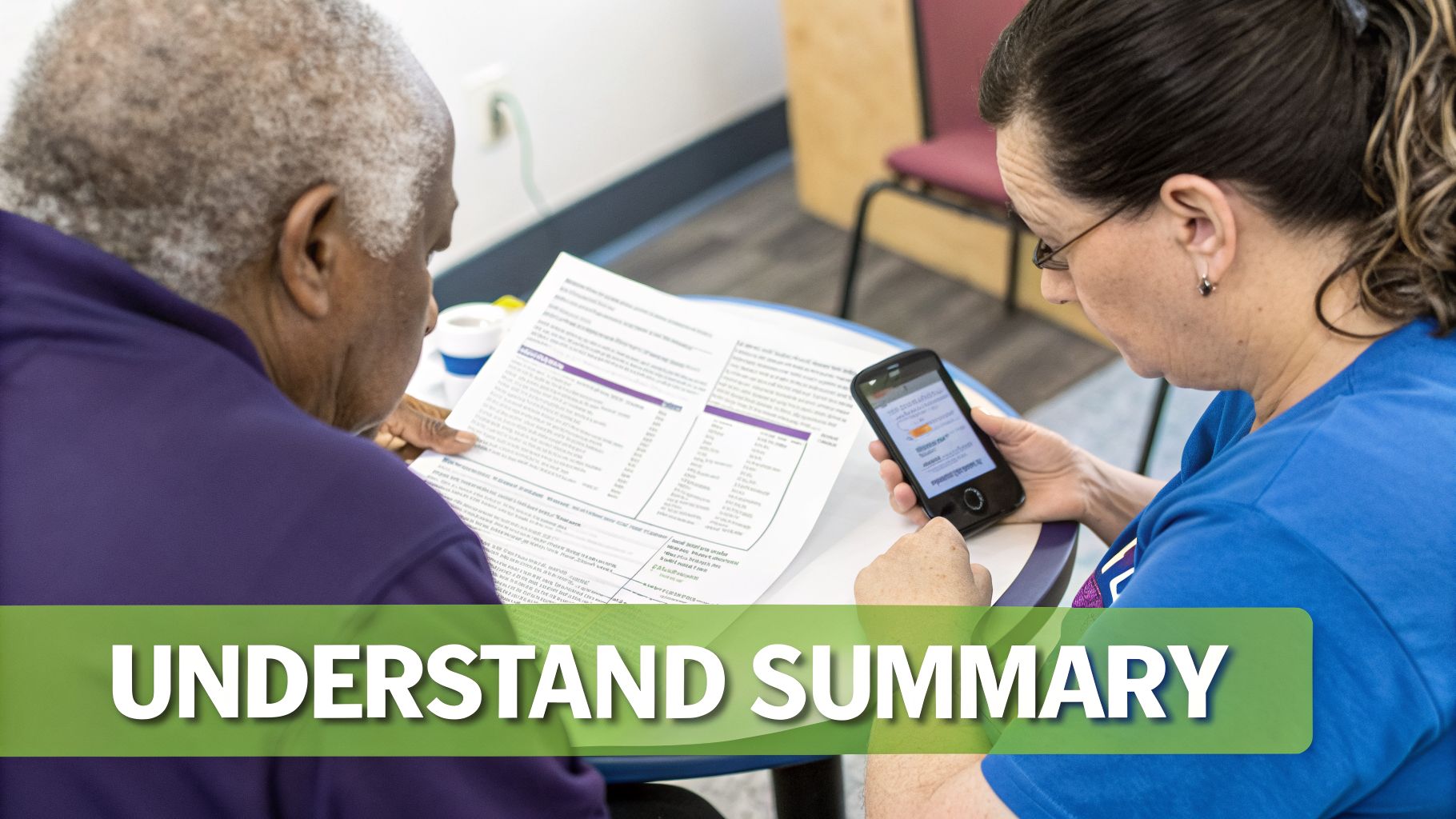
That stack of hospital discharge papers they hand you on your way out? It’s probably the last thing you want to deal with. The text is dense, packed with medical terms, and it arrives when you’re exhausted and just want to be home. But taking a few minutes to really understand these documents is one of the most important things you can do for your health.
Think of your discharge summary as your personal roadmap for a safe recovery. It’s the bridge between the care you received in the hospital and the care you’ll need at home to stay well and avoid another visit.
What to Look for in the Main Sections
Let's walk through the paperwork together, piece by piece. When you know what you’re looking for, it’s much easier to digest the information and flag anything that seems confusing or wrong.
First up, you’ll see the final diagnosis. This is the official medical reason you were admitted. Does it match what your doctors have been telling you? If not, now is the time to ask why.
Next is the summary of your hospital course. This section tells the story of your hospital stay—what tests they ran, what procedures were done, and how you responded to treatments. It’s written for other medical professionals, but you should still give it a once-over to make sure it looks accurate.
Double-Check Your Medication List
Pay extra close attention here. The medication list is arguably the most critical part of your instructions, and mistakes can be dangerous. Your papers should clearly list every medicine you need, spelling out which are new, which you should stop taking, and which to continue from your old routine.
Focus on these details for every single one:
- Medication Name: Is it a brand name or a generic? Knowing both can prevent confusion at the pharmacy.
- Dosage: How much should you take? Look for specific numbers, like 500mg or 1 tablet.
- Frequency: How often do you need to take it? This could be twice a day, every 6 hours, or only as needed.
- Reason for Taking: Why was this prescribed? Understanding its purpose helps you stick to the plan.
Before you walk out the door, ask a nurse to review each medication with you. A great tip is to have your pharmacist check your new prescriptions against your old ones to spot any potential issues or conflicts.
Your Guide to Activity and Diet
Your body needs the right conditions to heal properly after a hospital stay. Your discharge summary will outline specific restrictions tailored to you. This isn’t just general advice—it’s a personalized plan to keep you safe and prevent setbacks.
These instructions often include things like:
- Physical Activity Limits: You might be told not to lift anything heavier than 10 pounds, to avoid driving for a week, or to skip certain exercises.
- Dietary Changes: This could be a low-sodium diet for blood pressure or a soft-food diet after a digestive surgery.
- Wound Care: If you had an operation, you'll find clear directions for keeping the incision clean, changing dressings, and showering.
This is a great section to snap a photo of with your phone. Having it handy makes it easy to remember what you can and can’t do, whether you're at the grocery store or just going about your day.
Don’t Miss Your Follow-Up Appointments
Getting home is just one step in your recovery. Your paperwork will list all the follow-up appointments you need with your primary doctor or specialists. These visits are essential for checking on your progress.
Put these appointments in your calendar right away. If they haven't been scheduled yet, the papers will tell you who to call and by when. Making those calls promptly is key to getting seen within the recommended timeframe. To see how all these pieces fit together, you can look at a sample discharge summary that shows what a complete document looks like.
Finally, find the section that lists "warning signs" or "when to call a doctor." This is your safety net. It will list specific symptoms—like a fever, worsening pain, or shortness of breath—that mean you need to seek medical help immediately. Knowing what to watch for can be the difference between a simple phone call and another trip to the ER.
The Hidden Journey of Your Discharge Papers
Those hospital discharge papers that land in your hands right before you head home might seem like they were put together in a rush. The truth is, they’re the final product of a long and complicated process that kicks off almost the minute you're admitted.
Think of it less like a last-minute checklist and more like assembling a complex puzzle. Every doctor, nurse, and therapist you see holds a different piece. A physician might change a prescription, a physical therapist could set new limits on your activity, and a social worker might be arranging for a visiting nurse. The discharge summary is where all those scattered pieces are supposed to fit together perfectly.
This isn’t a simple task. It takes a ton of coordination behind the scenes to get every detail right, and a lot can get lost along the way.
From Admission to Discharge Plan
Believe it or not, your care team starts planning your departure right from the start. A dedicated case manager or discharge planner is usually assigned to you early on. Their entire job is to look ahead and make sure everything is lined up for a safe and smooth transition back home.
Throughout your hospital stay, information is constantly being gathered from all sides:
- Doctors' Rounds: These are the daily huddles where your progress is reviewed and your treatment plan gets tweaked.
- Nursing Notes: Nurses are with you 24/7, and they’re documenting everything—from vital signs and symptoms to how you’re reacting to treatment.
- Specialist Consultations: If a heart specialist or a surgeon comes to see you, their expert opinion and recommendations become part of your growing file.
- Therapy Sessions: Notes from physical, occupational, or speech therapy are critical for understanding what you can and can't do on your own yet.
Every single one of these updates is a crucial puzzle piece. They all help build the complete picture of what you'll need to continue your recovery safely at home.
The Challenge of Assembling the Puzzle
So, what makes it so hard to get this right? One of the biggest roadblocks is that information often gets trapped in "silos." Even with an Electronic Medical Record (EMR) system, different departments might use their own methods for documenting care, and important details don't always cross over.
A nurse might update your medication chart, but if that change isn't immediately visible to the doctor finalizing your paperwork, an error can occur. This fragmentation is a major bottleneck in many traditional hospital workflows.
This problem gets even bigger when you consider the sheer scale of it all. In 2026, U.S. hospitals are projected to handle over 9.8 million discharges per quarter. That’s a staggering amount of pressure on hospital staff—about 116 discharges for every 1,000 people—and it naturally raises the risk of mistakes. You can get a better sense of these numbers by checking out more insights on hospital discharge rates in the United States.
Add a few different specialists to the mix, and it gets even more complex. Someone recovering from a heart attack might get instructions from their cardiologist, a dietitian, and a physical therapist. Making sure all that advice is consistent and clearly spelled out in a single document is a huge administrative lift. Knowing just how tough this process is makes it clear why good communication is absolutely essential for your safety. It also shines a light on where new tools can help connect the dots, cut down on manual work, and reduce the chance of errors.
Common Errors in Discharge Paperwork and How to Address Them

Let's be honest—even in the best hospitals, mistakes can slip into hospital discharge papers. The discharge process is often a whirlwind. Doctors, nurses, and case managers are juggling multiple patients, and everything depends on getting information recorded perfectly. For patients and their families, finding an error in that stack of papers can feel overwhelming, but it’s one of the most important things you can do to stay safe once you’re home.
For those of us on the clinical side, these aren't just minor clerical slip-ups. They represent a breakdown in the care journey that can easily lead to a patient bouncing right back to the hospital, experiencing a setback, or worse. Fixing this means digging deeper than just the typos and looking at how our systems and workflows can be improved.
Common Issues for Patients and Caregivers
When that paperwork is handed to you, it’s your turn to be the final line of defense. It’s okay to pause, take a deep breath, and review everything before you head out the door. You should never feel rushed or hesitant to ask questions. Your health depends on it.
Here are a few of the most frequent (and critical) problems to watch out for:
- Incorrect Medication Information: This is, without a doubt, the most dangerous potential error. Look for the wrong drug, an incorrect dose, or confusing schedules. Make sure it also clearly states which medications you should stop taking.
- Vague or Confusing Instructions: What does "take it easy" even mean? You need specifics. Look for concrete directions like, "do not lift anything heavier than 10 pounds for two weeks," or "walk for 15 minutes, twice a day."
- Missing Contact Information: If you have a question at 2 a.m., who do you call? The papers must have a direct phone number and specify which doctor to contact for which issue.
- Inaccurate Follow-Up Details: A simple mix-up in the date, time, or address for a follow-up appointment can cause you to miss that vital first check-in with your doctor.
If you spot an error or something feels unclear, speak up immediately. Ask the nurse or case manager to clarify and, if necessary, print a corrected version of your discharge summary before you leave. If you only notice the mistake after getting home, call the hospital unit you were discharged from or your primary care physician's office right away.
Root Causes and Prevention for Healthcare Practices
From a provider's standpoint, these errors are usually symptoms of a bigger process problem. Just telling your team to "be more careful" won't fix it. The only real solution is to pinpoint where the system is breaking down and build in some practical safeguards.
Most of these documentation mistakes boil down to a few familiar challenges:
- Manual Data Entry: Every time a human has to type information into an EMR, there's a chance for a typo or a copy-paste error. It’s unavoidable.
- Fragmented Communication: Think of the "telephone game" that happens during shift changes or when specialists hand off a patient. Key details can get lost in translation between doctors, nurses, and pharmacists.
- Poor EMR Integration: When the different software systems your hospital uses don't talk to each other smoothly, you get information gaps. These gaps create incomplete records and, ultimately, faulty discharge instructions.
The table below offers a practical guide for both patients and healthcare practices to identify, fix, and prevent these all-too-common errors.
Identifying and Fixing Common Discharge Paper Errors
This guide helps both patients and providers spot frequent documentation mistakes and take the right steps to correct them.
| Common Error | Potential Patient Risk | Action for Patient or Caregiver | Prevention Strategy for Practice |
|---|---|---|---|
| Wrong Medication Dosage | Overdose, under-treatment, or harmful side effects. | Go over every single medication with the nurse before you leave. Ask them to confirm the dose and why you're taking it. | Implement barcode scanning for medication administration and CPOE (Computerized Provider Order Entry) to minimize manual input. |
| Ambiguous Activity Limits | Injury from doing too much too soon, or a slow recovery from being too inactive. | Ask for concrete, measurable limits. For example, "Can I lift my grandchild? How many pounds is too much?" | Build standardized, condition-specific instruction templates into your EHR. |
| No Contact for Questions | Not knowing who to call can lead to delayed care for a new symptom or confusion over medications. | Ask directly: "Who is the exact person I should call if I have a question about my new blood pressure medicine?" | Make sure discharge templates automatically pull in the correct on-call or office contact information for the responsible clinician. |
| Incorrect Appointment Info | Missing a critical follow-up can create a gap in care, increasing the risk of readmission. | Call the specialist's or PCP's office to verbally confirm the appointment date, time, and location before leaving the hospital. | Use EHR-integrated tools to automate appointment scheduling and send automated reminders to patients. |
By working together, patients can feel more confident in their recovery plan, and practices can significantly reduce the risks that come from simple, preventable documentation errors.
Improving the Discharge Process with Modern Technology
Anyone who's worked in a busy clinic or hospital knows the discharge process is a minefield of paperwork and potential mistakes. Creating accurate hospital discharge papers is a huge administrative lift, involving everything from transcribing a doctor's notes to coordinating follow-up care. All that manual work is a recipe for human error, leading to staff burnout and a greater risk of patients ending up back in the hospital.
Thankfully, technology—specifically automation and AI—is starting to provide real relief. These tools don't replace clinicians. They act as tireless assistants, taking over the repetitive, administrative jobs that eat up so much valuable time. This frees up your medical team to do what they do best: focus on their patients.
How AI Can Automate Discharge Communication
Think about a system that can deliver personalized patient education on demand. Intelligent voice agents can now walk patients through their discharge instructions—medication schedules, activity restrictions, dietary changes—using simple, clear language.
This technology allows a patient to ask a question in their own words and get an immediate, correct answer. If a patient wonders, "Can I take this medicine with food?" the AI can check the clinical guidelines and respond instantly.
For a medical practice, this approach offers some major advantages:
- Consistency: It ensures every single patient receives the same high-quality, approved information, removing the guesswork that can happen with rushed verbal instructions.
- Accessibility: Patients can review the information 24/7 from home, which is a huge help when they're trying to remember their care plan days later.
- Documentation: Every conversation is automatically logged, creating a clean record of what information was shared and what questions the patient asked.
Slashing Administrative Work and Reducing Errors
Beyond just communicating with patients, automation can tackle the most tedious parts of the discharge workflow. These tools can automatically schedule follow-up appointments, send prescription reminders by text, and even get a head start on prior authorizations for new medications.
With hospital employment expected to hit 5.6 million by 2026, the administrative load on clinical teams is only going to get heavier. As hospitals become more like complex care networks, finding efficiencies is no longer a luxury—it's a necessity. AI-powered voice agents can ease this burden by translating patient conversations into EMR notes, helping to cut administrative overhead by as much as 60%.
When you automate these tasks, you also get rid of the risk of manual data entry mistakes. No more typos in appointment times or errors in transcribing a doctor's orders. It's a massive win for patient safety. For practices looking to cut down on manual work across the board, it's worth exploring tools like document automation software.
"By automating routine discharge tasks, a practice can free up a significant amount of clinical time. This allows nurses and case managers to handle complex patient needs and have more meaningful, unhurried conversations before discharge."
The Power of Seamless EMR Integration
The real magic happens when these tools connect directly with your practice's Electronic Medical Record (EMR) system. This integration is a game-changer for your workflow. When an automated system books a follow-up visit, for instance, that appointment simply appears in the EMR. No one has to enter it manually. You can see how this works in our guide on EMR system integration.
This direct link ensures all discharge-related information is logged in one central, reliable place. The patient's record is always current, giving every clinician who views it the full picture. The end result is a more efficient practice with less staff burnout, lower readmission rates, and a safer, smoother experience for your patients.
How to Get a Copy of Your Medical Records
Just because you've left the hospital doesn't mean you're done with the paperwork. You might need your complete medical record for a new specialist, to sort out an insurance claim, or just to keep for your own files. The good news is, you have a legal right to this information, including your hospital discharge papers and the full history of your stay.
Getting these records isn't quite as simple as picking up a prescription—it’s a formal process. But once you know the steps, it's completely manageable. Knowing how to do this puts you in the driver's seat of your own healthcare.
Your Right to Access Health Information
Under a federal law called the Health Insurance Portability and Accountability Act (HIPAA), you are legally guaranteed the right to see and get a copy of your health records. This covers nearly all healthcare providers, including the hospital you just left. Once you make the request, the hospital has 30 days to provide your records, though many are able to get them to you much faster.
Think of it as your personal health data. Just like you can request a copy of your credit report, you can ask for a copy of your medical history. It's a fundamental part of being an informed patient.
Step-by-Step Guide to Requesting Your Records
To get your records, you’ll need to work with a specific department. While the exact steps can differ a bit from one hospital to another, here's how the process generally works.
Find the Right Department: Your first task is to find the hospital’s Medical Records Department. Sometimes it's called the Health Information Management (HIM) department. The easiest way to find them is by checking the hospital’s website or calling the main switchboard and asking for that department directly.
Submit a Formal Request: You'll almost always need to put your request in writing. Most hospitals have a standard "Authorization for Release of Information" form you can download from their website. Just print it out and fill it in.
Provide Necessary Information: To make sure they pull the right file, you'll need to give them a few key details on the form:
- Your full name and date of birth.
- The dates you were admitted and discharged.
- Exactly what you need (e.g., "discharge summary only," "lab results from my stay," or "the complete record").
- Your signature and the date.
Understand Potential Fees: Hospitals are allowed to charge a "reasonable, cost-based fee" for the time and materials used to copy and mail your records. This often depends on the number of pages. It’s a good idea to ask about their fees upfront so there are no surprises.
How to Correct an Error in Your Records
What happens if you get your medical records and spot a mistake? Whether it’s a simple typo in your address or something more serious like an incorrect diagnosis, you have the right to ask for a correction. To do this, you’ll need to submit a written request to the hospital's Medical Records Department explaining what you believe is wrong.
The hospital has to review your request and respond, usually within 60 days. They aren’t required to make the change if they disagree, but they must add your letter of disagreement to your file. This ensures that anyone who looks at your record in the future will see your side of the story, making you an active partner in keeping your health history accurate.
Common Questions About Hospital Discharge Documents
Even with the clearest instructions, it’s completely normal to have a few more questions pop up after you’ve been given your hospital discharge papers. Let’s walk through some of the most common ones so you can feel confident handling your recovery.
What Do I Do If I Don't Understand My Discharge Papers?
If you're still at the hospital, don't be shy. Ask the nurse or case manager to go over the instructions with you again. It’s their job to make sure you’re comfortable with the plan, so have them explain any confusing medical terms or steps. Seriously, there are no bad questions here.
Already home? Your first and best move is to call the hospital unit where you were treated. They can access your file and clear things up over the phone. Your primary care doctor is another great resource, as they also get a copy and can help translate the medical-speak into a practical plan.
Should I Get My Discharge Papers Before I Leave the Hospital?
Yes, absolutely. You must have your discharge instructions in hand before you walk out the door. Think of it as your immediate roadmap for recovery—it’s a required and essential part of leaving the hospital.
Just keep in mind, this initial document is your action plan. If you need a copy of your full medical record (which includes the more detailed discharge summary), hospitals have up to 30 days to provide it after you make a formal request under HIPAA.
Can My Family Get a Copy of My Discharge Papers?
A family member can get a copy, but only if you give your explicit legal permission. Hospitals take patient privacy very seriously and are bound by strict rules.
Usually, this means you’ll need to sign a HIPAA release form that names the specific person you're authorizing. The only other way is if that person is already your designated healthcare power of attorney. Without that formal green light, the hospital simply can't share your information with anyone.
Are Digital or Paper Discharge Summaries Better?
Honestly, each has its perks. A digital copy in a patient portal is incredibly convenient—it’s easy to find, simple to share with other doctors, and impossible to lose in a stack of mail.
But there’s something reassuring about a physical paper copy. It’s tangible, doesn’t require a login or internet, and you can stick it on your fridge as a reminder. The best strategy? Get both. Grab a paper copy before you leave the hospital, but also make sure you have access to the digital version for your long-term records. It’s the perfect combination of immediate access and a secure backup.
Are you a practice manager looking to reduce administrative burdens and prevent the errors that lead to these questions? Simbie AI offers intelligent voice agents that automate patient education, scheduling, and documentation, ensuring every patient gets clear, consistent information every time. Discover how you can improve patient outcomes and free up your staff by visiting https://www.simbie.ai.