

At its heart, hospital administration software is the digital command center for a healthcare facility. It's an integrated system that connects and manages all the core operations, from the moment a patient schedules an appointment to the final billing process and resource management. This comprehensive platform, often referred to as a hospital management system (HMS), serves as the central nervous system, ensuring every department—from admissions to the pharmacy—is perfectly in sync. The primary goal is twofold: to elevate the standard of patient care through efficiency and to maintain the financial stability and growth of the healthcare institution.
Think of it as the central nervous system for a hospital, making sure every department is in sync. The goal is to improve how patients are cared for while also keeping the facility financially healthy. By centralizing data and automating workflows, this software provides administrators with a holistic view of the entire operation, enabling data-driven decisions that enhance both patient outcomes and operational excellence. It's the key to transforming a complex, often fragmented, organization into a cohesive, high-performing entity.
The Digital Control Tower of Modern Healthcare
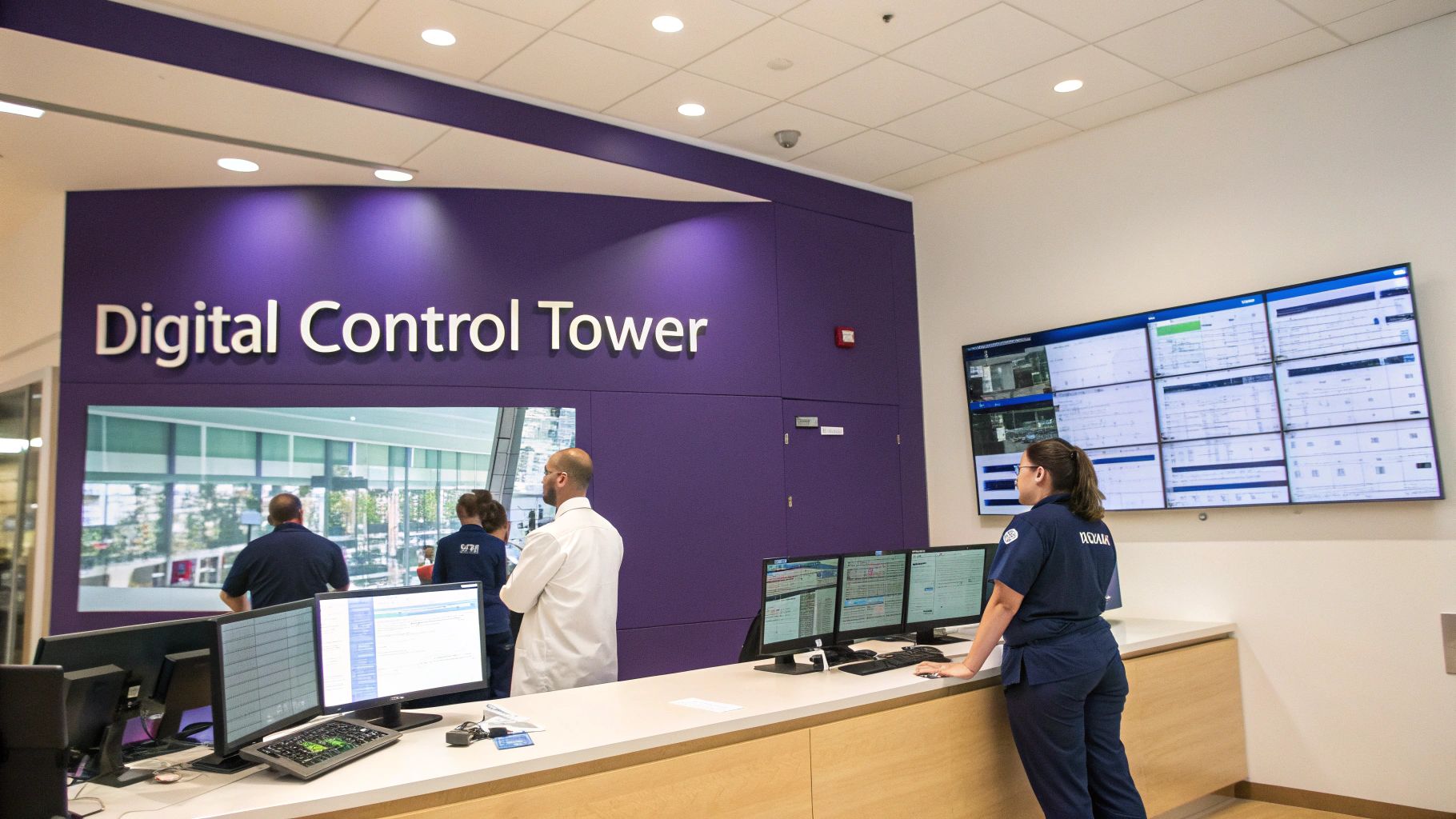
A busy hospital can feel a lot like an airport. You have patients, doctors, nurses, and supplies all moving around constantly, much like planes, passengers, and crew. Without a central command, it would be pure chaos. This is exactly where hospital administration software comes in—it’s the digital air traffic control for the entire medical center. It's the sophisticated system that orchestrates the complex dance of healthcare delivery, ensuring every element is precisely where it needs to be, exactly when it's needed.
This kind of software coordinates all those moving parts to keep operations running smoothly, safely, and efficiently. It’s so much more than a shared calendar or a fancy spreadsheet; it’s a powerful, multifaceted system architected to manage the entire patient journey and the vast administrative workload that supports it. From resource allocation and staff scheduling to regulatory compliance and supply chain management, it provides a single, unified platform to oversee and optimize every facet of the hospital's day-to-day functions.
From Basic Tools to Essential Infrastructure
The evolution of this technology really tells the story of its importance. Decades ago, hospital management systems were rudimentary, often limited to simple accounting and billing functions. Now, they've grown into complex, interconnected platforms that are absolutely essential for modern healthcare. Today, this software isn't just another IT purchase; it's a fundamental infrastructure investment, as critical as the medical equipment in an operating room. It is the digital bedrock upon which efficient, safe, and effective patient care is built.
The market size backs this up. In 2024, the global hospital management software market was valued at over USD 25 billion, and it's expected to keep growing fast. This boom is fueled by the constant pressure on hospitals to reduce operational expenses, improve patient outcomes, enhance data security, and find real solutions for the pervasive issue of staff burnout. You can dig into more of the data on this trend over at Market Research Future. This growth underscores the industry's recognition that robust administrative software is no longer a luxury but a necessity for survival and success.
A well-implemented administration platform is the backbone of a modern hospital. It directly addresses critical challenges like long patient wait times, administrative backlogs, and the risk of human error that can compromise patient safety.
What This Software Actually Solves
So, what does this software do on a practical level? It's designed to fix the real-world headaches that bog down healthcare facilities every single day. It brings structure and automation to incredibly complex workflows, making sure important details don't get missed in the shuffle of a busy hospital environment. By digitizing and streamlining processes, it transforms chaotic, paper-based systems into efficient, transparent, and manageable operations.
Here are a few of the key problems it tackles:
- Inefficient Patient Flow: It helps manage appointments, admissions, transfers, and discharges to cut down on wait times, reduce bed turnover delays, and make sure clinical resources are used effectively.
- Administrative Overload: It automates repetitive, time-consuming work like billing, insurance eligibility verification, and claims processing, which frees up skilled administrative staff to focus on higher-value, patient-facing tasks.
- Poor Communication: It creates a single source of truth for all non-clinical data, ensuring that everyone—from the front desk to the clinical staff to the billing department—is looking at the same up-to-date information, eliminating dangerous communication gaps.
- Revenue Cycle Delays: It smooths out the entire process from patient registration to final payment, significantly cutting down on billing mistakes, reducing claim denials, and speeding up reimbursements to improve the hospital's cash flow.
By solving these core issues, the software creates a more resilient, efficient, and patient-focused environment. This solid foundation is what allows more advanced tools, like Simbie AI, to plug in and add a layer of intelligent automation to make things even better, further enhancing productivity and patient satisfaction.
Exploring the Core Software Modules
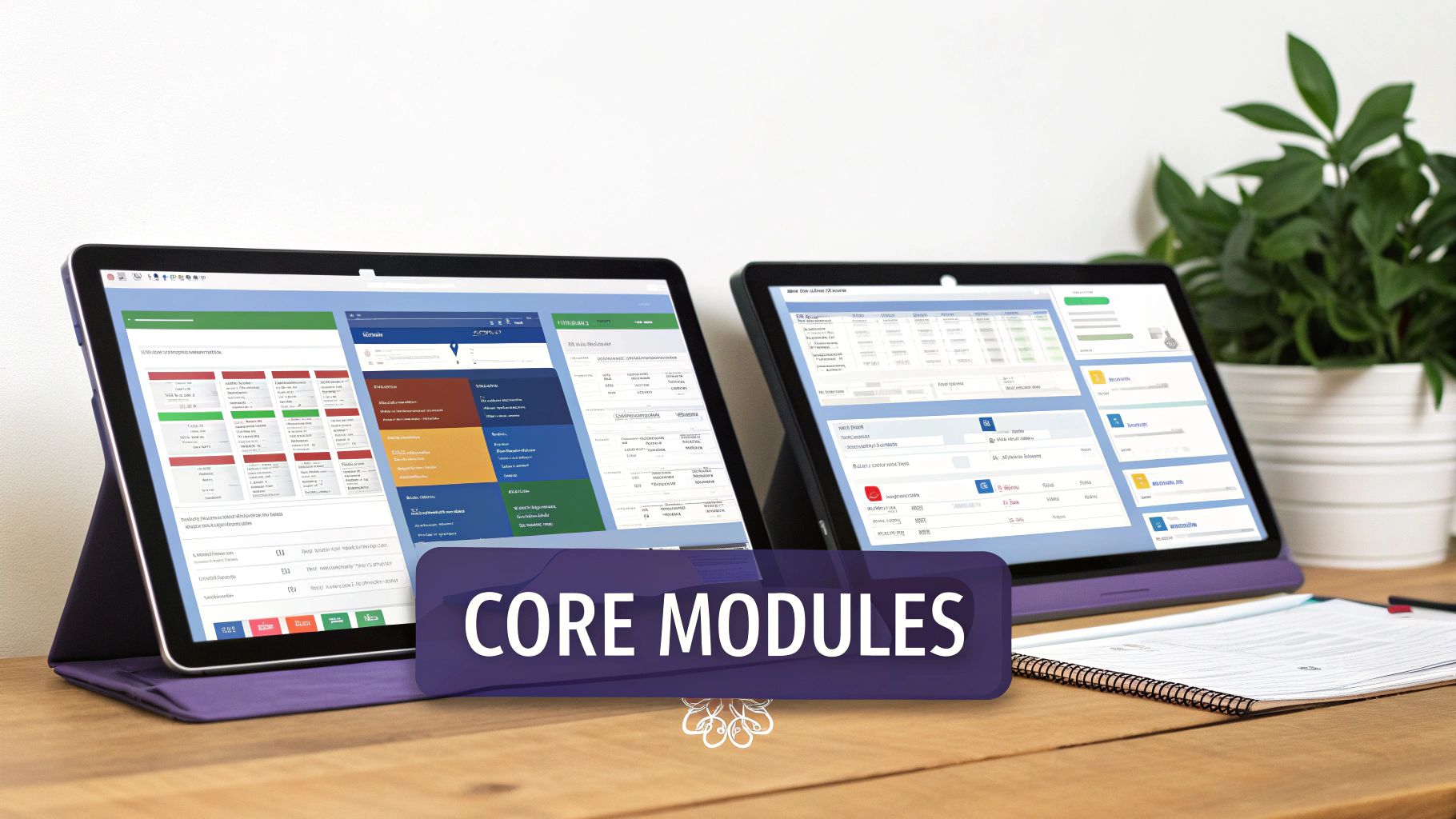
A great hospital administration system isn't one giant piece of software. It’s more like a team of specialists working together. Think of it as a set of interconnected modules, where each one handles a specific job—like different departments in the hospital itself. This modular architecture allows a hospital to implement the features it needs most and scale the system as its requirements evolve.
Their real strength isn't just what they do on their own, but how they communicate with each other. This seamless integration creates a smooth, unified workflow that keeps the entire facility running like a well-oiled machine. These essential building blocks usually fall into three main categories: patient management, clinical operations, and financial administration, each containing specialized sub-modules.
Patient Management and Scheduling
This module is essentially the digital front door to your practice. It manages everything about a patient’s administrative journey, from the moment they book an appointment to their registration, admission, and follow-up care. This is where you make your first impression, and efficiency here can make all the difference in patient satisfaction and retention. This module often includes features for managing patient demographics, insurance details, and communication preferences, creating a comprehensive profile for each individual.
The star of this module is patient scheduling. And it's so much more than a digital calendar. A smart scheduling tool helps you optimize a doctor's time, manage resources like operating rooms, cut down on no-shows, and improve patient throughput. For example, the system can automatically send appointment reminders via text or email, a simple trick that has been shown to reduce missed appointments by over 30%, directly impacting the hospital's revenue and efficiency.
Clinical Operations and EMR Integration
While the administration software keeps the business side running, the Electronic Medical Record (EMR) or Electronic Health Record (EHR) system is the heart of patient care. The two systems must be perfectly in sync. Any quality hospital administration software needs to talk flawlessly with the EMR, ensuring patient information moves securely and accurately between the front desk, the billing office, and the exam room. This interoperability is non-negotiable for delivering safe and coordinated care.
Without that connection, you get information silos, which can be dangerous and inefficient. A note from a scheduler about a patient’s need for an interpreter, for instance, should be immediately visible to the clinical staff in the EMR. This is what coordinated care looks like. Many platforms offer a suite of practice management software features specifically designed to bridge this critical gap, ensuring that administrative actions and clinical decisions are always based on the same complete set of information.
A truly integrated system means booking an appointment can automatically trigger an insurance eligibility check in the billing module while simultaneously preparing a new patient record in the EMR. This interconnectedness is what turns separate tasks into a single, efficient workflow.
Financial Administration and Billing
The financial health of any hospital hinges on its revenue cycle management (RCM). That’s where the billing and invoicing module comes in. It automates the entire complex process—from charge capture and coding to creating and submitting insurance claims, processing payments, and managing patient balances. This module is the financial engine of the hospital, ensuring that services rendered are accurately billed and promptly paid for.
This module is built to catch the human errors that often lead to costly claim denials. It can flag coding mistakes, check for missing pre-authorizations, and verify patient insurance information before a claim goes out the door. It tracks every dollar from start to finish. By automating these financial tasks, the software not only speeds up cash flow and reduces accounts receivable days but also gives administrators a real-time, transparent snapshot of the hospital's financial health, enabling better forecasting and strategic planning.
To help you see how these pieces fit together, here is a quick breakdown of the most common modules you'll find in a comprehensive hospital administration platform.
Essential Modules in Hospital Administration Software
A breakdown of the core components, their primary functions, and the key benefits they deliver to a healthcare practice.
| Module | Primary Function | Key Benefit for the Practice |
|---|---|---|
| Patient Registration & Scheduling | Manages patient demographics, appointments, and check-in/out processes. | Reduces wait times and minimizes no-shows with automated reminders. |
| Electronic Medical Records (EMR) | Stores and manages all clinical patient data, including diagnoses and treatment plans. | Centralizes patient information for better-coordinated and safer care. |
| Billing & Claims Management | Automates the creation, submission, and tracking of insurance claims. | Accelerates revenue cycles and reduces claim denial rates. |
| Inventory & Pharmacy Management | Tracks medical supplies, equipment, and pharmaceuticals from purchase to use. | Prevents stockouts, reduces waste, and ensures medication availability. |
| Lab & Radiology Information Systems | Manages orders, results, and reporting for laboratory and imaging tests. | Speeds up diagnostic turnaround times and improves accuracy. |
| Reporting & Analytics | Gathers data from all modules to generate insights on operational performance. | Provides data-driven insights for strategic decision-making and improvements. |
These modules are the engine of a modern hospital, working behind the scenes to ensure everything from patient care to the bottom line is managed effectively. Their seamless interaction is what unlocks the true potential for operational excellence and superior patient care.
So, What’s the Real Payoff of a System Upgrade?
Upgrading your hospital administration software isn't just about getting a few new bells and whistles. It's about fundamentally rethinking and re-engineering how your facility runs, from the front desk to the back office, and from the supply closet to the operating room. The right system creates a positive ripple effect, making your operations smoother, your finances stronger, your staff more engaged, and your patient experience genuinely better.
Let's break down the three core areas where you'll see the biggest and most tangible impact.
You'll Run a Tighter Ship
One of the first things you’ll notice is the power of automation. A modern hospital administration software takes over the monotonous, time-draining, and error-prone tasks that bog down your team. This automation frees up your valuable human resources to focus on what really matters—the complex, critical work that requires a human touch, empathy, and problem-solving skills.
Think about the nightmare of prior authorizations. Manually chasing approvals means endless phone calls, navigating complex payer portals, and mountains of paperwork. An automated system can fire off these requests electronically, track them in real-time, and flag any that require follow-up, turning a multi-hour ordeal into a quick, a few-minute task. The best part? It dramatically cuts down on the human error that leads to delays in care and claim denials.
This boost in operational efficiency means your team can get more done without feeling stretched thin. Your daily workflow becomes more predictable and less chaotic, with administrative chores humming along in the background, allowing for a calmer, more controlled, and more productive work environment.
"When your administrative tools fight your staff at every turn, burnout is inevitable. Good software isn't just for productivity—it's essential for keeping your team happy and focused on patients, not paperwork."
Your Finances Will Get Healthier
The financial upside is just as compelling. By automating your billing and claims, you speed up the entire revenue cycle. The software acts as a diligent quality check, ensuring claims are clean, complete, and coded correctly the first time. This simple change drastically reduces costly denials and the frustrating, time-sucking appeals process that follows, directly impacting your bottom line.
A single typo in a medical code or a patient's date of birth can delay a payment by weeks or even lead to a permanent write-off. A good system catches these potential slip-ups before the claim even goes out the door. This leads to some major financial wins:
- Faster Reimbursements: Clean claims get paid faster, reducing the number of days in accounts receivable. It’s that simple.
- Fewer Denials: Automation nips the common errors that cause rejections in the bud, increasing your first-pass claim acceptance rate.
- Better Cash Flow: A steady, predictable revenue cycle means you always have a clear view of your financial standing and can manage resources more effectively.
Your Patients Will Notice the Difference
At the end of the day, all these operational and financial gains lead to one thing: a better experience for your patients. When your front office is a well-oiled machine, patients feel it from the moment they walk in or make their first call. Shorter waits, fewer scheduling mix-ups, accurate billing, and clear communication all add up to happier, more satisfied patients who are more likely to return and recommend your facility.
Simple things like a streamlined check-in process, an automated appointment reminder, or an online portal for paying bills make a world of difference. When patients can get what they need without sitting on hold, wrestling with confusing forms, or receiving surprise bills, their entire perception of your practice improves. This focus on a smooth, hassle-free journey is how you build lasting trust and loyalty in a competitive healthcare market.
How AI Is Changing the Game in Hospital Administration
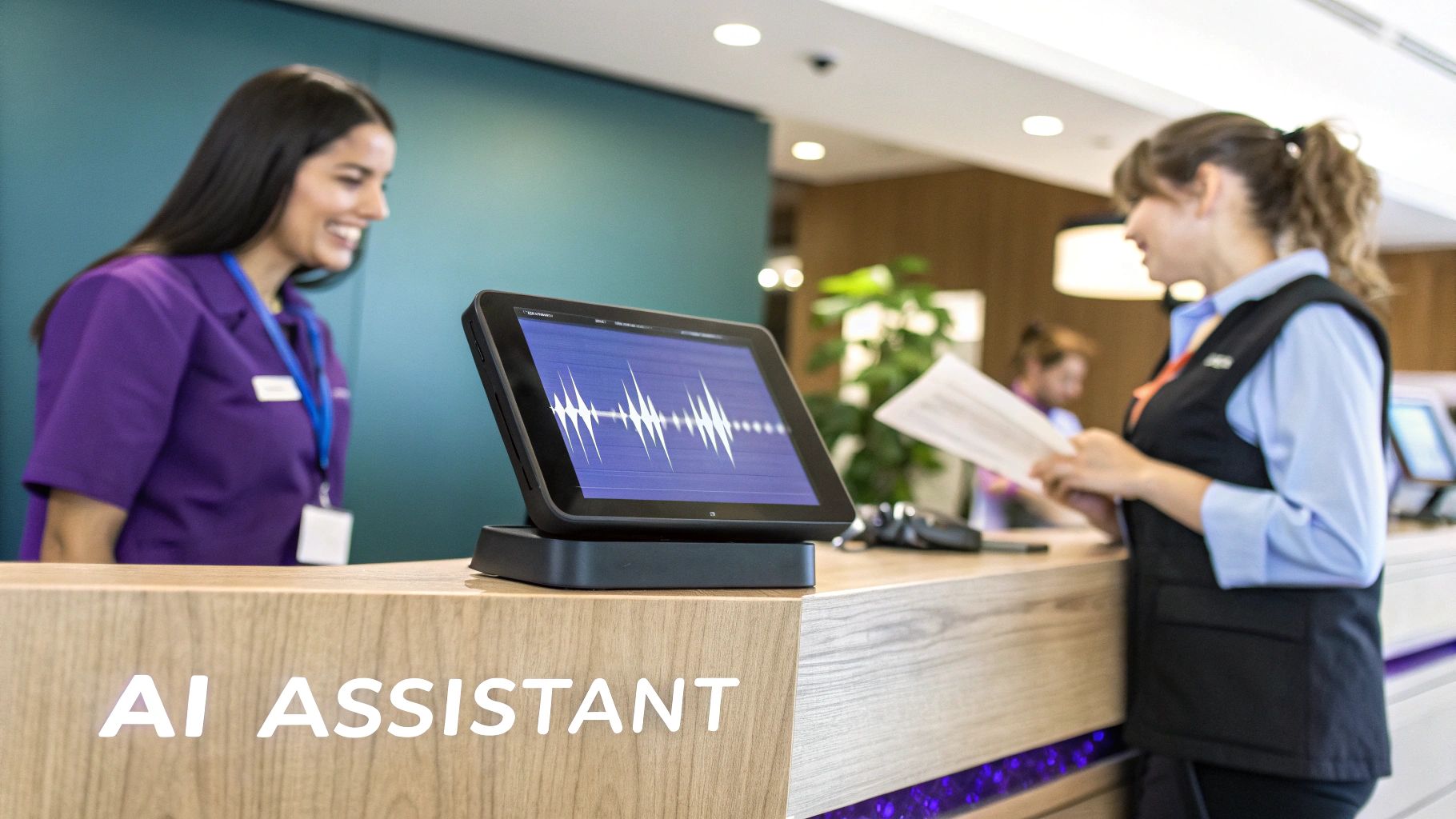
Artificial intelligence isn't some far-off concept anymore; it's the next logical step for making hospitals run better. Think of it as a powerful partner for your staff. AI doesn’t replace people—it gives every team member a “digital assistant” to take over the repetitive, soul-crushing tasks that lead to administrative bottlenecks, staff burnout, and costly errors. AI augments human capabilities, allowing your team to work at the top of their licenses.
The best part? This technology plugs right into the hospital administration software you already use. There's no need to rip out your entire system and start from scratch. Modern AI solutions are designed for seamless integration, enhancing the value of your existing IT investments.
For example, an AI-powered voice agent like Simbie AI can field patient calls around the clock. It can handle appointment requests, refill prescriptions, answer frequently asked questions, and route complex issues to the appropriate staff member. This lets your front desk staff give their full attention to the patients right in front of them, improving both efficiency and the in-person experience. It's a perfect example of the healthcare SaaS trend toward specialized, intelligent tools.
This move toward smarter, cloud-based tools is exploding. The global market for healthcare enterprise software was valued at a staggering $43.62 billion in 2024, and it’s expected to shoot up to $158.63 billion by 2034. That tells you hospitals are serious about investing in tech that smooths out the entire patient journey and automates administrative burdens.
What AI Can Actually Do for Your Admin Team
AI’s impact reaches far beyond just answering the phone. It's fundamentally changing core administrative jobs, making them faster, more efficient, and far more accurate. By connecting with your existing EMR and practice management system, AI can handle high-volume work that used to tie up staff for hours, allowing them to focus on more complex and patient-centric responsibilities.
Here are a few real-world examples:
- Smarter Claim Processing: Before a claim even goes out the door, AI algorithms can scan it for common coding errors, missing information, or inconsistencies that usually trigger a denial. This simple step drastically boosts the number of claims approved on the first try.
- Hands-Off Prior Authorizations: The dreaded prior authorization process—a huge time sink and a major source of frustration—can be almost completely automated. AI can submit the initial request, track its status with payers, and follow up without anyone having to lift a finger.
- Predictive Scheduling: AI can analyze your clinic's historical data to predict no-shows, identify patterns in appointment cancellations, and find the best time slots to offer. It can also juggle complex provider schedules to optimize resource utilization and ensure every minute of clinic time is put to good use.
Adding AI Without Causing Chaos
One of the biggest wins with modern AI is that it’s designed to enhance, not replace. These tools are built to play nicely with the systems you’ve already invested in. They use secure connections, known as Application Programming Interfaces (APIs), to talk directly to your EMR and other administrative software, essentially making your existing systems much more powerful and intelligent.
The real magic of AI in healthcare administration is its ability to handle the high-volume, low-skill tasks. This frees up your talented professionals to focus on what they do best: patient care and solving complex problems.
This kind of smooth integration means you get a massive upgrade in capability without the headache, cost, and disruption of a full system migration. It’s a strategic move that makes your whole operation smarter and more agile, allowing you to adapt quickly to changing demands. To get a closer look at how this works, check out our guide on the role of AI in healthcare administration.
Choosing the Right Administration Software
Picking the right hospital administration software is a big deal. It’s a strategic decision that will echo through every department of your facility for years to come. Think of it less like buying a new tool and more like choosing a long-term partner for your entire operation. A poor choice can lead to staff frustration, operational inefficiencies, and wasted investment, while the right choice can be transformative.
To make a smart choice, you have to look past the shiny feature lists and get down to what really matters for your specific needs. I've found it helps to evaluate potential vendors on three core pillars that really determine if a system will be a help or a headache in the long run.
Core Evaluation Criteria
Your evaluation needs to start with a practical, real-world perspective. Forget the marketing jargon for a moment and focus on scalability, integration, and usability. These are the things that make or break a system in a real-world hospital setting.
-
Scalability: Can this software grow with you? The last thing you want is to invest in a system only to outgrow its capabilities in a few years. It needs to be able to handle more patients, more staff, new service lines, and even additional locations without skipping a beat or requiring a costly replacement.
-
Integration: How well does it play with your existing tech ecosystem? Seamless EMR system integration isn't just a nice-to-have; it's an absolute must. Your new software has to talk to your clinical tools, lab systems, and financial platforms to avoid creating dangerous data silos and disrupting patient care workflows.
-
Usability: Can your team actually use it effectively? A system packed with powerful features is worthless if your staff finds it clunky, confusing, or counterintuitive. A clean, logical user interface means less training time, higher adoption rates, and gets everyone from the front desk to the billing office on board quickly.
Building a Practical Vetting Process
Don't just wing it. A structured process for comparing vendors is your best friend here. Kick things off with a thorough needs analysis. Get people from every department—clinical, administrative, and financial—in a room to map out exactly what you need, what your current pain points are, and what your future goals look like. This creates a clear scorecard for evaluation.
Once you have a shortlist of potential vendors, insist on live, customized demos that use your hospital’s actual workflows, not some generic sales pitch. It's also smart to apply some actionable IT vendor management best practices from the get-go to set yourself up for a healthy, long-term partnership. Ask for references from hospitals similar to yours in size and specialty.
The best way to vet a system is to see it perform with your own scenarios. A vendor who truly believes in their product won't hesitate to set up a custom demo for your team.
This hands-on approach lets your staff get a real feel for the software's user experience, so you can spot potential problems, assess its true capabilities, and make an informed decision before you sign any contracts.
Evaluating Modern Add-Ons and ROI
As you compare options, think about the value of modern features, especially those powered by AI. With staffing shortages hitting hospitals hard across the country, tools that automate workforce management, patient communication, and revenue cycle tasks are becoming essential, not just optional. The market for these systems is expected to hit USD 5.20 billion by 2034, which tells you precisely where the industry is heading to combat these challenges.
When you look at AI-driven tools like Simbie AI, the return on investment (ROI) is easy to see and quantify. You can measure it in concrete terms: fewer staff hours spent on phone calls and prior authorizations, a reduction in claim denials, increased patient appointment volumes, and better access for your patients. This turns the software from a simple expense into a clear operational win, which makes building a compelling business case for it that much easier.
Got Questions? We've Got Answers
Thinking about hospital administration software can definitely spark a few questions. The landscape is complex, and it's a significant investment, so it's natural to want more clarity. Let's break down some of the most common ones to give you the confidence you need to move forward.
What’s The Difference Between Hospital Administration Software and an EMR?
It's a great question, and the distinction is crucial for understanding how a hospital's technology stack works.
Think of an Electronic Medical Record (EMR) as a patient's digital medical file cabinet. It’s where all the clinical information lives—diagnoses, lab results, allergies, medications, and treatment notes. Its primary purpose is to support clinical decision-making and document the care a patient receives. It's laser-focused on patient health.
Hospital administration software, on the other hand, is the central nervous system for the entire facility. It manages everything around the clinical care: patient scheduling, staff assignments, billing, insurance claims, inventory management, and payroll. It’s the operational backbone that keeps the hospital running smoothly as a business.
So, while an EMR is all about the patient's health journey, the administration software is about the business of healthcare. The best systems make these two talk to each other seamlessly, so a clinical action in the EMR can trigger an administrative or billing action in the HMS, and vice versa.
How Long Does It Take to Get This Software Up and Running?
The timeline for implementation really depends on the size and complexity of your facility and the software you choose. There's no one-size-fits-all answer.
A smaller clinic or a single-specialty practice might get fully set up in a few weeks to three months. For a large, multi-department hospital with complex legacy systems, you could be looking at a significant project that takes six months, a year, or even longer.
Things like migrating all your data from an old system, customizing the software to fit your unique workflows, integrating with other third-party systems, and getting every staff member properly trained are the big time factors. The good news is that modern cloud-based tools and specialized AI add-ons often have much quicker setup times because there's less on-premise hardware to install and they're built with modern APIs to integrate more easily from the get-go.
Is This Software Actually Worth It For a Small Practice?
Absolutely. In many ways, small practices stand to gain the most from modern hospital administration software. The old days of needing a massive budget and a dedicated IT team are over, thanks to scalable, affordable, and user-friendly cloud-based options (SaaS).
Think about it: in a small clinic, every team member is juggling multiple roles. Automating things like appointment reminders, billing, insurance verification, and patient intake doesn't just save a little time—it frees up huge chunks of the day. This lets your team step away from the paperwork and focus on what they do best: taking care of patients and providing a personal touch that larger institutions often struggle with.
The right software gives a small practice the operational power of a much larger one. It automates the busywork, allowing a tight-knit team to pour its energy directly into patient care and experience.
How Does an AI Tool Like Simbie AI Fit in With My Current Software?
This is a common point of confusion, but a critical one to understand. An AI platform like Simbie AI isn't designed to rip out and replace your existing systems. Instead, it acts as a smart, automated layer on top of them, making the tools you already use even more powerful and efficient.
It connects to your current software through secure channels called APIs (Application Programming Interfaces). Here’s a real-world example: a patient calls to book an appointment. Simbie AI’s voice agent can securely tap into your scheduling module via its API, find an open slot that works based on the provider's template, book it, and even add a note to the patient’s file in the EMR. All of this happens in real-time, without any human intervention.
Essentially, it takes over the repetitive, time-consuming tasks your staff would normally have to do inside the software, letting them focus on more complex patient needs, escalations, and in-person interactions. It’s about augmentation, not replacement.
Ready to see what intelligent automation can do for your practice's workflow? Simbie AI offers a clinically-trained voice AI that handles patient calls, scheduling, refill requests, and more. Free up your staff to focus on what truly matters—your patients. Discover how Simbie AI can cut administrative overhead by up to 60%.