
A claim gets denied, the chart gets kicked back, and everyone in the office says the same thing: “But the patient has high blood pressure.” That's the problem with high blood pressure ICD 10 coding in small and mid-sized practices. The diagnosis may be clinically familiar, but the coding depends on exact wording, timing, and relationships documented in the note. If you run an internal medicine, GI, or dermatology practice, this guide will help you tighten documentation, choose the right code path, and avoid preventable rework.
Why Hypertension Coding Is More Than Just I10
Most denials around hypertension don't happen because the team forgot the code. They happen because the chart note doesn't support the code that was chosen. A single high reading gets treated like a chronic diagnosis. Heart disease is listed, but the claim still goes out with I10. Chronic kidney disease is in the assessment, but nobody adds the required code chain.
That gap matters because hypertension is common at scale. As of 2024, an estimated 1.4 billion adults aged 30 to 79 years worldwide have hypertension, and about 44% of those affected, or 600 million adults, remain unaware of their condition according to the World Health Organization hypertension fact sheet. In practice terms, that means intake, diagnosis, and documentation all carry weight, not just billing.
Where practices get tripped up
Independent practices usually feel this in three places:
- Front-desk intake: Staff hear “high blood pressure” on the phone and pre-load the wrong diagnosis.
- Clinical notes: Providers document findings, but not the diagnostic status clearly enough for coding.
- Claim review: Billers see “HTN” in one part of the chart and “high BP” elsewhere, then have to guess which one controls.
Clean coding starts upstream. If the note is vague, the claim is vague.
That's why the workflow matters as much as the code set. Teams that want fewer chart corrections usually need better prompts inside documentation, better intake scripting, and clearer provider habits. A focused clinical documentation improvement workflow helps because it turns “patient had high readings” into language a coder can use.
There's also a practical admin point here. When enrollment data, rendering provider details, or claim attribution are off, simple coding fixes still won't save the claim. For new billers and office managers, this Resource for provider NPIs is useful to keep nearby when you're checking provider identity data during setup or troubleshooting.
The Foundational Code Essential Hypertension I10
A common denial starts with a chart that says “BP high” in the vitals, “HTN” on the medication list, and nothing in the assessment that clearly establishes the diagnosis. The biller picks I10, the payer reviews the note, and the practice ends up correcting a claim that could have gone out clean the first time.
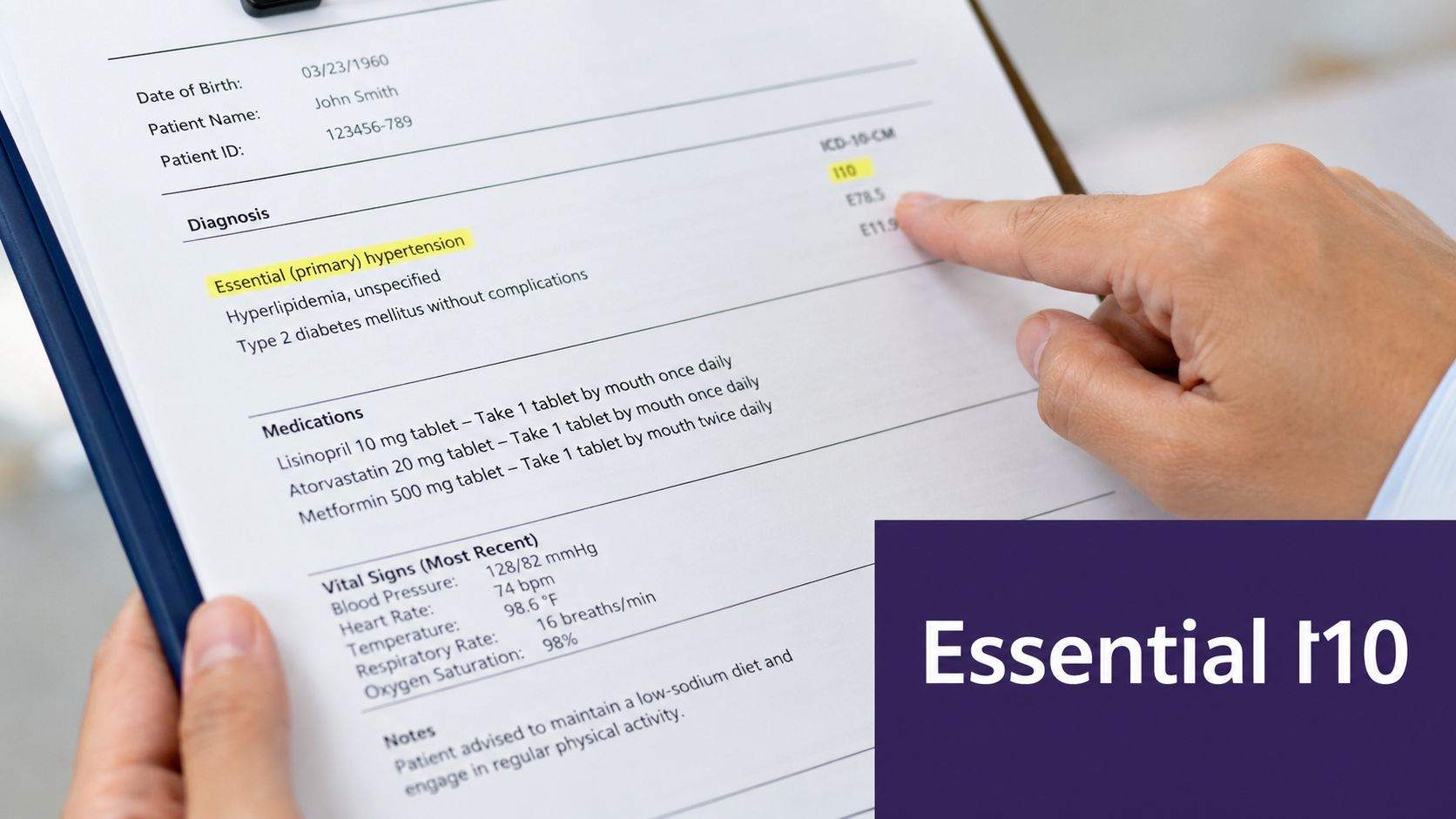
I10 is the ICD-10-CM code for essential (primary) hypertension. In office coding, it belongs in charts where the provider has documented hypertension as the patient's diagnosis and the record does not point you to a more specific hypertension category.
When I10 is appropriate
Assign I10 when the documentation supports all three of these points:
- The provider states hypertension, essential hypertension, or primary hypertension in the assessment or problem list with clear diagnostic intent.
- The condition is not documented as secondary hypertension.
- The record does not support a hypertensive heart disease or hypertensive chronic kidney disease combination code instead.
That third point is where new coders often miss the operational gap. The physician may be clinically managing “hypertension” in a broad sense, but the claim has to match the most accurate code family supported by the note. If the assessment names heart or kidney involvement tied to hypertension, I10 may be too general.
What good support looks like in the note
The wording in the assessment drives the code. “Essential hypertension, continue lisinopril” supports I10. “BP high today” does not. “History of high blood pressure” is also weak support unless the provider makes the current diagnosis clear.
A billable diagnosis needs diagnostic language, not just clinical context. That difference matters during audits and payer review because coders cannot infer a chronic diagnosis from vitals, refill history, or a problem list entry that conflicts with the visit note.
Examples that support I10:
- “Essential hypertension, controlled on current medication.”
- “Primary hypertension, follow up in 3 months.”
- “Hypertension, continue amlodipine.”
Examples that do not support I10 by themselves:
- “BP 148/92 in office.”
- “Monitor blood pressure at home.”
- “History of high blood pressure.”
In practice, I train staff to look first at the assessment and plan, then confirm that the rest of the chart does not create a coding conflict. Smart note templates help here because they prompt providers to choose diagnostic language instead of leaving the biller to interpret shorthand. A structured progress note template for hypertension documentation reduces those handoff problems and cuts down on claim rework.
Distinguishing Elevated BP from Diagnosed Hypertension
A patient checks in with a blood pressure of 168/96. The MA records the vitals, the provider writes “recheck in 2 weeks,” and the claim goes out with I10. That is a preventable denial pattern. The chart captured an abnormal reading, but it did not clearly support a hypertension diagnosis.
For coding, the deciding factor is the assessment language in the note. A single high value, even a markedly high one, supports R03.0, Elevated blood-pressure reading, without diagnosis of hypertension, unless the provider documents hypertension as the current diagnosis. Coders should not fill in that gap from the vitals, the medication list, or a history item buried in the HPI.
Use the documented diagnosis status, not the blood pressure number alone
This distinction matters in day-to-day operations because the clinical team and the billing team often read the same visit differently. Clinical staff may see a pattern developing. Billing staff need the provider to say whether that pattern has become a diagnosis.
| Documentation scenario | Coding direction |
|---|---|
| Elevated reading documented, follow-up planned, no hypertension diagnosis stated | R03.0 |
| Provider documents primary, essential, or established hypertension | I10 |
Borderline cases are where errors happen. White-coat readings, first-visit spikes, missed medications, pain-related elevations, and home logs under review all require precise wording. If the provider is still evaluating, the note should stay at the finding level. If the provider is making the diagnosis today, the assessment should say that directly.
Chart language that creates coding trouble
These phrases leave too much room for interpretation:
- “High BP, monitor”
- “High in clinic”
- “Return for recheck”
- “Home readings reviewed”
Those statements support follow-up. They do not, by themselves, establish I10.
Clearer documentation supports cleaner coding:
- “Primary hypertension”
- “Essential hypertension diagnosed today”
- “Established hypertension, continue losartan”
- “Hypertension remains uncontrolled, medication adjusted”
I tell new billers to look for one operational answer in the assessment and plan: has the provider stated a diagnosis, or documented only a current finding? That framing keeps the review focused without forcing a yes-or-no shortcut into the note itself.
A short sentence can prevent rework. “High BP today without diagnosis of hypertension” supports R03.0. “Hypertension confirmed, start amlodipine” supports I10.
The workflow problem usually starts upstream. Intake may collect prior readings, outside diagnoses, and current antihypertensive use, but if the EMR does not separate history from today's assessment, the provider may leave the visit note ambiguous. A structured progress note template for hypertension follow-up and diagnosis documentation helps prompt the provider to document three separate elements clearly: the measured reading, the clinical impression, and the diagnosis status for billing.
When those elements are distinct, coders do not have to infer intent. Claims go out cleaner, and audit risk drops with them.
Coding Hypertensive Heart and Kidney Disease
Once heart disease or chronic kidney disease enters the chart, I10 often stops being the right answer. In such cases, many otherwise careful teams undercode or code the wrong category altogether.
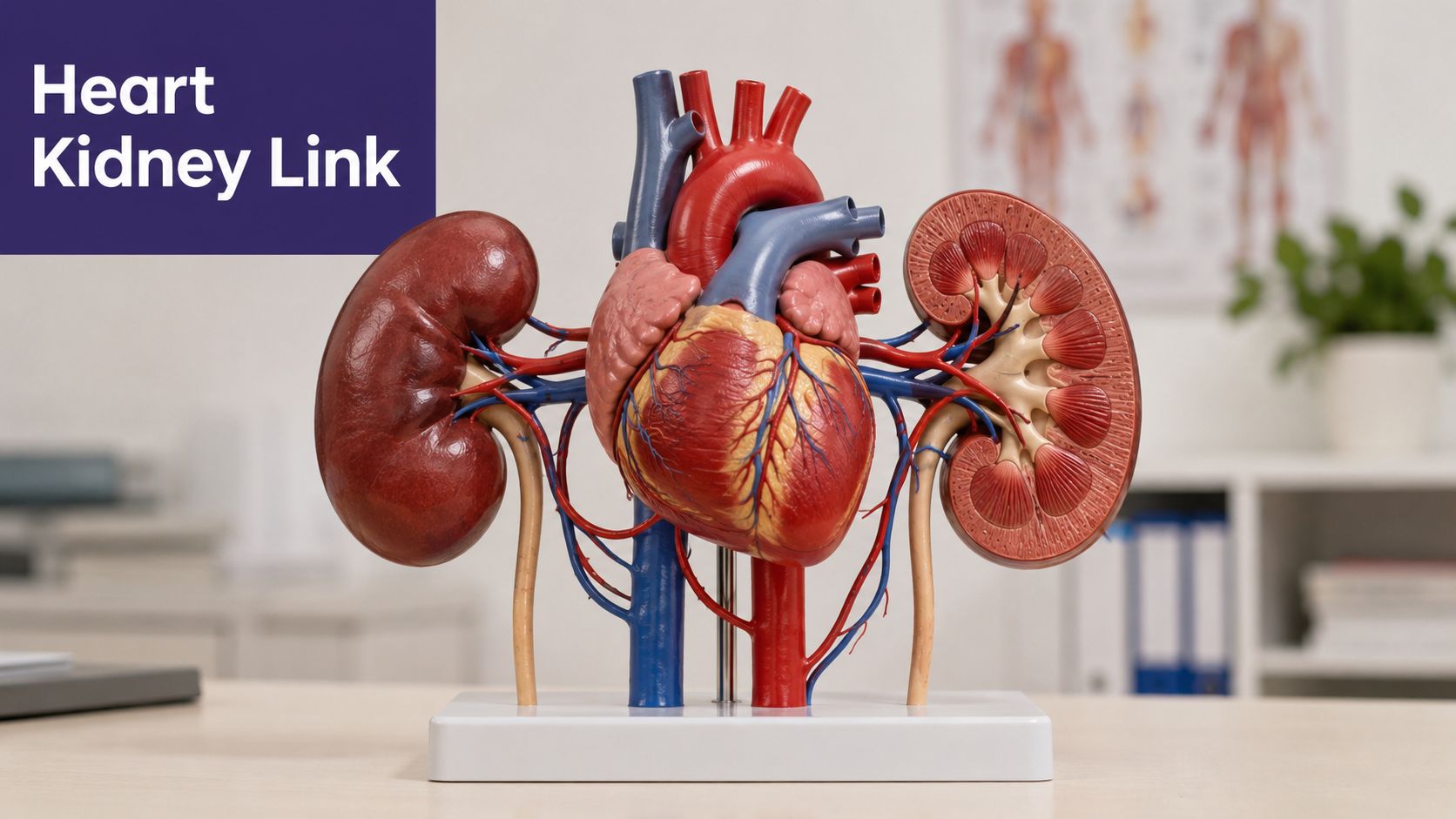
The key concept is the combination code. When hypertension coexists with cardiac or renal pathology, ICD-10 uses the I11, I12, or I13 categories rather than standalone I10. The coding logic is not optional. It follows documented relationships and official assumptions.
Hypertensive heart disease
The Patient Notes explanation of ICD-10 hypertension coding states that ICD-10 assumes a causal relationship between hypertension and heart disease when both coexist, unless the provider explicitly documents they are unrelated. That means if the patient has hypertension plus heart disease such as cardiomegaly, cardiomyopathy, or heart failure, coders should move to the I11 category rather than keep using I10.
Operationally, vague assessments create trouble. “HTN, CHF” sitting side by side in the note is enough to trigger a closer review. If the provider does not state the conditions are unrelated, the default path is hypertensive heart disease coding.
Hypertensive chronic kidney disease and combined heart plus CKD
Kidney disease adds another layer. Per the verified coding guidance, ICD-10 assumes a causal relationship between hypertension and CKD unless there is contradictory documentation. That means the coder should use an I12 code plus a secondary code for the CKD stage. If both heart disease and CKD are present with hypertension, the category moves to I13.
Here's the practical takeaway:
- Use I11 when hypertension coexists with heart disease and the documentation does not break that relationship.
- Use I12 when hypertension coexists with CKD, plus the secondary CKD stage code.
- Use I13 when hypertension, heart disease, and CKD are all part of the documented picture.
If the note says hypertension and CKD, the coder should be asking for CKD stage support, not defaulting back to I10.
For teams that want the underlying federal coding framework in one place, the CMS ICD-10 resource center is a reasonable reference point for official coding materials and updates.
Documentation that prevents denials
The difference between a billable, defensible claim and a delayed one often comes down to one sentence in the assessment.
Compare these examples:
- Weak: “HTN, kidney disease”
- Better: “Hypertension with chronic kidney disease”
- Strongest: “Hypertension with stage 3 chronic kidney disease”
The stronger version reduces coder guesswork and supports the required code chain more directly. That's what clean documentation looks like in real practice.
Navigating Secondary and Resistant Hypertension Codes
Not every hypertension diagnosis is essential hypertension. When the high blood pressure is caused by another condition, the coding path changes.
The verified coding guidance from Medical Billers and Coders on hypertension ICD-10 coding states that secondary hypertension requires an I15 category code plus an additional code for the underlying etiology. It also states that resistant hypertension is coded as I1A.0, with a required code first rule for the primary hypertension type.
Secondary hypertension
This is the category to think about when the provider identifies a cause such as renal artery stenosis or another underlying condition driving the blood pressure problem. In these cases, using I10 alone misrepresents the chart.
The practice habit to build is simple: if the provider documents a cause, the coder should look for the I15 path and the paired underlying-condition code.
Resistant hypertension
Resistant hypertension creates a sequencing issue, not just a diagnosis issue. The I1A.0 code does not stand alone in the same way new coders often expect. The primary hypertension type must be listed first.
That sequencing requirement matters because claim edits and downstream audits often catch errors that started as documentation shortcuts. If the provider writes only “resistant hypertension” without clearly stating the underlying hypertension type, the coder has to chase clarification.
What helps in daily operations
A short internal checklist usually works better than a long policy memo:
- Check for cause: If the note identifies an underlying etiology, review for I15 plus the additional code.
- Check sequencing: If resistant hypertension is documented, confirm the primary hypertension code appears first.
- Check the assessment wording: Notes that say only “HTN, difficult to control” may not support the same coding path as a clearly documented resistant hypertension diagnosis.
In this context, coding accuracy depends on provider language, not coder intuition.
Special Cases in Pregnancy and Gestational Hypertension
Pregnancy changes the coding family. When the patient is pregnant, hypertension coding moves into the O10 to O16 range in Chapter 15 rather than the I10 to I15 series used for the general adult population.
For office teams, the key rule is straightforward: do not default to I10 through I15 for a pregnant patient with hypertension. If the patient has pre-existing hypertension complicating pregnancy, gestational hypertension, or a hypertensive disorder such as pre-eclampsia, the chart needs the pregnancy-related code set.
Practical distinction for the chart
A few examples of the thinking process help:
- A patient with known essential hypertension who is now pregnant belongs in the pregnancy hypertension code family, not the routine essential hypertension bucket.
- A patient who develops gestational hypertension after pregnancy is established also belongs in the O-series.
- If the practice sees the patient for another specialty issue, the pregnancy status still matters if hypertension is being assessed and billed.
This comes up less often in dermatology and GI than in internal medicine, but when it does come up, miscoding tends to happen because staff rely on muscle memory. They know hypertension. They forget pregnancy changes the chapter and the logic.
What works in workflow
The fix is not complicated. Intake, rooming, and provider templates should make pregnancy status visible before the diagnosis is finalized. When that field is buried, the claim often reflects the wrong category.
A simple rule for new staff is worth repeating: if pregnancy is part of the clinical picture, pause before selecting any routine hypertension code.
Common Coding Pitfalls and Documentation Tips
Most hypertension denials can be traced back to a short list of repeat mistakes. They aren't dramatic. They're ordinary charting habits that force the billing team to clean up ambiguity after the visit.

The documentation issue that trips up many practices is described well in this hypertension documentation guide from Outsource Strategies. A major challenge is the lack of clarity on what evidence moves a case from R03.0 to I10, including uncertainty around whether separate readings across visits are needed. That ambiguity often leads to incorrect coding and claim denials.
The errors that show up over and over
- Using I10 for a one-time high reading: If the provider didn't diagnose hypertension, stay with the finding, not the disease code.
- Missing the combination category: If heart disease or CKD is present, I10 may no longer be appropriate.
- Forgetting secondary coding requirements: CKD stage and underlying-cause coding are common miss points.
- Coding from the medication list alone: Antihypertensives suggest history, but they don't replace assessment language.
Bad wording versus good wording
Here's where note language makes or breaks the claim:
| Weak documentation | Stronger documentation |
|---|---|
| “BP elevated” | “Elevated blood-pressure reading without diagnosis of hypertension” |
| “HTN, CHF” | “Hypertensive heart disease with heart failure” |
| “HTN, CKD” | “Hypertension with stage 3 chronic kidney disease” |
| “Secondary HTN” | “Secondary hypertension due to documented underlying condition” |
Practical rule: The assessment should tell the coder whether this is a finding, a diagnosis, or a relationship-driven combination code.
Practices also get better results when they train providers to document relationships explicitly. “With” is one of the most useful words in coding-supportive documentation. It often does more work than an extra paragraph.
Protecting Doctors' Time for Doctoring means removing the need for coders to chase routine clarifications. If your team wants to tighten intake, calls, and note support around those workflows, the overview of voice AI agents for medical practices is relevant because the documentation burden often starts before the provider opens the chart.
Optimizing Billing and EMR Workflows
A common denial starts before the coder ever sees the chart. The patient tells the scheduler they have “high blood pressure,” the MA records a high reading at intake, the provider writes “HTN?” in the assessment, and the claim goes out with a diagnosis that the note does not fully support. That is not a coding knowledge problem alone. It is a workflow problem.
Practices reduce those errors when the same hypertension language carries from intake to assessment to claim review inside systems they already use, such as eClinicalWorks, gGastro, EMA ModMed, Athenahealth, Epic, and DrChrono. The intake history should feed the HPI. The assessment should state diagnosis status in clear terms. The billing team should be able to confirm code selection from the note without sending a query back to the provider.
What an efficient workflow looks like
In practice, the cleanest workflows usually include three controls:
- Structured intake prompts: Capture prior hypertension diagnosis, home readings, current medications, and any known cardiac or kidney disease before the visit starts.
- Assessment templates with forced choices: The provider should choose the documented condition, such as high reading without diagnosis, essential hypertension, secondary hypertension, or hypertensive disease linked to heart or kidney conditions.
- EMR handoff that preserves context: Intake answers should land in the chart where the provider can verify and update them, not re-enter the same history from scratch.
That operational gap matters. Generic coding guides list ICD-10 options. They usually do not address how to get the note wording specific enough to support the right code on the first pass.
Where automation can help
Automation helps when it reduces variation in how information is collected and placed in the chart. Simbie AI is used for front-office and clinical support tasks such as scheduling, intake, refill requests, follow-up calls, and patient outreach. It also connects with practice systems through medical coding and workflow automation integrations and broader EMR integration workflows, which can help structure hypertension history before the provider signs the note.
The trade-off is straightforward. Tools can make intake and handoffs more consistent, but they do not replace provider judgment or coder review. A good setup prompts for the details that commonly go missing, like whether hypertension is already diagnosed, whether CKD is present, and whether the provider is establishing a causal relationship that supports a combination code.
For small practices, the payoff is practical. Billing staff spend less time chasing clarification. Providers sign cleaner notes. Front-desk staff deal with fewer chart corrections caused by incomplete phone intake or loosely documented follow-up visits.
Better hypertension coding starts at the first point of documentation, not at claim submission.