

The healthcare industry faces constant pressure to manage administrative costs, reduce staff burnout, and meet evolving patient expectations. Artificial intelligence has emerged as a practical solution, moving from a futuristic concept to a present-day tool. AI is actively streamlining workflows by automating tasks like patient intake and scheduling, freeing up valuable time for healthcare professionals. This automation allows teams to focus less on tedious administrative duties and more on what matters most: delivering exceptional patient care. The global healthcare AI market is projected to grow exponentially, underscoring the urgency for practices to adopt these technologies to remain competitive and efficient.
Navigating the crowded market to find the right tools can be a significant challenge. The sheer number of healthcare AI companies makes it difficult to determine which platform best fits your specific needs, whether for a small practice or a large hospital system. To grasp the full spectrum of AI's transformative power, explore a practical guide to AI-powered healthcare solutions. Understanding the possibilities helps in making an informed decision, ensuring your investment aligns with both immediate operational needs and long-term strategic goals.
This guide simplifies your search. We've curated a definitive list of the top 7 platforms and marketplaces leading the charge in healthcare AI. For each option, we provide a detailed overview, key features, practical use cases, screenshots, and direct links to help you evaluate and choose the best solution. Our goal is to give you a clear, actionable roadmap to enhance your practice's efficiency and improve patient outcomes, backed by insights into what makes each company a leader in this transformative field.
1. Simbie AI
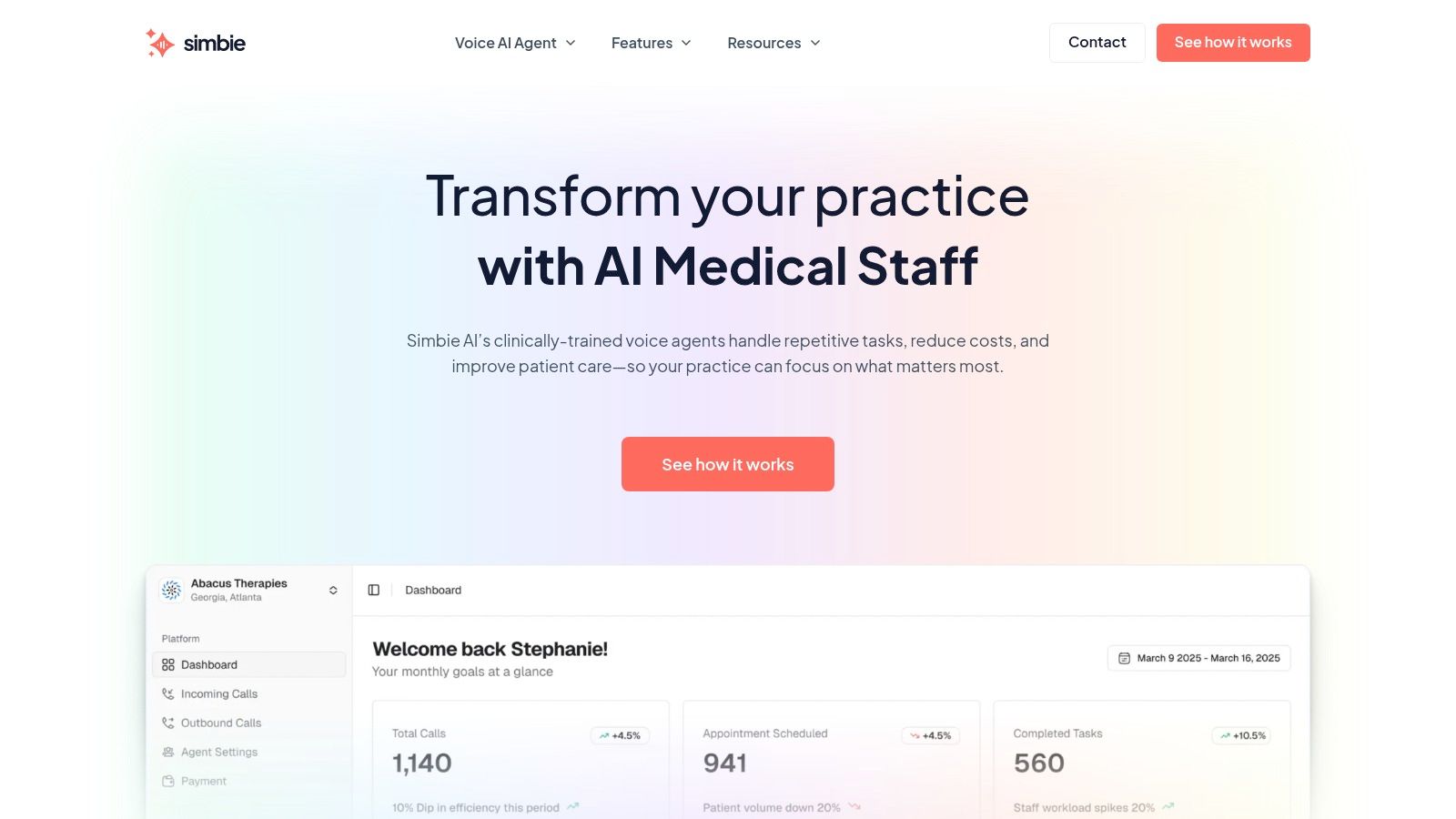
Simbie AI stands out among healthcare AI companies by offering a specialized platform designed to automate and streamline both administrative and patient-facing workflows. Built by a team of physicians and researchers, Simbie provides healthcare practices with clinically-trained, voice-based AI agents. These agents operate 24/7, handling essential tasks that traditionally consume significant staff time and resources, such as answering patient calls, scheduling appointments, and managing prescription refill requests.
The platform’s primary function is to serve as a tireless AI medical staff, managing everything from patient registration and pre-visit intake to appointment scheduling and prescription refills. By automating these routine interactions, Simbie directly addresses common operational bottlenecks, freeing human staff to concentrate on in-person patient care and complex clinical duties. This focus on practical, high-volume tasks provides an immediate and measurable return on investment for practices of all sizes.
Core Features and Differentiators
Simbie’s strength lies in its combination of clinical intelligence and seamless EMR integration. Unlike generic call automation systems, its AI agents are trained to understand and navigate clinical conversations. This capability allows them to perform tasks like medication reconciliation and collecting a patient's history of present illness (HPI) with a high degree of accuracy. The system is designed not just to answer calls, but to complete complex workflows from end to end.
Key features include:
- 24/7 Voice-Based Automation: Simbie ensures practices never miss a patient call. The system can handle hundreds of calls simultaneously with near-zero hold times, improving patient access and preventing revenue loss from unanswered inquiries. This round-the-clock availability is a game-changer for patient satisfaction and operational continuity.
- Direct EMR Integration: One of its most powerful features is the ability to translate voice interactions into structured data and push it directly into the practice’s Electronic Medical Record (EMR). This process minimizes manual data entry, reduces charting errors, and ensures patient records are consistently updated in real-time.
- Clinically-Trained Agents: The AI can manage complex workflows like prior authorizations and medication refills, understanding the specific information required for each task and documenting it correctly for physician review. This clinical awareness separates it from standard administrative bots.
- Human-in-the-Loop Oversight: While the platform automates routine tasks, it includes smart monitoring and allows for easy manual takeover. This hybrid approach ensures clinical accuracy is maintained and complex or sensitive cases can be escalated to a human team member without friction, providing a crucial safety net.
Who is Simbie AI Best For?
Simbie is an ideal solution for a wide range of healthcare providers aiming to enhance operational efficiency and patient experience. This includes small-to-mid-sized private practices, large clinics, and entire health systems. Practice managers and clinicians looking to reduce staff burnout from administrative overload will find its automation capabilities particularly valuable. Telemedicine providers can also leverage Simbie to manage patient communications and scheduling in a virtual environment, ensuring a consistent and responsive patient experience regardless of the care delivery model.
Key Strengths vs. Considerations
| Pros | Cons |
|---|---|
| Continuous Coverage: 24/7 availability eliminates missed calls and reduces patient frustration with long waits. | Utilization-Based Pricing: Costs are tied to call volume and workflows, so ROI varies between practices. |
| Clinical EMR Integration: Automates documentation by pushing structured call data directly into patient charts. | Implementation & Oversight: Requires initial setup and ongoing monitoring to manage clinical edge cases. |
| Proven ROI: Reports show cost savings of up to ~60% on administrative overhead and reduced staff burnout. | No Flat-Rate Pricing: The lack of a published flat rate makes upfront budget forecasting less direct. |
| Enterprise-Grade Security: HIPAA-compliant and SOC 2 Type II certified for robust data protection. |
Simbie’s focus on clinically-aware voice automation makes it a powerful tool for modernizing practice operations. For those interested in a deeper dive, Simbie offers more resources on using AI in healthcare.
Website: https://www.simbie.ai
2. AWS Marketplace – Healthcare and Machine Learning
Instead of being a single-solution provider, AWS Marketplace acts as a centralized hub for healthcare organizations to discover, procure, and deploy a wide range of third-party AI software and models. It functions like an app store specifically for healthcare AI, built on the secure and scalable foundation of Amazon Web Services (AWS). This makes it an essential resource for healthcare systems already using AWS for their cloud infrastructure, allowing them to leverage existing investments.
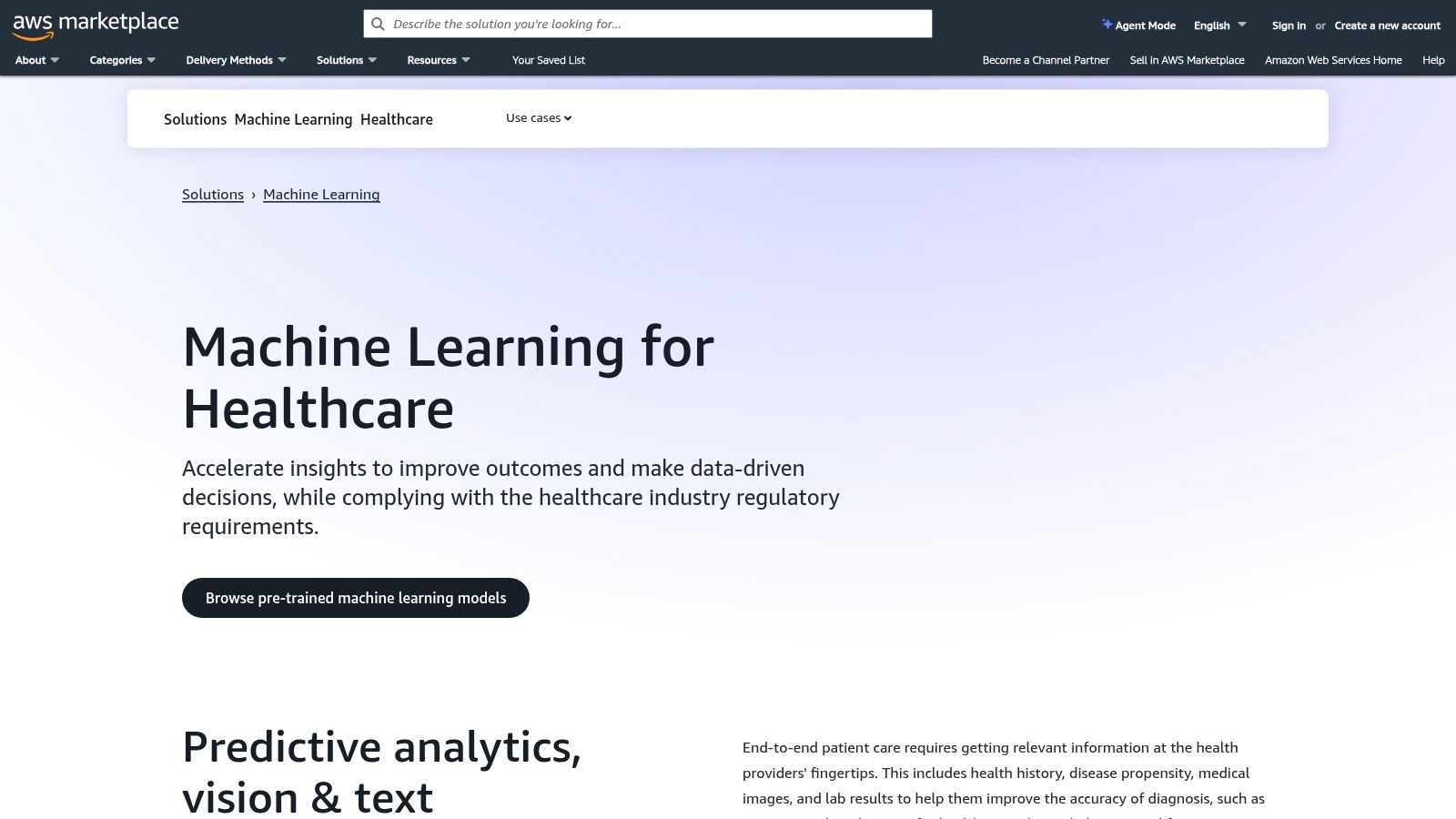
The platform streamlines the often-complex procurement process. Healthcare administrators can find, test, and purchase AI solutions directly through their existing AWS account, consolidating billing and simplifying vendor management. This approach significantly reduces the administrative burden of vetting and contracting with multiple individual AI vendors, accelerating the time-to-value for new technology adoption.
Key Features and Use Cases
The marketplace offers a diverse catalog of pre-vetted AI tools that can be deployed into HIPAA-eligible AWS services. This ensures that organizations can maintain compliance while innovating. The variety of solutions covers nearly every aspect of healthcare operations and clinical support.
- Clinical AI: Includes solutions for medical imaging analysis, diagnostic support, and predictive modeling for patient outcomes. For example, a radiology group could deploy an AI model from the marketplace to automatically detect abnormalities in chest X-rays, augmenting the radiologist's workflow.
- Operational AI: Features tools for revenue cycle management, patient scheduling optimization, and hospital resource allocation. A hospital network could use an AI tool to predict patient no-show rates and adjust scheduling accordingly, improving resource utilization and reducing lost revenue.
- Conversational AI: Provides chatbots and virtual assistants for patient engagement, appointment reminders, and answering common health-related questions. These can be integrated into patient portals or websites to improve communication.
Key Insight: The primary advantage of AWS Marketplace is its integration. It allows healthcare IT teams to leverage their existing AWS skills and infrastructure to deploy new AI capabilities, avoiding the need to build and manage separate, siloed systems for each new tool. This ecosystem approach is a major draw for large enterprises.
Pros and Cons
| Pros | Cons |
|---|---|
| Streamlined Procurement: Consolidates billing and governance through existing AWS accounts. | Requires AWS Expertise: Secure and effective deployment demands internal AWS knowledge. |
| Broad Vendor Selection: Access to a wide range of AI tools for clinical and operational needs. | Variable Pricing: Many listings require direct contact with the vendor for custom quotes. |
| Flexible Deployment: Easily deploy models and software into secure, HIPAA-eligible environments. | Integration Complexity: Connecting marketplace tools with existing EMRs can be challenging. |
Website: https://aws.amazon.com/marketplace/solutions/machine-learning/healthcare
3. Microsoft Azure Marketplace – Azure Health Bot / Health Data & AI
Similar to its AWS counterpart, Microsoft Azure Marketplace serves as a comprehensive catalog for healthcare organizations to find, purchase, and deploy third-party AI applications and services. It is deeply integrated into the Microsoft Azure ecosystem, making it a natural choice for providers already utilizing Azure for cloud computing, data storage, and other services. The marketplace simplifies the adoption of cutting-edge AI by centralizing procurement and billing through an existing enterprise Azure account.
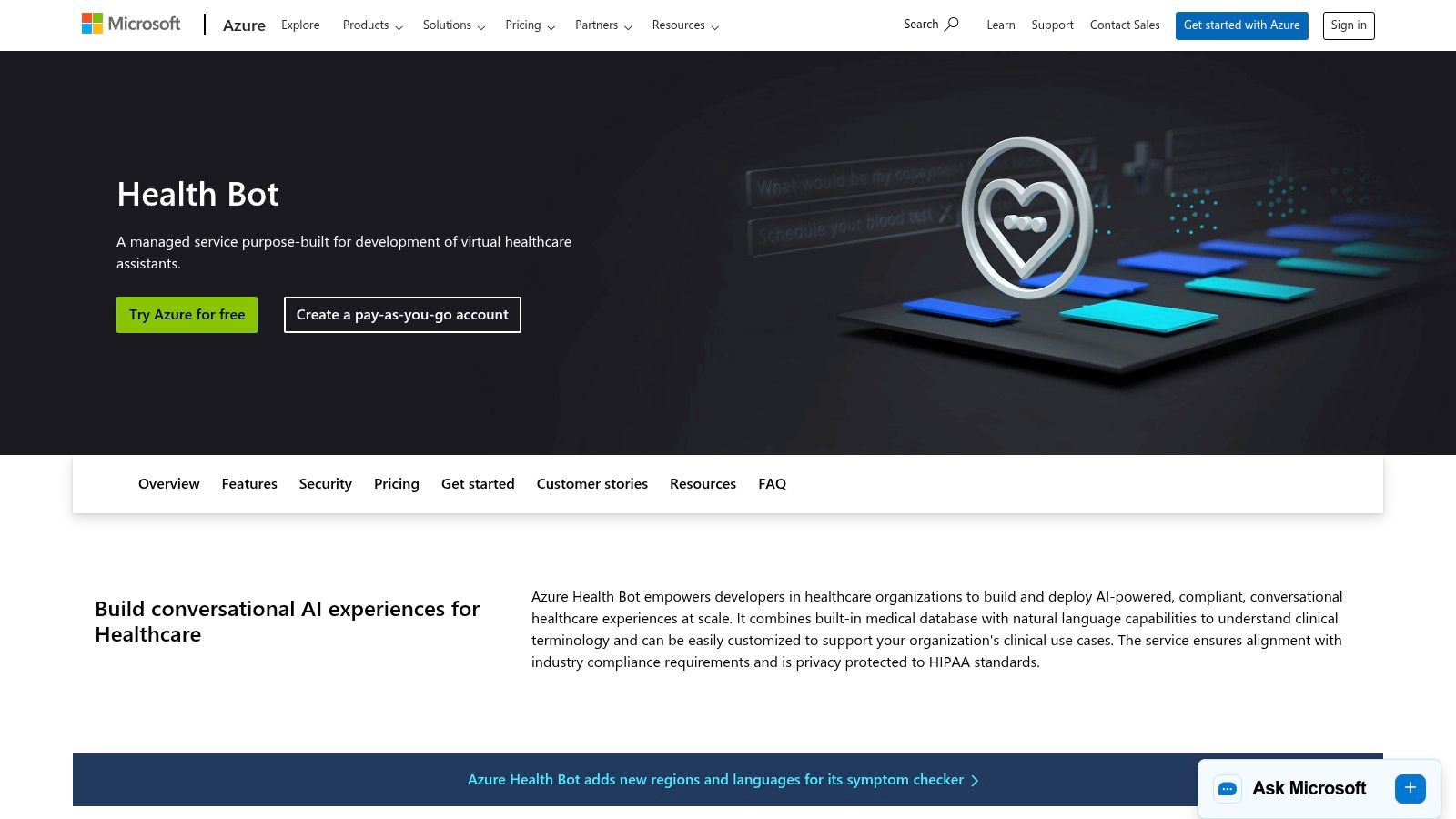
One of its standout offerings is the Azure Health Bot, a managed conversational AI service designed specifically for healthcare scenarios. This allows organizations to build and deploy HIPAA-compliant chatbots with built-in medical intelligence, triage protocols, and language understanding tuned for clinical terminology. This focus on specialized, ready-to-use healthcare services makes it a powerful platform for providers looking to enhance patient engagement and streamline administrative workflows without building AI models from scratch.
Key Features and Use Cases
The Azure Marketplace provides a curated selection of AI tools that are not only compliant but also designed for seamless integration with other Azure health data services. This creates a cohesive environment for building intelligent healthcare solutions that leverage a unified data strategy.
- Managed Conversational AI: The Azure Health Bot is a key feature, enabling rapid deployment of bots for symptom checking, answering FAQs about conditions and treatments, and guiding patients to appropriate care resources. A clinic could deploy a Health Bot on its website to handle initial patient intake questions 24/7.
- Native FHIR and EMR Connectivity: Many marketplace offerings and Azure services are built with interoperability in mind, supporting standards like FHIR (Fast Healthcare Interoperability Resources) to connect with electronic medical records (EMRs) and other clinical systems, which is crucial for data liquidity.
- Specialized Partner Solutions: Beyond Microsoft's own services, the marketplace lists applications from Independent Software Vendors (ISVs) specializing in areas like medical imaging, revenue cycle management, and population health analytics, offering a broad spectrum of capabilities.
Key Insight: Microsoft's primary differentiator is its emphasis on managed, healthcare-specific services like the Azure Health Bot. This provides a lower barrier to entry for organizations that need sophisticated conversational AI but lack the internal resources to build and train a custom model from the ground up.
Pros and Cons
| Pros | Cons |
|---|---|
| Rapid Deployment: One-click deployment for many services, including the Health Bot, integrates with existing Azure billing. | Enterprise Quotes Required: Many partner listings lack public pricing and require direct contact for a quote. |
| Strong Compliance Posture: Built-in HIPAA alignment and a wide range of global certifications. | Regional Availability: The Health Bot service has regional limitations that may impact performance and latency for global users. |
| Free Tier for Prototyping: A free plan is available for the Health Bot, allowing teams to test and prototype before committing. | Integration Expertise Needed: While powerful, connecting marketplace tools to legacy EMR systems still requires specialized IT skills. |
Website: https://azure.microsoft.com/en-us/products/bot-services/health-bot
4. Google Cloud Marketplace – Healthcare & Life Sciences
Similar to its AWS counterpart, Google Cloud Marketplace is a digital catalog where healthcare organizations can find, purchase, and deploy software from third-party vendors. It centralizes access to a curated selection of AI solutions designed for the healthcare and life sciences industries, all built to integrate with Google's robust cloud infrastructure. This makes it a go-to platform for organizations already leveraging Google Cloud for their data and operational needs.
The marketplace is designed to accelerate the adoption of AI by simplifying procurement and deployment. Healthcare IT teams can use their existing Google Cloud account to transact, enabling consolidated billing and private offers. This model removes significant friction from the vendor management process, allowing teams to focus on implementation rather than lengthy contract negotiations, thereby speeding up innovation cycles.
Key Features and Use Cases
Google Cloud Marketplace offers validated partner solutions that can be deployed into its HIPAA-capable services, ensuring a secure environment for protected health information (PHI). The offerings are deeply integrated with Google's own AI tools, like Vertex AI and Gemini, creating a powerful synergy between third-party applications and foundational models.
- Imaging and Diagnostics: Features a strong ecosystem of partners providing AI for medical imaging analysis, such as radiology and pathology, which can be integrated with the Google Cloud Medical Imaging Suite for a comprehensive diagnostic workflow.
- Search and Summarization: Provides advanced search tools that can parse unstructured data within EMRs and clinical notes to provide clinicians with quick, summarized patient histories or research findings, powered by Google's search and NLP expertise.
- Operational and Contact Center AI: Offers solutions to optimize hospital workflows and patient communication. A health system could deploy a contact center AI to automate appointment scheduling and answer common patient inquiries, integrated with Google's Contact Center AI (CCAI) platform.
Key Insight: Google Cloud Marketplace's main strength lies in its tight integration with Google's native AI stack. Organizations can leverage powerful foundational models like Gemini alongside specialized partner solutions, creating a more cohesive and intelligent healthcare ecosystem within a single cloud environment.
Pros and Cons
| Pros | Cons |
|---|---|
| Strong Native AI Stack: Deep integration with Google's powerful Vertex AI and Gemini models. | Requires Google Cloud Tenancy: Effective use demands a pre-existing Google Cloud infrastructure and expertise. |
| Broad Partner Ecosystem: A wide selection of validated solutions for imaging, search, and patient engagement. | Variable Vendor Pricing: Many solutions require custom enterprise quotes rather than transparent pricing. |
| Simplified Procurement: The ability to try and buy solutions directly through existing cloud billing simplifies purchasing. | PHI Governance is Essential: Organizations must have strong governance policies for managing PHI within the cloud. |
Website: https://cloud.google.com/marketplace
5. Salesforce AppExchange – Healthcare Apps & Agentforce
For healthcare organizations built on the Salesforce ecosystem, AppExchange serves as the go-to enterprise marketplace for AI-powered applications. Rather than a standalone tool, it offers a catalog of apps and agents designed to embed directly into Salesforce Health Cloud and Service Cloud. This allows care teams to discover, test, and deploy HIPAA-ready solutions that enhance existing CRM and EHR workflows without leaving the native Salesforce environment.
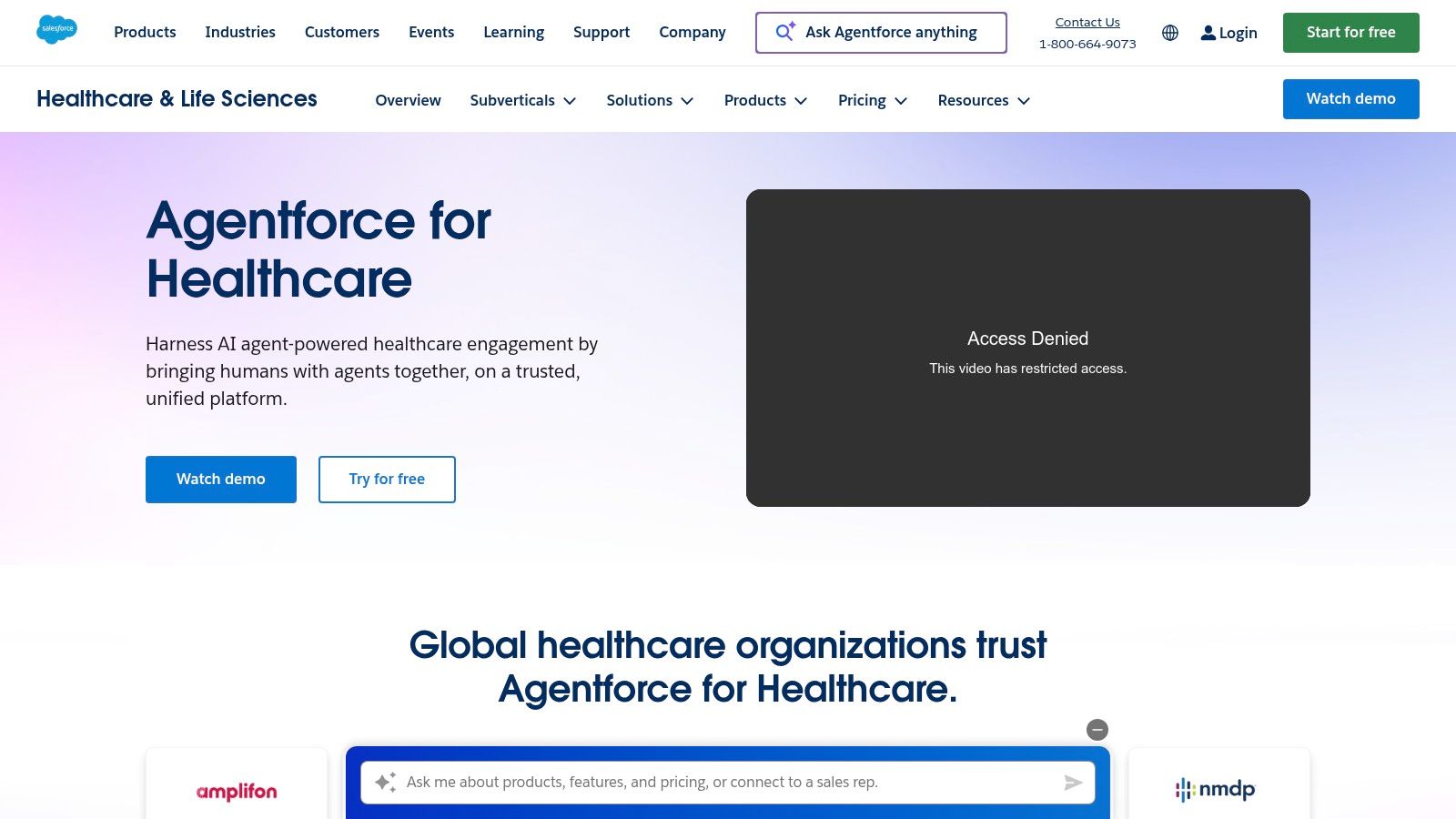
The platform is engineered to accelerate AI adoption by simplifying procurement and ensuring data security. Healthcare administrators can find and trial solutions through established enterprise processes, complete with security reviews. The integration of Agentforce orchestration and the Einstein Trust Layer provides a robust framework for data privacy, ensuring patient information remains protected while leveraging advanced AI capabilities. This focus on trust is paramount in healthcare.
Key Features and Use Cases
AppExchange provides a curated selection of tools from vetted partners, making it one of the most trusted resources among healthcare AI companies for Salesforce users. These applications are designed to solve specific challenges within the patient journey and administrative operations, turning the CRM into an intelligent engagement hub.
- Patient Communications: Deploy conversational AI chatbots and engagement tools to manage appointment scheduling, send reminders, and provide automated answers to common patient questions directly within Health Cloud, creating a seamless patient experience.
- Agent Assist: Equip service agents and care coordinators with AI-powered tools that provide real-time guidance, surface relevant patient information, and automate repetitive tasks during patient interactions, improving efficiency and consistency of care.
- NLP and Risk Adjustment: Implement Natural Language Processing (NLP) tools that analyze unstructured clinical notes to identify hierarchical condition categories (HCCs), improving the accuracy of risk adjustment coding and revenue cycle management.
Key Insight: The main advantage of AppExchange is its seamless, native integration. For organizations already using Salesforce Health Cloud, it provides a fast track to deploying sophisticated AI tools without the typical integration headaches, leveraging a familiar interface and security model.
Pros and Cons
| Pros | Cons |
|---|---|
| Accelerates Deployment: Ideal for organizations already on Salesforce Health Cloud, enabling rapid implementation. | Salesforce-Centric: Less suitable for organizations not using Salesforce, as it may require significant integration work. |
| Strong Data Privacy: The Einstein Trust Layer and AppExchange vetting process ensure a secure environment. | Variable Pricing: Many apps require contacting the vendor for custom quotes, making budget forecasting difficult. |
| Workflow Evaluation: Many listings offer demos and test drives to assess functionality within your workflows. | Dependency on Core Platform: The value of the apps is tightly coupled to your organization's use of Health Cloud. |
Website: https://www.salesforce.com/healthcare-life-sciences/healthcare-artificial-intelligence/
6. Epic Connection Hub / Epic App Market
Epic’s Connection Hub acts as a specialized directory for healthcare organizations that run on the Epic electronic health record (EHR) system. Rather than being a direct provider of AI, it is a curated marketplace where third-party vendors list applications, including AI-powered tools, that are designed to interoperate seamlessly with the Epic ecosystem. This makes it a crucial starting point for Epic-based health systems looking to extend their capabilities without facing complex, custom integration projects.
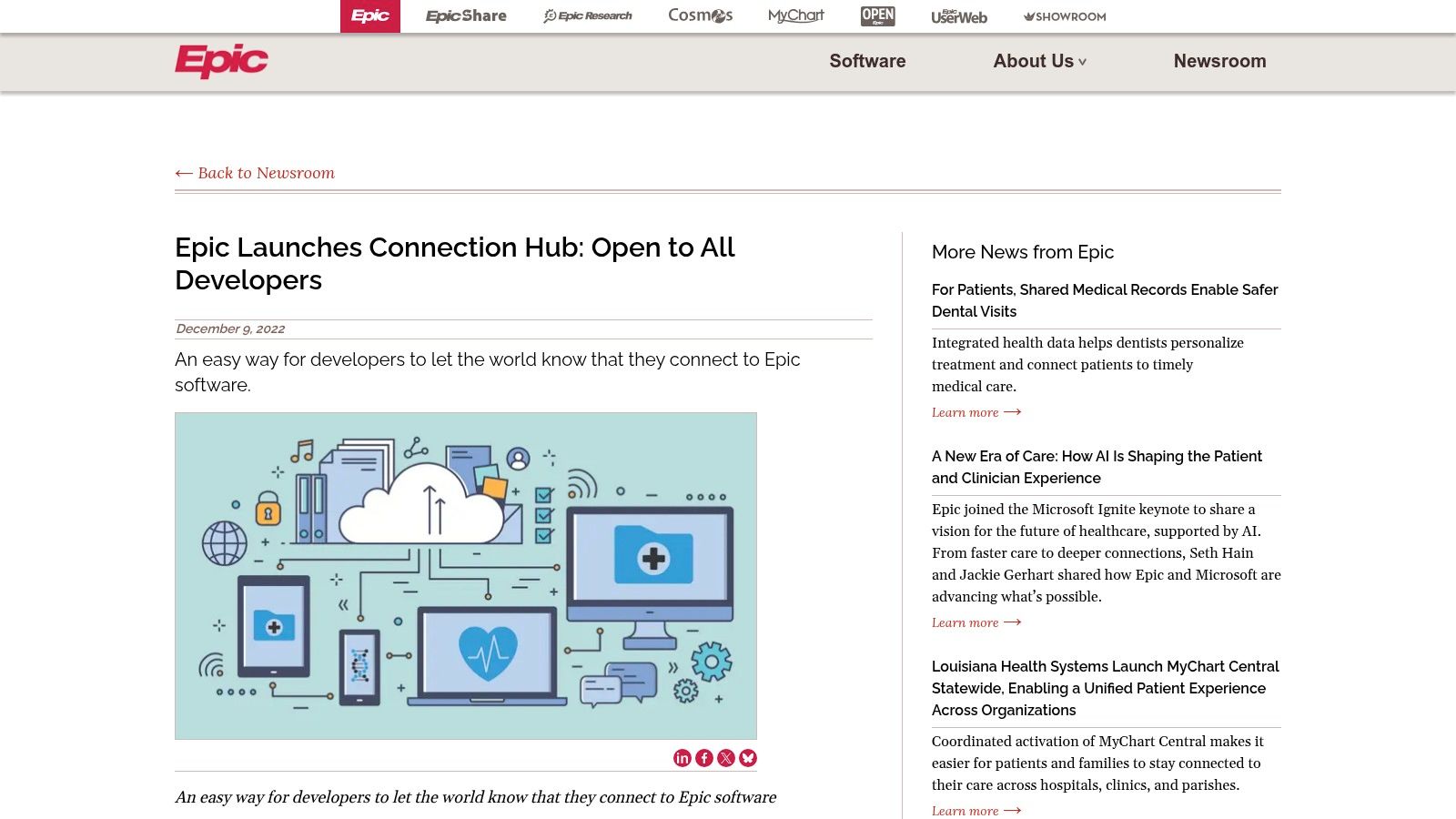
The platform’s primary function is to simplify the discovery and vetting process for compatible technologies. By browsing the Hub, healthcare administrators and IT leaders can identify AI solutions that plug directly into existing clinical workflows, from ambient documentation to diagnostic support. This approach helps reduce the significant technical and administrative overhead typically associated with integrating new software into a deeply embedded EHR like Epic, which is the lifeblood of many large health systems.
Key Features and Use Cases
The Connection Hub provides a centralized catalog of applications with self-reported interoperability details, all designed to connect via Epic’s APIs. This pre-vetted compatibility is its main draw for healthcare AI companies and their clients, signaling a commitment to work within this critical ecosystem.
- Clinical Workflow Integration: Features AI-driven tools for ambient clinical documentation, which automatically transcribe patient conversations into structured notes within the EHR. This reduces the documentation burden on clinicians, a major contributor to burnout.
- Care and Population Health Management: Includes platforms for remote patient monitoring and care-at-home services that feed data directly back into the patient’s Epic chart, enabling proactive care and better management of chronic conditions.
- Operational and Administrative AI: Offers tools for optimizing scheduling, managing referrals, and automating data exchange between different systems, all integrated within the Epic environment. This is where AI agents in healthcare can play a significant role in streamlining tasks and improving patient flow.
Key Insight: The Connection Hub’s value lies in its specificity. For the vast number of hospitals and clinics using Epic, it dramatically lowers the barrier to adopting new AI technologies by ensuring a foundational level of technical compatibility from the start, saving months of potential integration work.
Pros and Cons
| Pros | Cons |
|---|---|
| Simplified Discovery: Eases solution discovery for Epic-based providers seeking integrated AI tools. | Epic-Centric: Primarily useful only for organizations that already run on the Epic EHR. |
| Faster Implementation: Standardized onboarding and Epic APIs can significantly speed up deployment. | Vendor-Provided Content: Listings are vendor-submitted, so due diligence is still required. |
| Signals Interoperability: A listing signals a vendor's commitment to working within the Epic ecosystem. | Integration Isn't Guaranteed: While compatible, deep integration may still require significant effort. |
Website: https://www.epic.com/epic/post/epic-launches-connection-hub/
7. Snowflake Marketplace – Healthcare & Life Sciences data/AI assets
Snowflake Marketplace offers a unique angle for healthcare AI companies by focusing on the most critical component: data. Instead of providing pre-built models, it acts as a secure platform where healthcare organizations can access, share, and purchase de-identified clinical datasets, commercial intelligence, and analytics assets directly within their existing Snowflake environment. This approach is designed to accelerate AI and machine learning workflows by bringing analysis-ready data directly to the computational source.
The platform fundamentally changes how organizations acquire data for AI projects. Rather than dealing with slow and cumbersome data transfers and complex ETL (Extract, Transform, Load) pipelines, users can instantly provision datasets into their Snowflake Data Cloud. This live, secure data sharing means teams can start building and training models faster, using high-quality, de-identified longitudinal patient data or claims information without moving it outside a compliant environment.
Key Features and Use Cases
Snowflake’s primary strength is its data-centric model, which provides the foundational assets needed for sophisticated AI development within a secure and governed ecosystem. It powers the "data-first" approach to AI.
- Ready-to-Query Data: Provides access to analytics-ready datasets, including de-identified medical claims, lab results, and longitudinal patient records from various data partners. A research team could license a dataset to study real-world evidence (RWE) for a new therapy, drastically reducing data acquisition time.
- Zero-Copy Data Sharing: Allows data to be shared instantly and securely without creating multiple copies. This eliminates ETL bottlenecks and ensures all users are working with a single source of truth, improving data governance and consistency.
- Partner Applications and Toolkits: Offers applications and tools from partners that run directly on data within a user's Snowflake account, enabling analytics for payer, provider, and life sciences use cases without data ever leaving the secure perimeter.
- Commercial Intelligence: Features datasets that help organizations analyze market trends, prescriber behavior, and commercial performance to inform business strategy, crucial for life sciences companies and large provider networks.
Key Insight: Snowflake Marketplace's core advantage is its ability to radically shorten the time-to-value for AI initiatives. By eliminating data movement and providing direct access to rich datasets, it allows data science teams to focus on building models rather than on data acquisition and preparation.
Pros and Cons
| Pros | Cons |
|---|---|
| Accelerated AI Workflows: Provisioning data directly where analytics run shortens project timelines. | Requires Snowflake Tenancy: The full benefits are only accessible to organizations using Snowflake. |
| Secure Data Environment: Eliminates ETL bottlenecks and keeps sensitive data within a single, secure platform. | Primarily Data-Centric: Users must build or bring their own models; it's not a model marketplace. |
| Rich Data Selection: Access to commercial intelligence and de-identified patient data for modeling. | Limited Public Pricing: Many listings require direct negotiation for enterprise terms and custom quotes. |
Website: https://www.snowflake.com/
Top 7 Healthcare AI Platforms Comparison
| Item | Implementation complexity 🔄 | Resource requirements ⚡ | Expected outcomes ⭐ | Ideal use cases 📊 | Key advantages & tips 💡 |
|---|---|---|---|---|---|
| Simbie AI | Medium — EMR integration, clinical tuning and monitoring required | Moderate — integration work, staff oversight; utilization‑based pricing | High (⭐⭐⭐⭐) — 24/7 voice automation, fewer missed calls, claimed ~60% admin cost reduction | Small–mid practices to large clinics needing voice + charting automation | Clinically trained agents; direct EMR pushes; HIPAA & SOC2 compliance; plan for initial tuning |
| AWS Marketplace – Healthcare & ML | Variable — depends on chosen vendor; vendor deployment complexity varies | High — AWS tenancy, ops/security expertise for PHI, deployment/monitoring | Medium (⭐⭐⭐) — procurement speed and vendor variety; outcomes depend on product choice | Organizations on AWS wanting broad vendor choice and consolidated procurement | Large catalog and billing integration; private offers/enterprise terms; expect integration effort |
| Microsoft Azure Marketplace – Health Bot | Low–Medium — managed Health Bot simplifies deployment but regional limits and config needed | Moderate — Azure tenancy, FHIR/EMR connectivity, compliance setup | Medium‑High (⭐⭐⭐⭐) — rapid prototyping and compliant conversational solutions | Azure customers prototyping triage or conversational bots integrated with EMR | Managed Health Bot, free prototyping tier, strong compliance posture; check regional availability |
| Google Cloud Marketplace – HCLS | Variable — vendor-dependent; integration with Vertex/Medical Imaging can add complexity | High — Google Cloud tenancy, governance for PHI, ML/compute resources | Medium‑High (⭐⭐⭐⭐) — strong ML/imaging capabilities and validated partner solutions | Imaging, ML-heavy analytics, and AI projects on Google Cloud | Native AI stack (Vertex/Gemini), validated integrations; requires cloud governance for PHI |
| Salesforce AppExchange – Healthcare Apps | Low–Medium — smooth for Health Cloud customers; more work for non‑Salesforce orgs | Moderate — Health Cloud licenses, admin/config, integration with EHRs as needed | Medium‑High (⭐⭐⭐⭐) — fast embedding into CRM workflows and agent assist | Organizations using Salesforce Health Cloud seeking embedded patient/agent workflows | Native embedding, Einstein Trust Layer, vetted apps and demos; best for existing Salesforce customers |
| Epic Connection Hub / App Market | Medium — standardized Epic onboarding but requires Epic API integration and testing | Moderate — Epic customer integration teams and compliance checks | High (⭐⭐⭐⭐) — smoother Epic integrations and faster deployment for Epic sites | Health systems that run Epic and need interoperable AI apps | Epic‑focused discovery; reduces integration effort for Epic customers; vendor diligence still needed |
| Snowflake Marketplace – HCLS data/AI | Medium — data provisioning is straightforward but requires Snowflake setup | High — Snowflake tenancy, compute credits, analytics/ML teams to build models | High (⭐⭐⭐⭐) — speeds time‑to‑value for data/ML projects using de‑identified datasets | Payer/provider analytics, RWE, ML teams needing large curated datasets | Native secure data sharing, eliminates ETL, analytics‑ready assets; you must build or bring models |
Choosing the Right AI Partner for Your Practice
We've explored a diverse landscape of powerful tools, from dedicated platforms like Simbie AI to expansive marketplaces from tech giants like AWS, Microsoft, and Google. The key takeaway is clear: artificial intelligence is no longer a futuristic concept but a practical, accessible solution for modern healthcare challenges. The right AI can transform administrative workflows, unlock data-driven insights, and ultimately, free up your team to focus on what matters most: patient care. The decision is not about whether to adopt AI, but how and which partner to choose.
The journey to selecting the best fit from the many healthcare AI companies begins with a clear understanding of your organization's unique needs. There is no one-size-fits-all solution. A small private practice struggling with phone call volume and appointment scheduling will have vastly different requirements than a large hospital system looking to build custom predictive models for patient outcomes using vast datasets.
How to Define Your AI Needs
Before committing to a partner, it's crucial to perform an internal assessment. This strategic self-evaluation will serve as your compass, guiding you toward the most impactful and cost-effective solution. A hasty decision can lead to poor adoption and wasted resources, while a thoughtful one can yield transformative results.
Consider these key questions:
- What is our primary pain point? Is it administrative burnout, patient no-shows, inefficient data management, or a lack of clinical decision support? Pinpoint the single biggest problem you want to solve first. Prioritizing the most acute challenge ensures a quicker and more visible return on investment.
- What is our existing tech stack? Do you operate primarily in a specific cloud environment like AWS or Azure? Does your practice rely heavily on an EHR like Epic? Compatibility is essential for seamless integration and minimizing technical debt. The best AI tool is one that enhances, not disrupts, your current ecosystem.
- What are our internal resources? Do you have an in-house IT department or data science team capable of implementing and managing complex models from a marketplace? Or do you need a ready-to-use, fully managed solution that requires minimal technical overhead? Be realistic about your team's capacity for implementation and ongoing maintenance.
- What is our desired outcome? Are you aiming to reduce operational costs, improve patient satisfaction scores, increase appointment bookings, or enhance clinical research capabilities? Define what success looks like in measurable terms (e.g., "reduce patient hold times by 50%" or "increase scheduled appointments by 15%").
By answering these questions, you can narrow down the list of potential healthcare AI companies. A practice looking to automate its front desk will find immense value in a specialized tool like Simbie AI, while an organization with a sophisticated data team might leverage the Snowflake Marketplace to acquire new datasets for analysis. The goal is to match the solution to the problem, not the other way around.
Integrating AI is a strategic investment in the future of your practice. It’s about building a more resilient, efficient, and patient-centric operation that can thrive in an ever-evolving healthcare landscape. By starting with a focused problem and selecting a partner that directly addresses it, you can ensure a successful implementation and a tangible return on your investment.
Ready to see how a specialized AI can immediately reduce administrative burden and improve patient access? Simbie AI offers a fully-managed, AI-powered medical receptionist designed to handle calls, schedule appointments, and integrate seamlessly with your EHR. Discover how top practices are automating their front office by visiting Simbie AI today.