

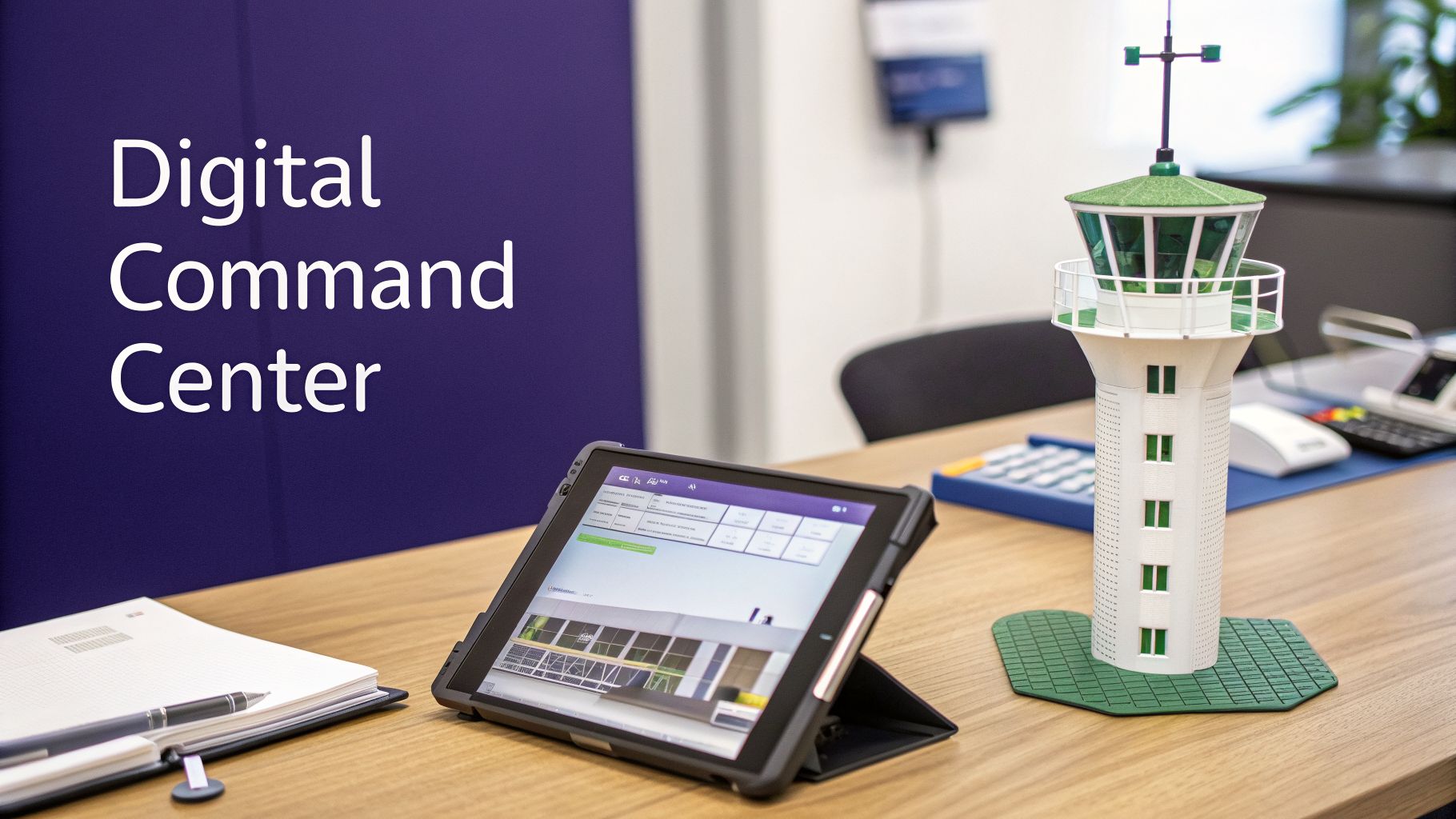
At its heart, healthcare administration software is the digital command center for your entire medical practice. It’s the engine that runs all the non-clinical operations humming along behind the scenes, from patient appointments to billing and staff workflows. The main idea is to get the administrative burden off your clinical team's plate so they can do what they do best: provide excellent care.
This kind of medical office management software is designed to automate and streamline the day-to-day tasks that, while essential, don't directly involve treating patients. By handling these repetitive jobs, the platform allows your clinical staff to dedicate their time and energy to patient outcomes, boosting both productivity and morale. A well-implemented system can fundamentally transform how a practice operates, making it more efficient, profitable, and patient-centric. In this guide, we'll explore what these systems do, the core components to look for, and how to measure their true impact on your practice.
What Is the Digital Command Center for Your Practice?
Picture your medical practice as a busy airport. Your doctors and nurses are the pilots and flight crew, focusing on the most critical job—safely flying the plane, or in this case, treating patients. So, who’s making sure everything on the ground runs smoothly? That’s where healthcare administration software steps in. It’s your practice's air traffic control tower.
The software directs the complex flow of your clinic, much like a control tower coordinates flight schedules, manages gate assignments, and guides ground crews. It ensures patients "land" in the right appointment slot, billing "takes off" without a hitch, and your admin staff has a clear view of every moving part, all without ever flying the plane itself.
From Simple Tools to Essential Systems
These platforms didn't just appear overnight. They've come a long way from the basic digital calendars and siloed tools of the past. Early on, you might have had one program for scheduling and a completely separate one for billing. Today, they are fully integrated suites that serve as the operational backbone for any modern practice.
This shift was really driven by the need to solve nagging operational headaches. The endless phone calls, the mind-numbing manual data entry, and the mountains of paperwork were—and still are—a huge drain on resources. At its core, good administrative software is all about smart business process automation.
By taking over repetitive, time-consuming tasks, these systems free up staff to focus on high-value patient interactions, reducing burnout and improving morale. It’s about giving your team back their most valuable asset: time.
The Real Purpose of Administrative Software
The goal isn't just to swap paper forms for digital ones; it's to fundamentally change how your practice operates for the better. We're talking about creating a system that’s more connected, more efficient, and far more patient-friendly. When you get the right platform in place, you can expect to:
- Reduce Costly Errors: Automating tasks like billing and data entry is a game-changer. It drastically cuts down on the human errors that lead to rejected claims and lost revenue.
- Prevent Administrative Headaches: A single, centralized system means no more hunting for information across different spreadsheets or programs. Everyone works from one source of truth.
- Enhance the Patient Experience: Little things make a big difference. When patients can book online or get automated reminders, it makes their life easier and their impression of your practice better.
- Improve Staff Efficiency: With routine tasks handled automatically, your team can manage a heavier workload with far less stress. This is a direct path to better productivity.
Ultimately, this software provides the sturdy framework your clinical team needs to excel. It clears the way for them to perform at their absolute best.
The Core Components of a Modern Practice
To really get what makes modern medical office software work, you have to look at the moving parts. A good platform isn't just one piece of software; it’s a set of tools that work together, each one built to fix a specific headache in your daily operations. Think of it like a well-oiled machine—every gear has its own job, but they all have to mesh perfectly to keep things running smoothly.
Instead of just giving you a boring list of features, let's walk through what these core pieces actually do in the real world. Each one tackles a common pain point, turning a clunky manual task into something that just happens automatically.

The Always-On Digital Receptionist
Let’s start with Patient Scheduling. For most practices, this is a huge time sink. Your staff spends hours playing phone tag, trading voicemails with patients just to lock down an appointment time. It’s frustrating for your team and for the patient.
Modern software completely changes the game. It’s essentially a digital receptionist that works 24/7, letting patients see your team's real-time availability and book their own appointments online, whenever it's convenient for them. The impact is immediate:
- Less phone duty for your front desk, freeing them up to focus on patients in the office.
- Patients can book after hours or on weekends without having to wait for your office to open.
- Fewer no-shows. Automated text and email reminders are incredibly effective at cutting down on missed appointments—which directly protects your revenue.
This one feature can easily give you back hundreds of staff hours every month.
The Smart, Paper-Free Welcome
Next up is Patient Intake and Registration. That old clipboard isn't just slow; it’s a recipe for errors. Between bad handwriting, missed questions, and the mind-numbing task of typing all that information into the EHR, mistakes are bound to happen.
A digital intake process creates a much smarter, paper-free welcome. Patients can fill out all their forms online from their own home before they even walk through your door.
The system guides them through every step, making sure all the required information is filled out correctly. This means patients show up ready to be seen, and their information is already sitting, clean and accurate, in your system.
The Financial Engine of Your Practice
This might be the most important piece of the puzzle: Billing and Revenue Cycle Management (RCM). This is the engine that makes sure you get paid for the work you do. Doing it all by hand is a nightmare of complexity and mistakes, leading to denied claims, late payments, and money left on the table.
A strong RCM module automates the entire process, from creating a claim to posting the final payment. It checks claims for errors before they're sent, keeps track of their status with insurance companies, and can even handle automatic appeals for common denials. There's a reason this software is in high demand. The broader enterprise software market was valued at USD 49.63 billion in 2025, with RCM being a major driver in 2024. This trend is expected to push the market to USD 158.63 billion by 2034.
For a practice, this means using software that can slash claim denials by 30-50%. That’s a huge deal when you consider providers lose billions every year to simple mistakes.
Tying It All Together
Of course, other modules help complete the picture. Automated Prior Authorizations can tackle one of the most frustrating and time-consuming jobs in any office. Integrated Patient Communication tools manage everything from sending follow-up instructions to broadcasting important clinic updates.
When all these parts work together on a single platform, you're not just making old processes digital—you're creating a fundamentally better way to operate. To make the most of this efficiency, a practice also needs a smart digital marketing strategy for healthcare that attracts new patients and keeps them engaged.
The Features That Truly Make a Difference
Having the basic modules like scheduling and billing is one thing. But if your healthcare administration software just digitizes your old, clunky workflows, you’re not really solving any problems—you’re just moving them onto a screen. The real magic happens when your software starts working for you.
Certain capabilities can completely reshape how your practice operates. They’re what separate a simple digital tool from a genuine strategic partner. Without them, you’re missing out on the biggest opportunities to boost efficiency, secure your data, and give your patients a better experience.
Let's dig into the non-negotiable features you should be looking for.
Seamless EHR Integration
Your Electronic Health Record (EHR) is the clinical brain of your practice. Your administrative software is the operational backbone. If these two systems don't communicate, you’ve created a massive headache for your staff. They're forced to constantly toggle between screens, manually re-entering the same information over and over again.
This is where seamless EHR integration becomes essential. It’s the bridge that allows data to flow automatically and instantly between your admin and clinical platforms.
Think about it: a new patient fills out their intake forms online. With proper integration, that information—demographics, insurance, medical history—appears directly in their EHR chart. No manual typing, no risk of typos. It just works. This saves a staggering amount of time and cuts down on potentially dangerous data entry errors.
HIPAA-Compliant Security
In healthcare, data security isn't just a nice-to-have; it's the law, and it’s the foundation of patient trust. A single breach can be devastating, leading to enormous fines, a ruined reputation, and a loss of faith from your community. Your software needs to be an ironclad vault for patient data.
Look for a platform that clearly provides:
- End-to-end encryption for all data, whether it’s sitting on a server or being sent across the internet.
- Role-based access controls, which means your team members can only see the specific information they need to perform their duties. Nothing more.
- A formal Business Associate Agreement (BAA). This is a non-negotiable legal document where the vendor contractually agrees to protect your patient data according to HIPAA standards.
Anything less than HIPAA-compliant security is a serious liability. For a deeper dive into security and other key capabilities, check out our guide on essential practice management software features.
Intelligent Workflow Automation
What's the biggest time-waster in most practices? It’s not the complex, high-level work. It's the mountain of small, repetitive tasks that eat up the day: sending appointment reminders, chasing down patient information, and sending routine follow-ups. These tasks are a major driver of staff burnout.
Intelligent workflow automation hands these jobs over to the software. You can set up simple rules to automate them completely. For instance, the system can automatically text a patient a reminder 24 hours before their appointment or send a satisfaction survey right after their visit. This ensures nothing falls through the cracks and frees up your team to focus on the patients right in front of them.
To see the real-world impact, let's compare how these tasks get done the old way versus with a modern, AI-powered system.
Comparing Manual vs. AI-Powered Administrative Tasks
| Administrative Task | Manual Approach (Traditional) | AI-Powered Approach (Modern) | Key Benefit |
|---|---|---|---|
| Appointment Scheduling | Staff answers calls, checks schedules, and books manually. | AI answers calls 24/7 and books appointments directly into the calendar. | No missed calls, zero hold times, staff is freed up. |
| Appointment Reminders | Staff member manually calls or texts each patient one by one. | System automatically sends customized reminders via text or email. | Drastically reduces no-shows and saves hours of staff time. |
| Prior Authorizations | Staff spends hours on the phone with payers, faxing forms. | AI initiates and tracks requests, often through payer portals. | Faster approvals, less administrative burden. |
| Patient Intake | Patients fill out paper forms in the waiting room; staff types it in. | Patients complete forms online; data syncs directly to the EHR. | Eliminates data entry, reduces errors, shortens wait times. |
This shift from manual effort to intelligent automation is where practices find incredible gains in both efficiency and team morale.
AI-Powered Voice Agents
Automation is great for background tasks, but what about your single busiest channel—your phone lines? This is where things get really interesting.
AI-powered voice agents are the next evolution in practice administration. Forget the frustrating, robotic phone trees of the past. Modern systems like Simbie AI use sophisticated AI that can understand natural conversation and handle complex requests just like a human would.
These AI agents can:
- Answer every single patient call, 24/7, so you never miss a booking.
- Schedule appointments, handle refill requests, and answer common questions without needing to escalate to a staff member.
- Manage an unlimited number of calls at once, which means patients never, ever have to wait on hold again.
This isn't just about saving time. It's about providing a level of service that would be impossible with human staff alone, turning your phones from a frustrating bottleneck into your most powerful tool for growth.
How to Choose the Right Software for Your Practice
Picking new healthcare administration software feels like a huge decision, because it is. You're flooded with options, and every vendor's website promises to fix every problem you have. The secret to making a great choice isn't found in their sales pitches, but by looking at your own practice first.
Don't get distracted by a long list of shiny features. The best software is the one that solves your most frustrating, time-consuming problems. Start there. Is your front desk drowning in phone calls? Are you losing money to a high rate of claim denials? Maybe patients are getting fed up and no-showing because communication is a mess.
Pinpoint your top three administrative headaches. This short list becomes your guide. When you see a demo, you can ask, "How does your system fix this specific problem?" A slick presentation is meaningless if it doesn't solve what's actually slowing you down.
Evaluate Scalability and Future-Proofing
Your practice is going to change, and your software needs to be ready to change with it. The system that seems perfect today could become a real roadblock in a couple of years. You need a platform that can handle your growth, whether you're bringing on more providers, opening another office, or diving into telemedicine.
This is all about scalability. Ask vendors point-blank how their system handles more patients and more staff. Is their pricing set up to punish you for growing? Think about how the software will keep up with the industry, too. You want a partner who is constantly updating their platform to meet new rules and tech, not one that will be obsolete in a few years.
A huge piece of this is how well it plays with others. Your new software absolutely must connect with the tools you already use, especially your EHR. Seamless EMR system integration isn't just a nice-to-have; it's essential. Without it, you're stuck with disconnected systems and the painful, error-prone task of entering data in two different places.
Analyze Support, Usability, and Total Cost
The price you see on the proposal is just the beginning. To get the real picture, you have to figure out the total cost of ownership (TCO). This means adding up all the hidden and ongoing expenses.
- Implementation and Training Fees: What's the one-time cost to get set up? What will it cost to get your entire team trained and comfortable?
- Ongoing Support and Maintenance: Is customer support baked into the price, or is that an extra fee? What exactly does it cover when something goes wrong?
- Upgrade Costs: When a new, better version comes out, will you get it for free, or will you have to pay up?
Beyond the numbers, think about the people who will be clicking around in this system all day. The most advanced software on the planet is worthless if your team hates using it. Always ask for a trial or a live demo where your own staff can get their hands on it. If your front desk and billing teams find it intuitive, you'll see much higher adoption and a way better return on your investment.
Thankfully, the rise of cloud-based systems has put powerful tools within reach for practices of all sizes. The healthcare software as a service (SaaS) market, valued at USD 37.68 billion in 2026, is on track to reach USD 82.37 billion by 2031. Hybrid cloud models are growing especially fast at an 18.35% CAGR. This shift offers practices secure, scalable options that easily connect with other tools. You can dig into what's driving this trend by checking out the latest industry reports.
Measuring the Real Return on Your Investment
Let’s get straight to the point: is this kind of software really worth the money? It's a major investment, and you need to see a real payoff, not just vague promises of "better efficiency." A good platform isn't just another expense—it's a tool that should pay for itself and then some. You can actually track its impact on your practice’s bottom line and day-to-day operations.
The most obvious win is getting time back. When you automate all those repetitive, manual tasks, you're literally buying back hours for your staff. That's time they can spend helping patients, solving complex billing issues, or doing anything more valuable than leaving voicemails. It’s about letting your team work smarter, not just harder.
Seeing the Dollars and Cents (Hard ROI)
"Hard ROI" is just the business-speak for the cold, hard cash your practice saves or earns. These are the numbers you can point to on a spreadsheet that prove the software is working. To see the change for yourself, track a few key metrics before you switch, and then check them again a few months after.
Here’s where you’ll see the money show up:
- Less Administrative Overhead: Think about how many hours your team spends on the phone scheduling appointments, manually sending reminders, or keying in patient data. Do the math. If you save just 10 staff hours a week at a modest $25/hour wage, that’s $13,000 back in your pocket over a year.
- Fewer Claim Denials: Nothing kills your cash flow like a denied claim. A solid system that automatically checks for errors before a claim even goes out can slash your denial rate. Every denial you prevent is pure revenue you didn't have to fight for.
- Lower Staff Turnover: Burnout is real, especially for front-office staff buried in tedious work. Good software removes a lot of that daily frustration, making the job more satisfying. When your team is happier, they stick around longer, saving you the thousands of dollars it costs to recruit, hire, and train a replacement.
We’ve seen practices that go all-in on automation, especially with AI-powered tools, cut their total administrative costs by as much as 60%. At that point, the software stops being an expense and starts becoming a financial advantage.
Don't Forget the "Soft" Benefits (Soft ROI)
While the numbers are crucial, some of the most important returns aren't so easy to quantify. These "soft" benefits are all about the quality of life in your practice—for both your patients and your staff. They are the foundation for long-term growth.
These wins are just as vital:
- Happier Patients: Think about it from their perspective. They can book an appointment online at 10 PM, get a quick text response to a question, and check in without filling out the same clipboard for the tenth time. A smooth experience makes patients feel valued, and they’re far more likely to stay with your practice and recommend you to others.
- Better Staff Morale: When you free your team from the mind-numbing cycle of phone calls and paperwork, their whole attitude changes. They can focus on more meaningful work and feel like they’re actually helping people. A happy, empowered team doesn't just reduce turnover; they provide better care.
In the end, these soft benefits directly fuel your hard ROI. Happy patients lead to better retention and more referrals. High staff morale means you're not constantly spending money on hiring. Together, they create a practice that isn't just surviving, but actually thriving.
The Future of the Front Desk Is Voice AI
While most clinic management systems focus on improving existing workflows, the biggest change is happening right where patients first connect with you: the front desk. This is where the next real leap in efficiency and patient experience is coming from, and it’s all thanks to voice artificial intelligence. This isn't science fiction—it's a practical tool that’s completely changing how practices handle their phones.
Think about it. A patient calls your office after hours, needing to book a visit. Instead of getting a voicemail and waiting for someone to call back, they're greeted by an intelligent assistant that checks the schedule and books them an appointment right then and there. That’s exactly what platforms like Simbie AI are doing today.
Forget those clunky, frustrating phone trees that just make callers angry. Modern voice AI actually understands natural conversation, handles complex questions, and does things that used to require a person. The effect on a practice is almost immediate.
Ending Hold Times and Missed Calls Forever
Let's be honest, the phone is a constant headache for everyone. Patients despise waiting on hold, and your staff is constantly pulled away from other tasks by a ringing phone. Voice AI finally fixes this by giving you a front desk that never gets tired and has unlimited capacity.
An AI voice agent can:
- Answer every single call the moment it comes in, 24/7.
- Handle an unlimited number of calls at once, which means hold times become a thing of the past.
- Ensure you never miss an opportunity for a new patient booking or an important patient question.
This alone turns the front desk from a major bottleneck into an incredibly reliable asset. If you're curious about how these assistants are changing daily operations, you can learn more about voice AI agents in healthcare.
From Simple Calls to Automated Workflows
The real magic of voice AI is that it does more than just answer the phone. It’s an intelligent digital assistant that can kick off entire administrative processes. For example, when an AI agent books an appointment, it can also gather the patient's information, pull relevant data from the EHR, and automatically start a prior authorization request.
By taking over these routine but critical tasks, the system frees up your human team to focus where they're needed most—on the complex, high-value interactions with the patients who are right there in the office.
This is what the modern front office looks like: a smart, hybrid model where AI handles the high volume of simple tasks, freeing up your staff to provide outstanding in-person care. This shift is part of a huge trend—the AI in healthcare market is expected to rocket from USD 50 billion in 2026 to USD 504 billion by 2032. AI voice agents, by automating intake and scheduling around the clock, can boost patient satisfaction scores by 20-30% while slashing administrative waste. You can find more on this growth in Deloitte's latest outlook on the healthcare industry.
Frequently Asked Questions
Making a big software change always comes with a lot of questions. Let's tackle the ones we hear most often from practice managers so you can feel confident about the road ahead.
How Long Does Implementation Take?
This is usually the first thing everyone wants to know, and the honest answer is: it depends. A realistic timeline is anywhere from a few weeks to a few months.
What makes the difference? It really boils down to three things:
- Practice Size and Complexity: A small, single-provider clinic will get up and running much faster than a large practice with multiple locations and intricate billing rules.
- Data Migration: Think of this like moving houses. Getting all your patient demographics, appointment histories, and billing records from the old system to the new one is the heaviest lift. The cleaner and more organized your data is now, the smoother the "move" will be.
- Customization: If you need the vendor to build special workflows just for your practice, you'll need to account for that extra development and testing time.
A good partner will walk you through their process and give you a clear, step-by-step timeline right from the start.
Will This Software Integrate With My Current EHR System?
This is a deal-breaker, and the answer needs to be a confident "yes." Modern administrative software is built to talk to major Electronic Health Record (EHR) systems. This connection is the bridge that lets clinical and administrative data flow back and forth automatically.
Without that bridge, your team is stuck entering the same information in two different places. That’s not just a waste of time; it’s a recipe for errors. Before you sign anything, confirm the vendor has a proven track record of integrating with your specific EHR. Don't be shy about asking for references from other practices using the exact same setup.
How Much Training Will My Staff Need?
Your new software is only as good as your team's ability to use it. The best vendors know this and build comprehensive training right into their implementation plan.
Typically, this looks like:
- Initial Onboarding Sessions: Guided tours for the whole team to learn the basics.
- Role-Specific Training: Focused training for your front desk staff, billers, and managers on the tools they'll use every day.
- Ongoing Resources: A library of "how-to" articles, video tutorials, and live support you can turn to long after launch day.
Pay close attention during the software demo. If the platform feels clunky or confusing to you, it’s going to be a headache for your staff. An intuitive design makes all the difference.
Is My Patient Data Secure with a Cloud-Based Solution?
Absolutely. It might seem counterintuitive, but a modern, cloud-based platform is often far more secure than a server sitting in your office closet. Reputable vendors pour huge resources into security to protect patient data and maintain HIPAA compliance—way more than a small practice could afford on its own.
You'll want to see proof of key security measures like end-to-end encryption, multi-factor authentication, and a formal Business Associate Agreement (BAA). This ensures your data is locked down and protected, both when it's stored and when it's being transmitted.
Ready to see how a clinically-trained AI voice agent can eliminate hold times and administrative busywork for your practice? Discover Simbie AI and learn how you can cut administrative costs by up to 60%. Schedule your personalized demo today.