
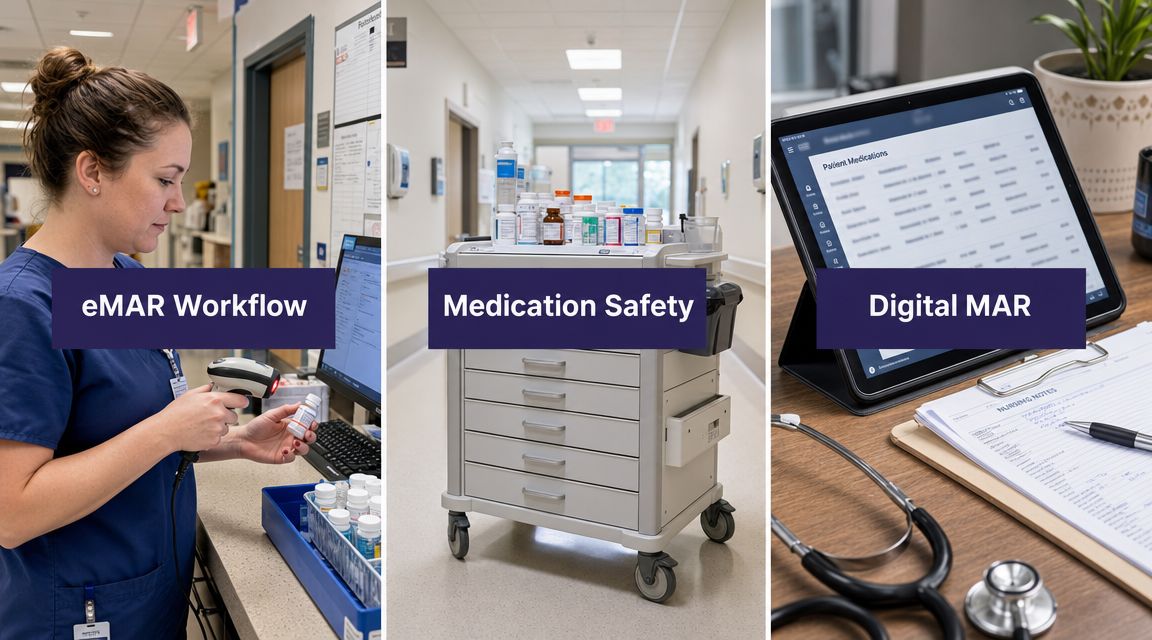
Paper medication passes don't fail because nurses stop caring. They fail because the process asks tired people to keep too much in their heads while also chasing updates across binders, sticky notes, faxed orders, and phone calls.
I've seen that pattern in long-term care and ambulatory settings. A med pass starts with good intent and ends with workarounds. Someone circles back to initial a dose later because a resident needed help. A new order arrives after the paper MAR was printed. A refill question sits in voicemail while staff are trying to keep the pass moving. None of this is unusual, which is exactly why electronic medication administration record software has become less of a nice-to-have and more of a basic operating tool.
The mistake is thinking the software itself fixes everything. Good eMAR systems can make medication administration safer, easier to audit, and easier to manage. Bad implementations just turn paper problems into screen problems. The difference comes down to workflow design, integration, and how honest you are about the work of change.
The familiar chaos of paper-based medication passes
The paper MAR binder usually looks organized from a distance. Up close, it's a different story.
A nurse starts the morning pass with a cart full of meds, a paper record that may or may not reflect the latest order, and a hallway full of interruptions. One patient refuses. Another is off the unit. A family member asks a question in the middle of the pass. Pharmacy calls back about a clarification. Meanwhile, every administration still has to be documented clearly and at the right time.
That's where paper starts to crack. The problem isn't just handwriting. It's timing, handoffs, and visibility.
Where paper breaks down in real life
On paper, the team has to do all of these things manually:
- Check the current order list: Staff often compare paper sheets against verbal updates, printed notes, or a separate chart.
- Track exceptions: Refused doses, late doses, and held meds need explanation, but the detail can be inconsistent.
- Keep signatures complete: A missed initial might mean a missed dose, or it might mean someone forgot to sign.
- Prepare for surveyors or audits: Staff have to reconstruct what happened from scattered documentation.
That kind of system depends on perfect follow-through during an imperfect shift.
Paper records don't just slow people down. They hide uncertainty until someone has time to go looking for it.
Why the risk feels normal until it isn't
One reason practices keep paper too long is that everyone learns how to cope with it. Nurses build personal routines. Charge nurses know where the weak spots are. Office staff call the pharmacy twice to make sure the order really changed. The process limps along because experienced people keep rescuing it.
But that isn't a stable system. It's human patchwork.
Once you've managed a survey response or had to trace a questionable administration event back through a binder, you stop romanticizing paper. The appeal of eMAR isn't that it looks modern. It's that it replaces a memory-driven process with a controlled one.
What is electronic medication administration record software
Electronic medication administration record software is not just a digital copy of the MAR. At its best, it is a point-of-care medication control system that helps staff verify what should be given, to whom, when, and how.
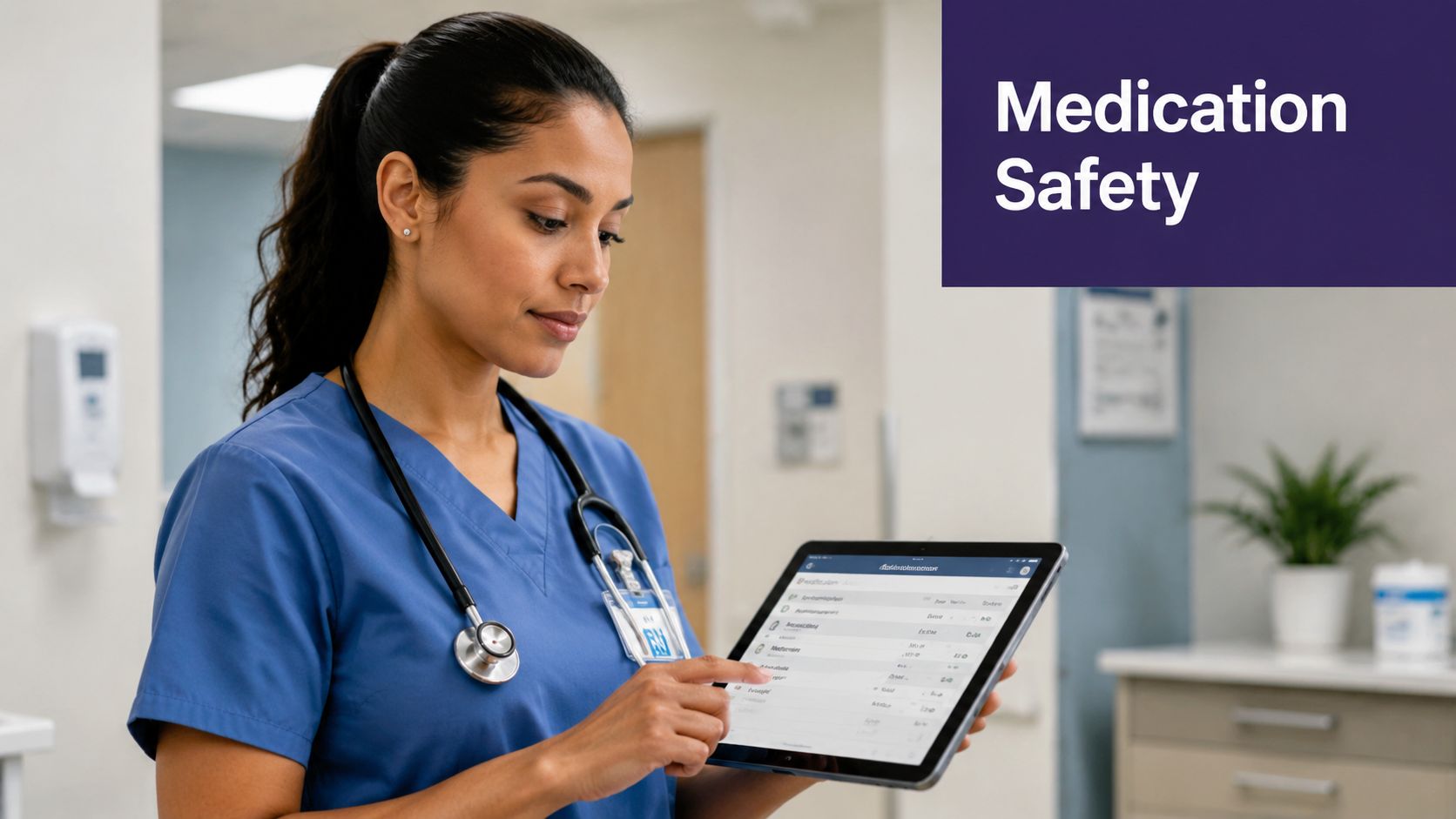
A solid eMAR supports the “five rights” of medication administration: right patient, right drug, right dose, right route, and right time. That matters because the software isn't only recording what happened after the fact. It is guiding the administration process while care is happening.
How the workflow changes
In a mature setup, the medication order flows from the prescribing and pharmacy side into the eMAR. Authorized staff then see that order on the medication worklist in real time. Instead of rewriting or rechecking the same information in multiple places, the nurse works from one current record.
That changes the nature of the med pass:
- The nurse opens the resident or patient profile.
- The scheduled medication appears with the active instructions.
- Barcode steps or verification checks confirm the patient and medication.
- The administration is documented immediately, with a timestamp and user record.
That is a very different process from documenting first on paper, then fixing discrepancies later.
Why barcode verification matters
Many buyers often underestimate the value. Barcode eMAR adds a live verification step before the medication reaches the patient. According to PointClickCare's eMAR overview, barcode eMAR systems have been shown to reduce medication administration errors by 41% in published studies.
That result makes sense from an informatics point of view. The software catches mismatch problems earlier in the workflow, before administration, instead of relying on someone to notice the error after chart review.
What eMAR is and what it isn't
It helps to be clear about the boundary.
- It is a clinical workflow tool: It organizes the med pass, supports verification, and records actions in real time.
- It is not a magic cleanup layer: If your medication data is stale, your interfaces are weak, or your refill process is chaotic, the eMAR will reflect those problems too.
- It is part of the legal health record: That means accuracy, access control, and documentation standards matter from day one.
Practical rule: If a vendor talks mostly about replacing paper, keep asking questions. The real value is in controlled workflow, not digitizing a form.
Core features that matter in daily practice
Feature lists are easy to inflate. Daily clinical use is not. The eMAR functions that matter most are the ones staff touch on every pass, every shift, and every exception.
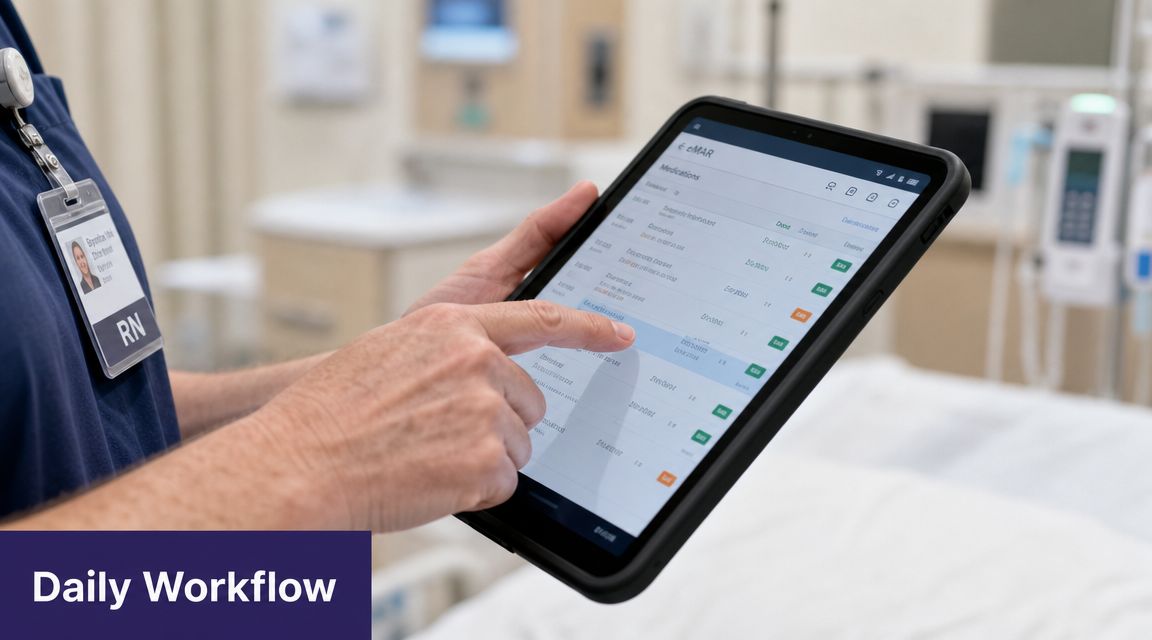
A 2023 systematic review screened 1,922 articles and included 41 studies on eMAR and BCMA. It found that implementation improved 52.3% of patient safety measures and 62.2% of clinician satisfaction measures, while efficiency results were more mixed, according to the review in JMIR Human Factors. That matches what many of us see on the ground. Safety and usability usually improve first. Speed comes later, if the workflow is designed well.
Medication scheduling and worklists
The first thing staff need is clarity. A good eMAR gives them a clean, current medication schedule with administration times, due windows, and exceptions that are easy to spot.
This sounds basic, but it changes the shift. Instead of flipping through pages to figure out what is due next, the nurse sees the worklist in sequence. That lowers the mental load, especially on high-volume passes.
Barcode medication administration
Barcode medication administration is one of the few features that staff understand instantly once they use it. Scan the patient. Scan the medication. Resolve a mismatch before the dose is given.
When BCMA is missing, staff often create their own safety checks. They re-read labels, compare names twice, or ask another person to confirm. Those habits are good, but they're inconsistent under pressure. Barcode verification turns that habit into a repeatable process.
Real-time charting and audit trails
Paper audit trails are only as good as the handwriting and the follow-up. Electronic documentation is easier to trust because the system captures who documented the administration and when.
That matters for more than compliance. It also helps charge nurses and managers answer practical questions quickly:
- Was the dose given or just prepared?
- Who documented the refusal?
- Did the timing drift over the course of the day?
- Was a held dose explained clearly?
Alerts and reconciliation support
Alerts can help or annoy, depending on how they're configured. Missed-dose prompts, duplicate therapy warnings, and administration timing checks are useful. Endless non-actionable popups are not.
Medication reconciliation is where many teams still struggle, especially during transitions of care. If your process is weak, the eMAR won't save you on its own. This is why I like to review the broader medication reconciliation process alongside the eMAR build. If those workflows don't fit together, staff end up correcting the same list over and over.
The real benefits we've seen safety, compliance, and efficiency
The return on an eMAR project is rarely just one thing. In practice, the gains show up in three places first: safer administration, cleaner compliance records, and less wasted effort around documentation.
Safety is usually the first clear win
Staff feel the safety benefit before they can always name it. They spend less time second-guessing active orders, less time checking whether a medication was already documented, and less time sorting out unclear initials.
A well-built eMAR reduces avoidable confusion. That matters because medication safety problems are often ordinary process failures, not dramatic mistakes.
Compliance gets easier because the record is readable
Survey prep changes once the record is digital and time-stamped. Instead of pulling binders and trying to reconstruct timelines, staff can review a legible administration history with documented exceptions.
That doesn't make audits painless, but it does make them more honest. You see patterns earlier. You can coach from actual documentation instead of anecdote.
The best compliance outcome isn't “we passed survey.” It's “we knew what surveyors would find before they walked in.”
Efficiency is real, but it comes later
My pushback in sales demos centers on this: Electronic medication administration record software can save time, but those gains usually arrive after staff stop fighting the build and trust the workflow.
The market direction shows that organizations still think the investment is worth making. The global eMAR software market for long-term care was valued at $597.3 million in 2023 and is projected to reach $1,066.8 million by 2030, according to Grand View Research's market analysis. That doesn't prove every implementation goes well. It does show this category is now established infrastructure, not an experiment.
If you're thinking about this more broadly, Nutmeg Technologies has a useful overview of digital transformation in healthcare that places medication systems in the larger shift toward connected clinical operations. That's the right lens. eMAR works best when it's part of a wider care delivery model, not a standalone purchase.
Integration connecting eMAR to your EMR and other tools
An eMAR that doesn't connect well to the rest of your stack will create new work faster than it removes old work.
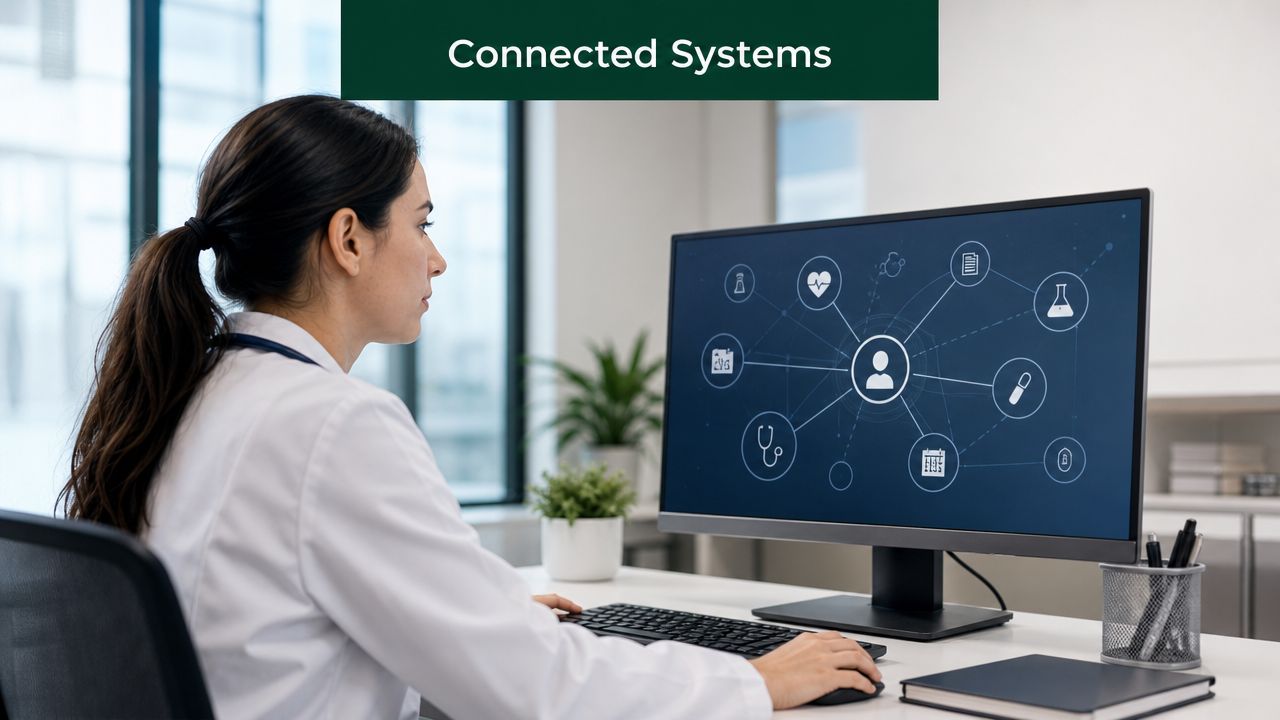
The best setup is simple to describe and hard to achieve. A provider enters or updates an order in the EMR. Pharmacy processes it. The approved medication appears in the eMAR without manual re-entry. Staff administer from the current list, and the documentation becomes part of the legal chart.
Where integrations usually fail
Problems usually show up in the gaps between systems:
- Order timing issues: The medication changes in one system, but not fast enough in another.
- Duplicate workflows: Staff still call, fax, or handwrite because they don't trust the interface.
- Partial interfaces: Demographics may sync, but medication orders or discontinuations don't.
- Exception handling: Hospital returns, held medications, or outside prescriptions break the normal process.
A peer-reviewed analysis noted that many eMAR systems still struggle with interoperability, and some facilities still rely on paper and fax for prescribing and pharmacy communication, as summarized by Definitive Healthcare's eMAR glossary. That matches what I've seen. “Integrated” can mean anything from true bidirectional data flow to a nightly file drop with a lot of staff cleanup in between.
Questions I always ask vendors
You learn more from integration questions than from a feature sheet. Ask these early:
| Integration area | What to ask |
|---|---|
| EMR connection | Which EMRs do you already connect to in live environments like ours? |
| Pharmacy interface | How do new orders, changes, and discontinuations move into the eMAR? |
| Data timing | Are updates real time, near real time, or batch-based? |
| Exceptions | How do you handle outside prescriptions, hospital returns, and held meds? |
I also want the vendor to show the workflow, not just describe it. If your organization is evaluating interface options, this guide on EMR integration software is useful background because it frames integration as an operational issue, not just an IT project.
Implementation is more than just installing software
The biggest eMAR mistake I see is treating go-live like a software deployment instead of a care process redesign.
You can buy a decent platform and still have a rough rollout if the current medication workflow is messy, inconsistent, or full of unofficial workarounds. The software will expose those problems quickly. That can be useful, but it won't feel pleasant.
What teams underestimate
Teams often underestimate four things:
- Workflow mapping: You need to know how orders arrive, who updates what, where exceptions live, and who reconciles discrepancies.
- Role changes: Nurses, aides, pharmacy contacts, and managers all work a bit differently after go-live.
- Training quality: Staff don't just need button training. They need scenario training.
- Post-live support: The first week is not the end of implementation. It's the start of stabilization.
A review of eMAR design challenges found barriers such as inadequate flexibility, poor information layout, and maintenance issues, which is why success depends heavily on workflow redesign and support, not just software choice. The underlying analysis is in this peer-reviewed review of eMAR design challenges.
What works better in practice
I've had better outcomes when teams do the boring work first. Walk the med pass. Shadow staff on different shifts. Write down every exception path. Test what happens with a refused dose, a late pharmacy delivery, a same-day order change, and a patient who returns from another setting with a different med list.
If the build only supports the happy path, staff will create side systems by day two.
You also need the right people on the project. Sometimes the failure point isn't clinical at all. It's that the organization can't get or keep the technical talent needed to build and support healthcare software well. If your group is dealing with that side of the problem, these Case studies in .NET talent acquisition are a useful reminder that staffing decisions shape implementation quality more than most leaders expect.
Enhancing eMAR workflows with voice AI
Even a good eMAR leaves one big problem untouched. Staff still spend a huge part of the day collecting the information that feeds medication workflows in the first place.

Refill requests, medication history updates, intake calls, discharge follow-up, and scheduling changes often start outside the eMAR. They begin on the phone, in voicemail, or during rushed front-desk conversations. Then someone has to document that information correctly so the rest of the system stays current.
Why upstream intake still matters
A key challenge in medication management is keeping records current when orders change or when patients move between settings. That creates a need for automated intake and reconciliation tools that help keep the record accurate, as discussed in Foothold Technology's overview of eMAR and current medication records.
That point gets missed in many software evaluations. Buyers focus on the med pass itself, but the med pass is only as clean as the data arriving before it.
Where voice AI fits
Voice AI is useful when it reduces manual intake work without creating more chart cleanup later. In the right setup, voice systems can:
- Capture refill requests: The system gathers the medication details, patient information, and the reason for the request.
- Document routine intake: Basic updates are recorded consistently instead of relying on handwritten notes.
- Queue work for staff review: Clinical teams review and approve instead of re-entering everything from scratch.
- Support reconciliation workflows: New information can feed the chart and reduce list drift over time.
This matters most in busy practices where calls interrupt clinical work all day. If you're exploring this category, it helps to understand what voice AI for healthcare looks like in operational terms, not just as a call-answering tool. The true value is in feeding cleaner information into the rest of the medication process.
What not to expect
Voice AI won't fix a bad formulary setup, poor pharmacy connectivity, or an eMAR build that staff hate. It is an upstream support layer, not a replacement for medication administration controls.
Still, it can remove a lot of the clerical drag that causes med lists to fall behind in the first place. That's a meaningful win, especially for smaller practices that don't have spare staff to absorb every refill call and chart update.
Your eMAR selection checklist
By the time you reach vendor demos, you should already know your hard parts. Maybe your problem is poor pharmacy connectivity. Maybe it's inconsistent documentation. Maybe it's that nobody trusts the current medication list. The right questions depend on that reality.
I'd use a checklist that forces vendors to talk about daily operations, not just product claims.
eMAR Vendor Evaluation Checklist
| Area of Inquiry | Key Question to Ask |
|---|---|
| Clinical workflow fit | Show us a full med pass for our setting, including refusals, held doses, and late administrations. |
| Five-rights verification | How does the system verify patient, drug, dose, route, and timing at the point of care? |
| Barcode support | What barcode steps are built in, and what happens when a scan fails? |
| Order management | How do new orders, changes, and discontinuations appear in the eMAR? |
| EMR integration | Which live integrations do you already support with systems like ours? |
| Pharmacy connectivity | What still requires phone, fax, or manual staff intervention? |
| Reconciliation workflows | How do you handle med list comparison during transitions of care? |
| Alerting logic | Which alerts are configurable, and how do you prevent alert fatigue? |
| Audit trail | What exactly is captured in the record, and how easy is it to retrieve for survey or review? |
| Usability | Can our staff test the mobile or tablet workflow before contract signature? |
| Training | What does role-based training look like for nurses, aides, managers, and super users? |
| Go-live support | Who is available during launch week, and how do issues get escalated? |
| Maintenance | How are updates, downtime, and interface changes communicated to customers? |
| Reporting | Which reports are standard, and which require custom build work? |
| Total cost | What costs sit outside the subscription, including interfaces, implementation, scanners, and support? |
A few questions I never skip
These are the ones that usually expose weak spots fastest:
- Ask for exception workflows: Normal workflows look polished in every demo.
- Ask who owns interface troubleshooting: Vendors and IT teams often assume the other side will handle it.
- Ask what customers complain about after six months: The answer is often more useful than the sales deck.
- Ask to speak with a site similar to yours: A hospital workflow and a small care facility workflow are not the same.
The right vendor is not just the one with the best screen design. It's the one that can support your actual operating model, with your staffing constraints, your pharmacy partners, and your charting habits.
If you're evaluating electronic medication administration record software now, don't leave the meeting with a brochure and a gut feeling. Leave with a documented workflow test, a list of interface commitments, and a clear picture of who will own the ugly parts after contract signing.
If your practice is trying to make medication workflows cleaner before they ever reach the eMAR, Simbie AI is worth a look. Its healthcare voice agents can handle intake, refill requests, chart documentation, and medication-related admin work around the clock, which helps staff spend less time chasing calls and more time on patient care.