
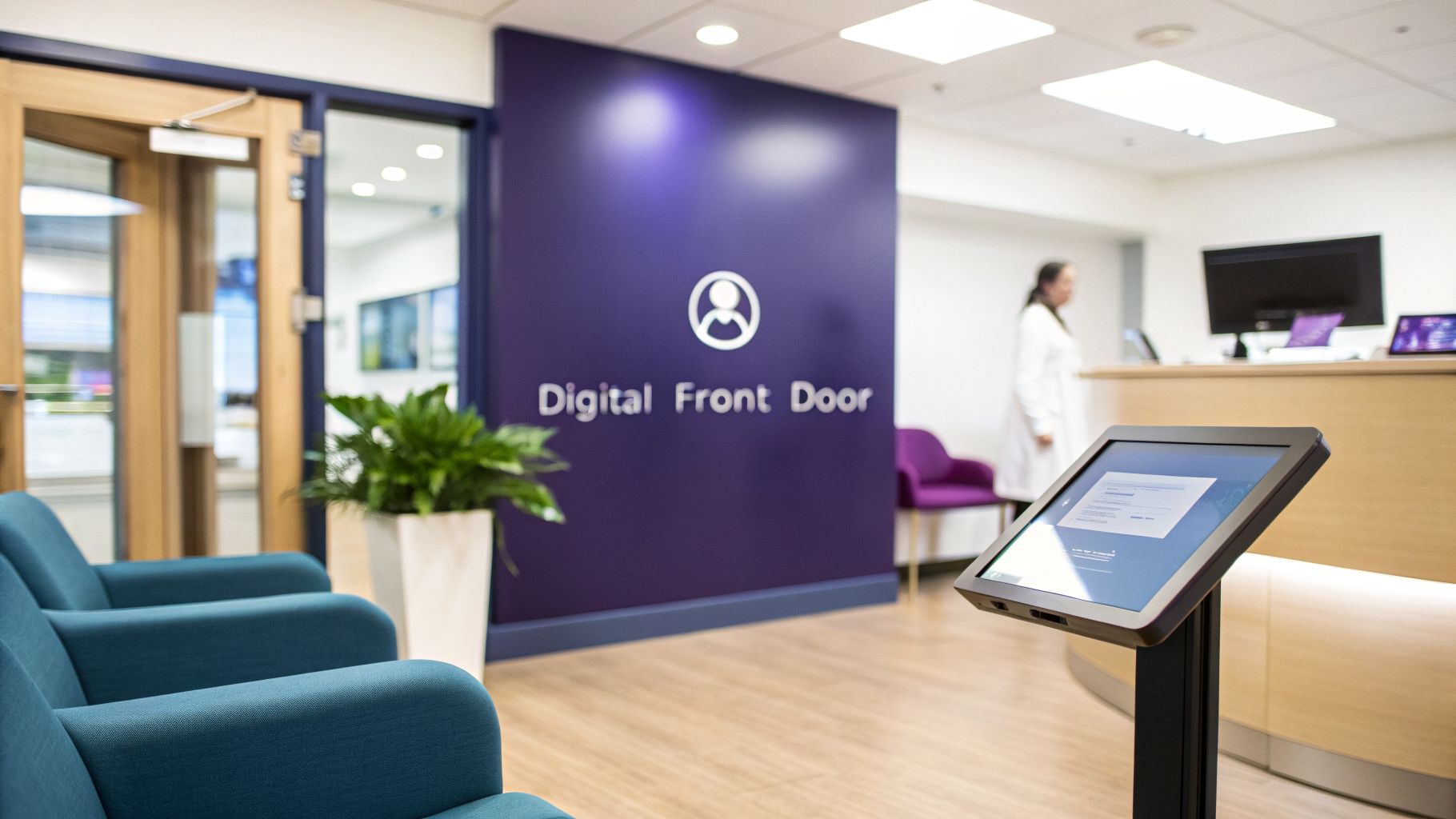
A digital front door in healthcare isn't a single piece of software. It’s a comprehensive, integrated strategy that weaves all your practice's digital tools together into one smooth, connected experience for your patients. Think of it as evolving healthcare to be as easy to navigate as ordering a pizza, managing your bank account online, or booking a flight. In a world where digital convenience is the norm, patients expect the same level of accessibility and control over their health journey.
This modern approach empowers patients, giving them control over their entire journey, from the moment they search for a doctor online to scheduling an appointment, completing intake forms, and receiving follow-up care. It's about meeting patients where they are—on their phones and laptops—and offering them the self-service tools they already use in every other aspect of their lives.

Unlocking Modern Patient Access
Let's be honest, the old way of doing things is broken and outdated. Patients are tired of playing phone tag, sitting on hold forever, and filling out the same clipboard of paperwork at every single visit. That traditional journey is disjointed, fragmented, and frustrating, forcing people to jump between different websites, phone numbers, and departments just to get the care they need. This friction not only creates a poor patient experience but also leads to administrative inefficiencies and staff burnout.
This outdated model creates headaches for everyone and simply doesn’t meet the high expectations people have today. A digital front door in healthcare is about completely redesigning that experience from scratch, shifting from a practice-centric model to a patient-centric one.
It’s less of a literal door and more like a smart, digital concierge who anticipates a patient's needs before they even ask. The whole point is to bring every digital interaction—scheduling, forms, payments, messaging—into one logical, intuitive flow. By tearing down the communication walls that make getting care so difficult, practices can create a seamless and supportive environment that builds patient trust and loyalty.
The Core Idea Behind the Digital Front Door
At its heart, this strategy is about moving from a reactive model, where the practice waits for patients to call, to a proactive one that guides them effortlessly. Instead of forcing patients to chase down information and connect the dots themselves, a good digital system guides them every step of the way with automated reminders, clear instructions, and easy access to information. It acknowledges that people now expect convenience, transparency, and personalization in every part of their lives, and healthcare should be no different.
A well-built digital front door brings several key pieces together into a unified ecosystem:
- Easy Discovery and Reputation Management: Patients can quickly find the right doctor and services online, often influenced by reviews and a strong digital presence.
- Simplified Scheduling: They have the power to book, change, or cancel appointments 24/7 from any device, no phone call needed. This self-service capability is a baseline expectation.
- Streamlined Intake and Registration: All the pre-visit forms, insurance details, and consent documents are handled digitally before the patient ever walks in, dramatically reducing wait times and administrative burden.
- Ongoing Communication and Engagement: Patients get automated appointment reminders, clear follow-up instructions, and can send secure messages to their care team for non-urgent questions, fostering continuous engagement.
- Integrated Telehealth Access: Virtual visits are seamlessly integrated into the patient's digital journey, making it simple to book and attend a telehealth appointment.
This unified approach makes sure the entire experience is connected, consistent, and simple. You can learn more about the technologies that create these modern patient access solutions and see how they work together. It’s all about building a healthcare system that respects people’s time and offers the kind of effortless, high-quality service they get everywhere else.
The Building Blocks of a Modern Digital Front Door
You can’t just buy a “digital front door” off the shelf. It’s not a single piece of software. Instead, think of it as a connected system—an ecosystem—of different technologies, all working in concert to create a seamless experience for your patients. It’s a lot like building a house—every part has its own job, but they all have to fit together just right for the whole structure to be sound and functional.
This integrated approach is catching on fast, and for good reason. The market for these kinds of digital health solutions is expected to jump from USD 31.66 billion in 2026 to a massive USD 82.25 billion by 2031. Why the exponential growth? Because patients want the same kind of easy, on-demand, personalized service from their doctor that they get from Amazon, Netflix, or their banking app. They are consumers first, and their expectations are set by these best-in-class digital experiences.

So, what are the essential pieces that make up this system? We can break them down into two main categories: the patient-facing tools that define the user experience, and the backend technologies and integrations that make it all run smoothly and securely.
Key Components of a Healthcare Digital Front Door
This table outlines the essential technologies that form a comprehensive digital front door strategy. Each component serves a distinct purpose, but their real power is unlocked when they work together to automate workflows, reduce administrative friction, and improve the patient journey from start to finish.
| Component | Primary Function | Key Benefit for the Practice |
|---|---|---|
| Online Scheduling | Allows patients to view open slots and book appointments 24/7 on your website or patient portal. | Drastically reduces phone call volume and eliminates the back-and-forth of finding a suitable time. |
| Digital Patient Intake | Enables patients to fill out forms, upload insurance cards, and sign consents from any device before their visit. | Minimizes waiting room delays, reduces data entry errors, and ensures staff has complete info upfront. |
| Secure Messaging | Provides a HIPAA-compliant channel for patients and providers to communicate about non-urgent matters. | Offers a convenient alternative to phone calls for follow-ups, questions, and sharing test results. |
| Telehealth Platform | Facilitates secure virtual consultations through video or phone, integrated directly into the EMR. | Expands access to care, improves convenience for patients, and creates new revenue streams. |
| Voice AI (e.g., Simbie) | Automates inbound phone calls, handling tasks like appointment booking and answering FAQs without human staff. | Ensures every call is answered 24/7, freeing up front-desk staff to focus on in-person patient needs. |
| EMR Integration | Creates a seamless data connection between all front-door tools and the electronic medical record system. | Eliminates manual data transfer, ensures a single source of truth for patient information, and automates workflows. |
| HIPAA Security | Implements robust encryption, access controls, and protocols to protect all patient data across the system. | Builds patient trust and ensures full compliance with federal regulations, avoiding costly fines. |
By combining these elements, a practice can build a robust digital front door that not only meets modern patient expectations but also drives significant operational efficiencies, reduces staff burnout, and ultimately improves financial performance.
Core Systems for Patient Interaction
At the very front are the tools your patients will actually touch and see. These are the components that replace old-school, manual processes with the kind of self-service options people have come to expect everywhere else. These are the digital touchpoints that define their perception of your practice.
- Automated Scheduling: This is a game-changer and a foundational element. It lets patients find and book their own appointments online, anytime, day or night, from their smartphone or computer. No more phone tag, and way less administrative work for your staff.
- Digital Patient Intake: Say goodbye to the clipboard for good. Before an appointment, patients can securely complete all their paperwork, upload their insurance card, provide their medical history, and sign consent forms right from their phone. This makes check-in a breeze and ensures data is accurate and available before the visit. You can see how this works with an AI patient intake solution.
- Secure Messaging: A simple, HIPAA-compliant messaging portal gives patients a direct, asynchronous line to your team for quick questions, prescription refills, follow-ups, or getting test results. This is far more efficient than phone calls for both parties.
These tools give patients more control, flexibility, and transparency, making their entire experience far more convenient and less stressful.
The Power of Integration and Automation
Behind the scenes, a few other technologies are doing the heavy lifting to make everything run like a well-oiled machine. These are the engines that connect all the pieces and automate your workflows. Without a solid, integrated back-end, even the slickest patient-facing tools will fall flat, creating more manual work for your staff.
Of course, a critical part of any digital tool in healthcare is keeping patient data safe. Properly Protecting PHI and incidental disclosure under HIPAA isn't just a feature; it's a foundational, non-negotiable requirement for every component in your system.
A truly effective digital front door isn’t just a collection of separate tools. Its real power comes from creating a single, unified system where data flows automatically, cutting out manual work, eliminating human error, and creating one source of truth for patient information.
One of the most powerful players here is Voice AI. An advanced system like Simbie AI can act as a virtual receptionist for your practice, 24/7. It answers inbound calls, schedules appointments, answers common questions, and handles other routine tasks, all without needing a person to pick up the phone. This means every call gets answered instantly, and your valuable staff can focus on the patients standing right in front of them and handle more complex, high-value interactions. It’s the perfect bridge, connecting the oldest form of patient communication—the telephone—to your modern, integrated digital system.
Why a Digital Front Door Is No Longer Optional
Let's be honest, the conversation about a digital front door in healthcare isn't about if you need one anymore—it's about how soon you can get one implemented effectively. Your patients live in a world where they can book a flight, deposit a check, or order groceries from their couch at 10 PM. They expect, and frankly demand, that same ease and control when it comes to managing their most important asset: their health.
Healthcare practices that stick to the old ways—endless phone calls, 9-to-5 business hours, and stacks of paper—are going to get left behind. This isn't just about modernizing for the sake of technology; it's about competitive survival. A smart, unified digital strategy is now the key to acquiring and retaining patients, growing your practice, and meeting the fundamental needs of both your staff and your patients.
Meeting Modern Patient Demands
Today’s patients think and act like consumers because they are. They value their time, they research their options, and they want convenience above all else. No one wants to play phone tag, sit on hold for ten minutes, or take time off work just to book an appointment during your rigid 9-to-5 business hours. A digital front door hands them the self-service tools they’re already used to using everywhere else, allowing them to engage with your practice on their own terms.
When you empower patients to manage their own care journey, you create a much better, more respectful experience. It’s that simple. They feel seen, heard, and in control, which is exactly what builds the kind of lasting loyalty that drives a practice forward.
A recent study revealed that a staggering 81% of patients are unhappy with their healthcare experience. Giving them 24/7 access to scheduling, easy-to-use digital forms, and clear communication channels is one of the fastest ways to fix that and keep them coming back.
When you offer these tools, you’re not just providing a service; you’re showing patients you understand and respect their modern lives. You’re turning what was once a major headache into a smooth, simple, and positive interaction.
Boosting Practice Efficiency and Reducing Burnout
While making patients happy is the ultimate goal, the benefits for your practice's internal operations are just as powerful, if not more so. Your front-desk staff is likely drowning in a sea of administrative tasks—the constant phone calls, the mind-numbing data entry from paper forms, the repetitive questions. It’s a perfect recipe for stress, errors, and burnout. A digital front door automates a huge chunk of that manual work.
- Less Admin Overload: Automating tasks like scheduling, registration, and intake can free up 30-40% of your staff's time. Imagine what they could do with that time—like giving more focused, empathetic, in-person attention to the patients right in front of them or managing complex billing issues.
- Lower Staff Burnout: Taking the most tedious, repetitive work off their plates creates a less stressful, more rewarding job. That means better morale, lower employee turnover, and a happier, more experienced team that provides better patient care.
- A More Efficient Practice: When workflows are automated, patient information flows straight into your EMR without manual keying. This cuts down on typos and errors, reduces no-shows with automated reminders, and helps the whole practice run more smoothly and profitably.
This isn't just an expense; it's a strategic investment in a more resilient, efficient, and profitable future for your practice. You’re essentially transforming your front office from a chaotic call center into a well-oiled machine. Investing in a digital front door in healthcare creates a healthier work environment for your team and directly strengthens your bottom line.
How the Digital Front Door Looks in the Real World
The idea of a digital front door in healthcare isn't just theory; it’s being put into practice every day by forward-thinking organizations. While the goal is always to create a simpler, more connected patient journey, how it gets done can look very different depending on whether you're a massive hospital network or a small local clinic. The strategy must be tailored to the organization's scale, resources, and patient population.

Large Hospitals and Health Systems
Big health systems often go all-in, building comprehensive, branded mobile apps that become a central hub for everything a patient needs. Think of it as a one-stop shop for healthcare, designed to keep patients engaged and within their network for all their care needs.
- Integrated Patient Portals: Patients log in to a single app to see their entire medical history, check lab results, view imaging reports, and message specialists across the entire network.
- Unified Billing and Payments: Instead of getting separate, confusing bills from different departments (like radiology, the lab, and the physician), the app pulls everything together into one clear summary that’s easy to understand and pay online.
- Centralized Appointment Management: A patient can schedule an appointment with their primary care doctor, a physical therapist, and a specialist all in one place, across multiple locations, with a unified and consistent scheduling experience.
This "walled garden" approach is fantastic for building patient loyalty and increasing patient lifetime value. It makes staying within the health system so convenient and seamless that patients have little reason to look elsewhere for care. It’s like the Apple ecosystem—everything just works together, creating a sticky and superior experience.
Independent Practices and Clinics
For smaller, independent practices, a custom-built, all-encompassing app is usually out of reach due to cost and complexity. But they don't need a huge IT budget to compete effectively. Instead, they can adopt a more agile, modular approach. They focus on adopting smart, specialized tools that solve their most pressing problems first and build from there.
A great starting point for many small practices is using a Voice AI tool like Simbie AI to handle the relentless, overwhelming volume of phone calls. This single change makes a huge and immediate difference, ensuring every call gets answered 24/7 without burning out the front desk staff. This frees the team to give their full, undivided attention to the patients in the office. From that initial win, they can layer on other integrated tools for online scheduling or digital intake, building a powerful and cost-effective digital front door in healthcare one step at a time.
The New Competitive Landscape
It's important to remember that traditional providers aren't the only ones in the game anymore. A new wave of competitors, from retail clinics in CVS and Walmart to well-funded digital health startups and even health insurers, are launching their own slick digital experiences. They are setting a new, higher bar for patient expectations across the entire industry. Convenient, on-demand access is quickly becoming the standard, not the exception.
The digital front door is rapidly becoming a $54 billion imperative for healthcare leaders. As patients become more empowered consumers, they are demanding the kind of personalized and convenient care they receive from top retail brands. You can discover more insights about this growing market trend and what it means for healthcare's future.
This intense competitive pressure means that having a digital entry point is no longer a "nice-to-have" feature—it's essential for survival and growth. Whether you're a large hospital or a solo practitioner, if you don't make it easy for patients to find you and connect with you online, they will find someone who does.
Building Your Digital Front Door Strategy Step by Step
Creating an effective digital front door in healthcare isn't a one-and-done software purchase. It’s a fundamental shift in how your practice operates, engages with patients, and manages its workflows. It demands a smart, thoughtful, and strategic plan. Trying to do everything at once is a classic mistake and a sure-fire way to overwhelm your team, confuse your patients, and waste resources. The key is to take a phased, methodical approach, tackling your biggest problems first to get the biggest wins.
Start by taking a good, hard look at your current patient journey. Literally map it out from the patient's perspective, from the moment a person decides they need care to their final follow-up communication. Where are the snags? Where does frustration build up for both patients and staff?
Is it the endless phone tag just to book a simple appointment? Maybe it’s the waiting room logjam, with patients juggling clipboards and insurance cards while your staff struggles to keep up. Or is it the constant no-shows that throw your entire day's schedule off, wasting valuable provider time? Identifying these specific pain points tells you exactly where to begin your digital transformation.

Start with a High-Impact Solution
For most independent practices, the telephone is the single biggest bottleneck. Your front desk staff are constantly fielding calls for routine, low-value tasks—scheduling, reschedules, cancellations, refills, directions, and basic questions. This ties them up for hours and leaves patients stewing on hold, creating a poor first impression. That’s why automating your phone lines is often the most logical and impactful first step.
Bringing in a Voice AI solution gives you immediate and measurable relief. It’s a quick win that proves the value of the whole digital front door project to your team and leadership. Suddenly, you have a system working 24/7 so no call ever goes unanswered and patients can self-serve for common requests. Your team is instantly freed up to focus on the patients standing in front of them and handle more complex issues that require a human touch. This one change can do wonders for staff burnout and patient happiness, creating the perfect momentum to keep going and build on this success.
Adopting a digital front door in healthcare is like renovating a house. You wouldn't tear down all the walls at once. You start with the room that makes the biggest difference—like the kitchen—and build out from there, ensuring each step adds value.
Select the Right Technology Partners
With that first win under your belt, you can start layering in other tools, such as online scheduling or digital intake. As you evaluate new technology, keep two non-negotiable factors at the top of your list: ironclad HIPAA compliance and seamless EMR integration.
- Prioritize HIPAA Compliance: Any tool that touches, stores, or transmits Protected Health Information (PHI) absolutely must be HIPAA-compliant. This is not the place to cut corners. Do your homework, vet potential vendors, request their security documentation, and make sure they have ironclad security protocols to protect patient data.
- Demand EMR Integration: A collection of disconnected, siloed apps creates more work, not less. Your digital front door is only effective if information flows smoothly and automatically from one system to another. Your scheduler, intake forms, and patient messaging all need to talk to your EMR in real-time. This eliminates tedious manual data entry, reduces errors, and ensures everyone is working from a single, reliable source of patient information. A solid EMR system integration is the foundational plumbing of a truly connected and efficient digital practice.
Prepare Your Team for a Smooth Transition
Great technology is only one part of the equation. Your team is the other, equally important, part. They need to be brought along on the journey and properly prepared for the new way of doing things. Solid, ongoing training is essential so everyone feels confident and proficient with the new tools and understands how they fit into the daily workflow.
Be sure to communicate the why behind the change. Show your staff how these tools will make their lives easier, not harder, by eliminating repetitive tasks and freeing them up to focus on what they do best: providing excellent patient care. When your team is on board, understands the benefits, and is excited about the changes, your patients will feel that positive energy, creating a better experience for everyone involved.
Answering Your Top Questions About the Digital Front Door
Even the most well-planned strategy comes with questions. When practice leaders and physicians start exploring a digital front door in healthcare, a few key concerns almost always pop up. Let's tackle them head-on so you can move forward with clarity and confidence.
"Is this just for big hospital systems?"
Not at all. This is a common misconception. While large hospitals were certainly the first to jump in due to their scale and resources, today's tools are designed to be affordable, scalable, and accessible for practices of all shapes and sizes. You don't need a huge IT team or a bottomless budget to see a massive impact.
Think about it this way: a solo practitioner using a Voice AI to catch every single patient call suddenly has the same 24/7 availability and responsiveness as a major health system. For a small, lean team, those efficiency gains aren't just helpful—they're often a game-changer that allows them to compete and thrive. The modern technology landscape has democratized access to these powerful capabilities.
"How can we be sure patient data is secure?"
Security is everything. It's the absolute, non-negotiable foundation of any digital tool you introduce into your practice. When you're looking at potential technology partners, your first and most important questions should be about HIPAA compliance, their security architecture, and their data protection protocols.
Your digital front door is a direct extension of your practice's promise to protect patient privacy. Every single component, from messaging to scheduling, has to be built on a bedrock of trust and ironclad security.
Drill down on the specifics. You should be looking for vendors who can demonstrate:
- End-to-end encryption on all messages and data transfers.
- Secure, cloud-based data storage that meets or exceeds all federal and state requirements.
- Transparent documentation of their compliance, security audits (like SOC 2), and Business Associate Agreements (BAAs).
Any vendor worth your time will be eager to show you how they protect patient health information (PHI) and answer every one of your security questions in detail. If they're cagey, evasive, or can't provide clear documentation, walk away immediately.
"What's the best first step to get started?"
Start with your biggest headache. Don't try to boil the ocean. My advice? Identify and solve the single largest bottleneck in your practice, and for most clinics, that’s the relentless, time-consuming flood of phone calls. This is where you'll get the biggest and fastest win with the least disruption.
Putting a Voice AI on your phone lines delivers an immediate, tangible return on investment. It instantly stops your front desk staff from being bogged down by routine scheduling requests, basic questions, and other repetitive FAQs. Nailing this first step creates incredible momentum for your entire digital front door in healthcare strategy because it proves the value from day one, making your staff's lives easier and improving the patient experience simultaneously. It's the perfect foundation upon which to build the rest of your digital ecosystem.
Ready to take that first, high-impact step? Simbie AI is a clinically-trained Voice AI that puts your phone lines on autopilot, 24/7. You’ll free up your staff for higher-value work and give every patient a perfect, instant experience when they call. Discover how Simbie can transform your practice today.