
If you're a practice manager, you know the drill all too well: mountains of paperwork and endless hours on hold with insurance companies. Automated prior authorization is the answer to this administrative nightmare.
It uses smart technology to take over the entire process of getting that crucial pre-approval from payers. Instead of manual phone calls and faxes, you get an efficient, software-driven system that slashes administrative work and gets patients the care they need, faster. By streamlining this critical but often frustrating step in the revenue cycle, automation helps medical practices improve efficiency, reduce claim denials, and ultimately enhance the patient experience. This guide will walk you through how it works, the benefits it offers, and how to implement it in your own practice.
Escaping the Paperwork Trap with Automation

For most healthcare practices, prior authorization is a constant battle. It's a soul-crushing cycle of filling out forms, waiting on hold, and tracking down information that pulls your best people away from what they should be doing—caring for patients. This manual process is not just inefficient; it's a significant operational drag that impacts everything from staff morale to patient care timelines.
In fact, the average medical practice sinks a staggering 13 hours a week into managing these requests. That's nearly two full workdays dedicated to administrative tasks that could be handled more effectively. This administrative quicksand doesn't just cause headaches; it creates real bottlenecks that delay necessary treatments. Trying to manage prior authorizations manually is like trying to navigate a cross-country road trip with a crumpled, outdated paper map. You might get there eventually, but the journey will be slow, frustrating, and full of wrong turns.
Putting Administration on Autopilot
Now, imagine having an administrative autopilot. That’s exactly what automated prior authorization provides. Instead of your team manually digging through patient charts, deciphering payer-specific rules, and submitting requests one by one, a smart system does all the heavy lifting for you. It acts like a digital assistant that plugs right into your existing Electronic Medical Record (EMR).
From there, it automatically pulls the right clinical notes, fills out the correct forms based on up-to-the-minute payer requirements, and sends the request off electronically. This is more than just new software; it’s a complete operational upgrade. By integrating directly with existing systems, it creates a seamless flow of information that eliminates the need for manual data entry and reduces the likelihood of human error.
An automated system verifies medical necessity and submits requests in moments, not hours. This transforms prior authorization from a reactive, manual chore into a proactive, streamlined workflow.
This frees up your administrative team to focus on what truly matters: engaging with patients, handling complex scheduling, and ensuring a smooth front-office experience. Automation takes over the repetitive, mind-numbing tasks so your practice can run like a well-oiled machine. You can learn more about the wider benefits of automating healthcare processes and how it reshapes the modern clinic.
To get a clearer picture of just how different these two approaches are, let's compare them side-by-side.
Manual vs Automated Prior Authorization At a Glance
| Metric | Manual Prior Authorization | Automated Prior Authorization |
|---|---|---|
| Process | Phone calls, faxes, manual data entry, navigating multiple payer portals. | Integrated with EMR, electronic submission, real-time status updates. |
| Time to Submit | 20-30 minutes per request on average. | 2-3 minutes per request. |
| Approval Time | Can take days or even weeks. | Often provides instant or same-day decisions. |
| Error Rate | High, due to human error in data entry and outdated payer rules. | Low, with built-in checks for accuracy and completeness. |
| Staff Focus | Administrative tasks: paperwork, phone calls, follow-ups. | High-value tasks: patient engagement, complex case management. |
| Cost | High operational costs due to staff hours and administrative overhead. | Lower operational costs and increased staff efficiency. |
This table makes the contrast pretty stark. The old way is slow, inefficient, and prone to errors that lead to costly denials. The new way is fast, accurate, and empowers your team to work smarter, not harder.
By removing the friction of manual work, automated prior authorization helps your practice get ahead in a few key ways:
- Reduced Administrative Workload: Your team reclaims hours once lost to paperwork and phone tag.
- Faster Approval Times: Patients get the green light for necessary care much sooner.
- Lower Denial Rates: Automated checks catch errors and missing information before submission, preventing rejections.
- Improved Staff Morale: Taking away the most tedious part of the job helps reduce burnout and boost satisfaction.
The Hidden Costs of Manual Prior Authorizations

Manual prior authorizations are so much more than a daily annoyance. They’re a silent drain on your practice’s financial health and a major source of frustration for your team. Every request handled by phone or fax is an opportunity for something to go wrong, chipping away at both your revenue and your staff's morale. The cumulative effect of these small inefficiencies can be devastating over time.
Sticking with these old-school methods is like trying to plug a leaky pipe with your bare hands. Eventually, the pressure builds up, and the consequences spill over into three critical areas: delayed patient care, burned-out staff, and serious revenue leaks. It's a domino effect. A simple clerical error—a mistyped CPT code or a missing clinical note—can trigger an immediate denial. That single mistake forces your staff to start the entire time-consuming process all over again, while a patient is left waiting for care they urgently need.
The Financial Bleed from Preventable Denials
Claim denials are one of the biggest sources of lost income for any practice, and manual processes are almost always the culprit. When your staff is forced to navigate a maze of constantly changing payer rules without any help, mistakes aren't just possible; they're practically guaranteed. A single incorrect digit or a missing piece of documentation can halt the entire revenue cycle for a particular service.
We've seen prior authorization denials shoot up recently. Commercial claims saw a 20% increase in denials, and Medicare Advantage (MA) claims jumped by a staggering 55% between 2022 and 2023 alone. This isn't just bad luck—it's the direct result of manual errors colliding with payers who shift their requirements on a whim, creating chaos for administrators.
This trend forces you into a painful cycle of rework, appeals, and write-offs that hits your bottom line hard. Each denial requires additional staff time to investigate, correct, and resubmit, compounding the initial cost of the manual process. It’s a costly problem that an automated prior authorization system is built to fix.
Manual prior authorization isn't just inefficient; it's a significant business risk. Issues with authorizations are responsible for up to 35% of all denied claims, creating a direct and preventable revenue leak for healthcare providers.
How Manual Errors Impact Patient Care
Beyond the financial headaches, the most damaging cost of manual processes is the toll they take on patients. When approvals are delayed, treatment is delayed. For patients dealing with chronic conditions, awaiting surgery, or needing specialized medication, these delays can cause significant physical and emotional distress. This can lead to worse health outcomes and a whole lot of anxiety for the people who depend on you.
The most common failure points are frustratingly simple:
- Incorrect CPT Codes: One wrong digit can cause an automatic rejection, leading to hours of phone calls to sort it out.
- Incomplete Documentation: Forgetting to attach a single required clinical note can send the request right back to the beginning.
- Outdated Payer Rules: Your staff might follow old guidelines, unknowingly submitting a request that’s no longer compliant with what the payer wants.
Each of these small mistakes can add days, or even weeks, to the approval timeline. By not tackling the root cause—the reliance on manual labor for a complex, rule-based task—practices are letting administrative hurdles get in the way of providing timely care. For a deeper dive into the basics, you can explore our guide on what prior authorization is in healthcare. The case for change is clear—automation isn't just a nice-to-have anymore; it's essential for modern medical practices.
How Automated Prior Authorization Actually Works
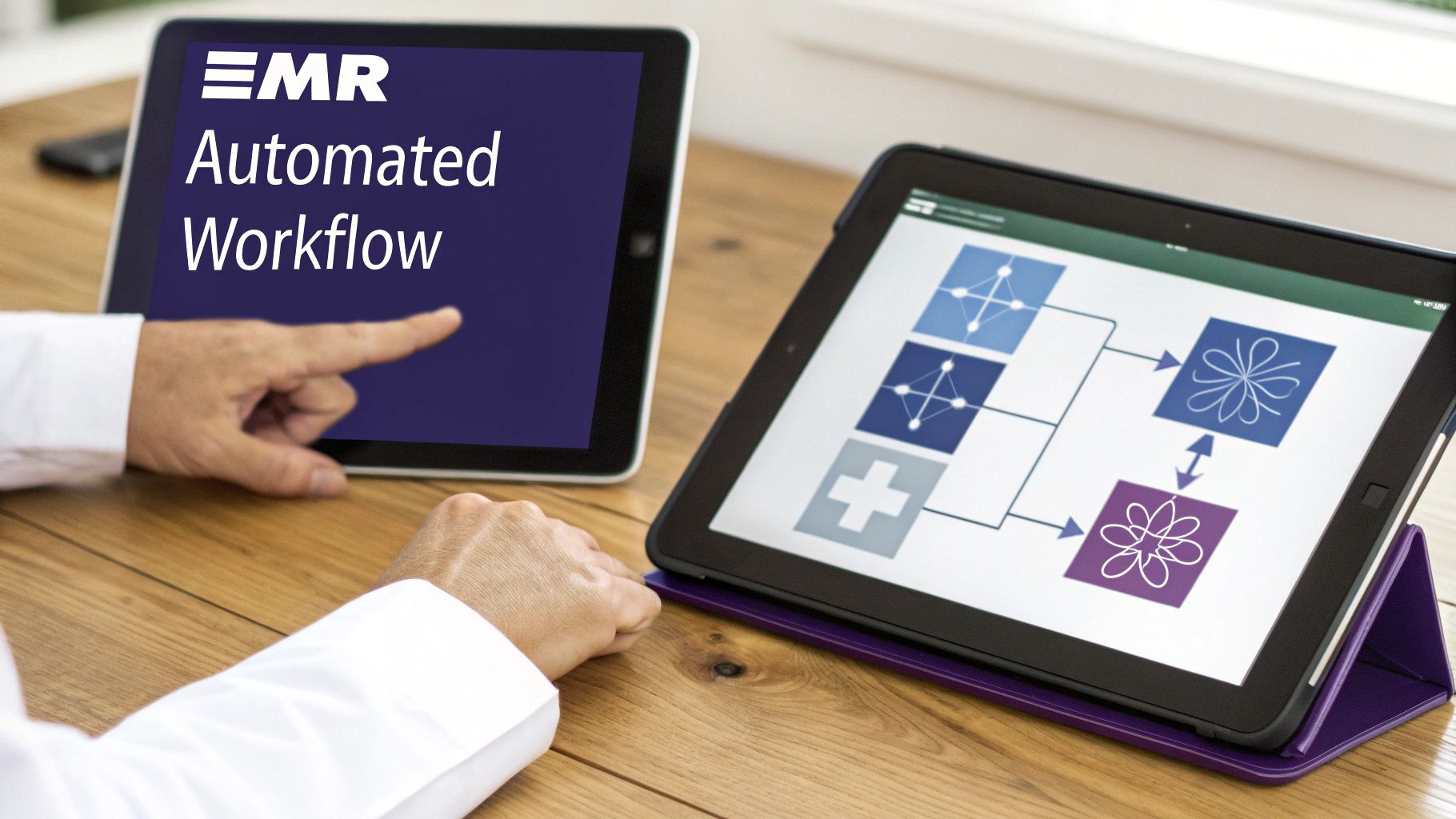
Think of an automated prior authorization system as a smart digital assistant that lives inside your practice’s Electronic Medical Record (EMR). The moment a provider orders a procedure that needs pre-approval, this assistant gets to work. No more manual chart-pulling or searching for files. It acts as an intelligent layer on top of your existing infrastructure, orchestrating the entire authorization process without human intervention.
This direct connection to the EMR is what makes it all possible. The software is built to talk to your EMR, securely pulling the exact patient data and clinical notes required for the submission. It happens instantly, cutting out the delays that make the traditional process so frustrating. This deep integration ensures data accuracy and completeness, which are the cornerstones of a successful submission.
The Core Technology in Action
So, what’s going on under the hood? The system runs on two key technologies: Artificial Intelligence (AI) and Natural Language Processing (NLP). The AI acts as the brain, constantly learning and applying each payer’s unique and ever-changing rules. This rules engine is continuously updated, ensuring that every submission adheres to the most current payer requirements, something that is nearly impossible for a human team to manage.
NLP gives the system its ability to read and understand human language. It can scan unstructured clinical notes—the kind doctors actually write—to find the specific details that prove medical necessity. It’s trained to spot the keywords, diagnoses, and treatment histories that an insurance reviewer is looking for. This is a critical capability, as it translates complex medical narratives into the structured data payers require.
Getting different systems to talk to each other is crucial. This is where SaaS integration in business automation becomes so important, as it allows the authorization software to pull data from the EMR and send it to the right payer without a human touching it. The final output is a perfectly assembled submission, every single time. The system gathers all the necessary documents, fills out the payer’s forms with 100% accuracy, and submits the request electronically.
From Submission to Decision
But the job isn't done after hitting "submit." The automated system keeps a close eye on the request in real time, giving your team instant updates. No more logging into a dozen different payer portals just to check a status. All information is centralized in a single, easy-to-use dashboard.
Automated systems don't just submit requests; they manage the entire lifecycle. By tracking submissions and providing real-time status updates, they turn a black box of uncertainty into a transparent and predictable workflow.
This constant monitoring is a game-changer. If a payer asks for more information or makes a decision, your staff is notified immediately. This allows your team to act fast, keep the process moving, and shrink the approval timeline from weeks down to hours or even minutes. This proactive approach prevents requests from falling through the cracks and ensures a prompt resolution.
Here’s a simple breakdown of the automated workflow:
- Request Initiation: A provider orders a service in the EMR, which automatically kicks off the prior authorization process.
- Intelligent Data Collection: The software securely accesses the patient's file and uses NLP to pull out the relevant clinical information.
- Automated Form Submission: It fills out and submits the correct electronic forms based on the payer's current rules.
- Real-Time Status Tracking: The system watches the submission status and sends instant updates to your team.
- Final Documentation: Once approved or denied, the decision is automatically recorded back in the patient's EMR, closing the loop.
Real-World Benefits of Automating Your Workflow

Switching to an automated prior authorization system does more than just save a bit of time—it brings real, tangible results that you can see in your clinic's day-to-day. It takes what is often a chaotic, mistake-filled process and turns it into a predictable and efficient part of your workflow. The change isn't just on paper; you'll feel it across the entire practice, from the front desk to the billing department.
These benefits show up directly in your bottom line. When you take manual data entry and guesswork out of the equation, you drastically lower the risk of denials from simple human error. That means cleaner claims and a much healthier revenue cycle. Reducing denials means less time spent on appeals and rework, and more predictable cash flow for the practice.
Slashing Administrative Workloads
One of the first things you'll notice is how much administrative weight is lifted from your team's shoulders. No more spending hours on hold or jumping between dozens of different payer websites. The software takes over the grunt work, allowing your staff to manage by exception rather than handling every single case manually.
This isn't just a small improvement. Across the board, practices using automated prior authorization are cutting their administrative workload by a massive 75%. We're seeing this firsthand as electronic prior authorization (ePA) platforms use smart technology to predict what needs approval and handle the processing automatically. For example, one large Midwest health system saw its prior authorization turnaround drop from an average of 7 days down to just 1.2 days after putting an ePA solution in place. You can dig into more examples in this report on prior authorization technology trends. This reclaimed time can be reallocated to more valuable, patient-centric activities.
Accelerating Approvals and Patient Care
With automation, that agonizing wait for a payer’s green light can become a thing of the past. The old manual way often leaves patients hanging for days, sometimes weeks, for necessary care. This adds a ton of stress and can even lead to worse health outcomes if a condition progresses while waiting for approval.
An automated system can shrink that timeline from days to minutes. It sends a perfectly put-together request the second it’s ready, often getting an approval back instantly or on the same day. This speed is a huge win for the patient experience and lets you get treatments on the calendar right away, improving patient throughput and clinic efficiency.
Automation transforms prior authorization from a roadblock into an enabler of timely care. By reducing approval times, you not only enhance patient satisfaction but also improve clinical outcomes by getting treatments started sooner.
Getting approvals faster means your clinic runs more smoothly, but more importantly, it frees up your skilled staff. Instead of chasing paperwork, they can focus on the patient-facing work that truly requires a human touch, such as care coordination and financial counseling.
Boosting Staff Morale and Reducing Burnout
Let's be honest: battling with insurance companies over prior authorizations is a recipe for burnout. It’s a frustrating, thankless task that wears people down. When you implement an automated prior authorization workflow, you remove one of the biggest daily headaches your team faces, leading to a more positive and productive work environment.
The positive effects ripple through your whole office:
- More Fulfilling Work: Your staff gets to focus on meaningful tasks, like helping patients and solving complex care coordination issues. This leverages their skills and expertise far more effectively.
- Lower Turnover: A less stressful environment makes for happier employees, which helps you keep your best people and avoid the high cost of recruiting and training new ones.
- Better Patient Focus: With administrative busywork off their plates, your team can put all their energy into creating a great patient experience, from scheduling to follow-up care.
In the end, automating your workflow isn't just about the money. It's a genuine investment in your people and the quality of care you provide.
Getting Ready for What's Next in Healthcare Administration
The ground is shifting beneath our feet in healthcare administration. Between new federal rules and lightning-fast tech advancements, the entire prior authorization game is changing. For practices that get ahead of these shifts, what looks like a regulatory headache can actually become a major competitive advantage. The future belongs to practices that embrace technology to become more agile and responsive.
Let's be honest, the old way of doing things—endless phone calls and fax machines—is on its last legs. We're moving toward a world where data moves instantly and securely between providers and payers. Getting a handle on these trends is the first step to making sure your practice doesn't get left behind. Those who fail to adapt risk becoming operationally inefficient and competitively disadvantaged.
Riding the New Regulatory Wave
A huge part of this shift comes from the CMS Interoperability and Prior Authorization Final Rule. This isn't just a friendly suggestion; it’s a mandate. It's forcing health plans to build and maintain specific APIs (the tech that lets different systems talk to each other) to automate the entire prior authorization process. This rule aims to break down the data silos that have plagued healthcare for decades.
By 2027, payers will have to make decisions faster and give clear, specific reasons for any denials. What does this mean for you? It means having an automated prior authorization system will be non-negotiable if you want to play in this new, faster, more transparent sandbox. Practices that adopt these technologies now will be well-prepared when these regulations take full effect.
At its core, this regulatory push is all about standardization. The goal is to get rid of the chaotic mess of different payer portals and processes, creating one clean, simple channel for all prior authorization conversations.
This move will really level the playing field, making it much easier for practices of any size to work with payers without pulling their hair out. It replaces a fragmented, frustrating system with a streamlined, predictable one.
The Whole Industry is Moving This Way
This isn't just a government thing, either. The healthcare industry is in the middle of a massive tech upgrade. Right now, 52.5% of U.S. providers are already using more flexible IT systems to handle electronic prior authorizations. This number tells a story: the entire industry is hungry for more efficiency and a single, standard way of doing things. You can dive deeper into this on IDC's blog about AI and the prior authorization crisis.
The big insurance companies are jumping on board, too. More than 50 health plans, including giants like Aetna and Cigna, have publicly committed to revamping how they handle prior authorizations. Their goals are pretty straightforward:
- One Way to Submit: They want to use a standard format (called FHIR) for all submissions to keep things consistent.
- Quicker Decisions: The target for 2027 is to give 80% of responses in real-time.
- Clearer Communication: They've promised to explain their decisions better and make sure patient care isn't interrupted.
When you bring automated prior authorization into your practice now, you're doing more than just installing new software. You're aligning your team with where healthcare is headed, setting yourself up to thrive in a much more connected and efficient future.
Your Guide to Implementing Automation
Bringing an automated prior authorization system into your practice is a big move, but with a solid game plan, it doesn't have to be overwhelming. Think of it less as a massive overhaul and more like a strategic upgrade to your practice’s engine. The real work actually begins long before you ever sign on the dotted line. A thoughtful implementation strategy is key to realizing the full benefits of the technology.
First things first, you need to take a hard look at how you're doing things right now. Where are the most frustrating bottlenecks? Are there specific insurance companies or procedures that always seem to bog you down? Conduct a thorough workflow analysis to map out your current process, identify pain points, and quantify the time and resources spent on manual tasks. Pinpointing these headaches is crucial because it tells you exactly what problem you need the new tech to solve. This way, you can find a solution that fits your real-world needs, not just a generic one.
Defining Your Must-Have Features
Once you've figured out your "why," it's time to focus on the "what." Let's be clear: not all automation platforms are the same. You need a system that's built for what your practice actually does day-to-day. For those interested in the nitty-gritty of how these systems work, especially those using artificial intelligence, you can find more info from specialists in AI-powered automation solutions.
Before you even start looking at different vendors, make a checklist of your non-negotiables. Here are a few features that should probably be on that list:
- Seamless EMR Integration: The last thing you want is another silo. The system absolutely must connect smoothly with your current Electronic Medical Record to avoid endless re-keying of patient info. Look for a vendor with proven integration experience with your specific EMR.
- Multi-Payer Support: Your platform should have a massive, up-to-date library of rules for all the major payers you deal with. No exceptions. Ask potential vendors for their payer list and how frequently their rules engine is updated.
- Real-Time Status Tracking: Your staff needs one place—a single dashboard—to see the status of every single request. No more jumping between a dozen different payer websites. This visibility is essential for efficient workflow management.
- Robust Analytics and Reporting: You have to be able to measure success. The system should let you track denial rates, how long approvals take, and how much more productive your team is. These metrics will demonstrate the ROI of your investment.
Choosing the right technology is about more than just a list of features. It’s about finding a partner who is genuinely invested in seeing you succeed. Look for a vendor that provides great training, real support when you need it, and a clear plan for how their product will evolve.
With that checklist in hand, you're in the driver's seat. You can ask sharp questions and compare your options intelligently. This prep work makes sure you pick the best prior authorization software for your practice—one that not only fixes today's problems but can also grow with you tomorrow. It’s this structured approach that lays the groundwork for a smooth transition and gets your team on board from day one.
Got Questions? Let's Talk About Automated Prior Authorization
It's completely normal to have questions when you're thinking about bringing a new system into your practice. After all, you need to know it's the right move. Let's tackle some of the most common things we hear from practice managers who are on the fence about automation. Answering these questions upfront can help build confidence and ensure a smoother adoption process.
Is This Technology Secure?
Yes, without a doubt. Patient privacy is non-negotiable. Reputable platforms are built from the ground up to be HIPAA-compliant, treating patient data with the same level of security as a bank. This is a fundamental requirement for any technology used in a healthcare setting.
They use powerful encryption for any information that moves between systems and are hosted on secure cloud servers. This means every piece of data is locked down and handled according to the highest industry standards. Look for vendors who can provide documentation on their security protocols, such as SOC 2 compliance, to ensure they meet rigorous third-party standards for data protection.
How Painful is the EMR Integration?
This is probably the biggest sigh of relief for most practices: it’s surprisingly easy. Modern automation tools are designed to play nicely with your existing EMR. The days of long, complex, and costly integrations are largely over for best-in-class solutions.
They use standard connectors (like HL7 and FHIR, if you're into the technical side of things) to link up with major EMR systems. A good partner will handle the entire integration for you, providing a dedicated implementation team to manage the process from start to finish. This ensures it fits right into your workflow without causing a major headache or significant downtime for your practice.
Automation isn't about replacing your people; it's about empowering them. It gets rid of the tedious work so your team can focus on what they do best: taking care of patients.
Are We Going to Have to Let Staff Go?
Absolutely not. Think of it as a promotion for your administrative team. Automation takes over the monotonous, time-sucking tasks—the endless phone calls, the form-filling, the waiting on hold. This is a common misconception, but in reality, automation augments the capabilities of your existing staff.
This frees up your skilled staff to handle the work that truly requires a human touch. They can spend more time on complex cases, talk patients through their financial options, manage intricate appeals, and provide the kind of support that builds real loyalty. It boosts their job satisfaction and lets them make a much bigger impact on both the patient experience and the practice's financial health.
Ready to get rid of the administrative busywork and give your team the tools they need to shine? Simbie AI handles prior authorizations automatically, letting you get back to what matters most: your patients. Learn more at Simbie.ai.