

The pattern is familiar in almost every clinic I work with. The last patient leaves, the waiting room is quiet, and the second shift starts. Notes pile up, inbox tasks keep coming, and a physician who was fully present all day now spends the evening reconstructing visits from memory.
That's why the ambient AI medical scribe has landed so hard in healthcare. It speaks to a problem clinicians already feel in their bones. Not just slow documentation, but the drain that comes from carrying unfinished charting into lunch, into dinner, and into home life. The technology matters because the problem is already expensive in attention, morale, and retention.
The growing burden of the EHR and the promise of ambient AI
The EHR didn't create clinical work, but it changed how much of that work follows the clinician home. In small practices, I often see the same pattern. Doctors accept charting as “part of the job” until the accumulated drag starts changing how they practice. They shorten conversations. They type while patients talk. They delay closing charts because they need a block of quiet time later.
That's the context in which ambient AI scribes started getting real traction. This isn't a novelty purchase anymore. Market data say the U.S. AI-in-medical-scribing market was USD 397.05 million in 2024 and is projected to reach USD 2,955.72 million by 2033, according to Grand View Research's U.S. AI medical scribing market report. The same report says Cleveland Clinic had more than 4,000 of 6,000 eligible physicians and advanced practice providers actively using ambient AI scribe software within 15 weeks, and the system had documented 1 million patient encounters.
That scale matters. It tells me buyers are no longer asking, “Is this real?” They're asking better questions. Where does it work well? Where does it break? How much review is still needed? What happens to risk when a draft note starts entering the charting workflow?
Why the appeal is immediate
An ambient AI medical scribe promises something ordinary but valuable. The clinician can focus on the visit while software listens in the background and drafts the note afterward. For burned-out teams, that sounds less like automation and more like relief.
Still, I've learned to frame the promise carefully.
Ambient scribing is not a magic fix for the EHR. It is a way to change who does the first draft, and that can be a big deal if your clinicians are drowning in documentation.
The practices that get the most value usually aren't chasing a gadget. They're trying to reduce after-hours work, improve clinician attention during the visit, and make documentation less mentally expensive. Those are strategic goals, not IT goals.
Why this has become a leadership issue
Once a health system rolls ambient documentation out at scale, it stops being a physician preference issue. It becomes a governance issue, an operations issue, and in many cases a retention issue.
Leaders should care for four reasons:
- Clinician well-being: Documentation burden is one of the clearest daily stressors in ambulatory care.
- Patient interaction: A doctor who isn't typing through the visit often listens better and explains better.
- Standardization: Draft notes can bring more consistency, but only if editing rules are clear.
- Risk management: If the system introduces errors into the chart, the organization owns that exposure along with the clinician.
That mix of upside and risk is why ambient AI belongs in clinical strategy discussions, not just software demos.
What is an ambient AI medical scribe really?
An ambient AI medical scribe is basically a “listen, think, write” system for clinical documentation. It is not the same thing as old voice dictation, where the clinician speaks commands or dictates the note after the visit. The ambient version listens during the encounter, sorts through what matters, and produces a draft in a clinical format.

The three parts that do the work
Published reviews describe ambient AI scribes as a three-stage pipeline. First, automated speech recognition captures the clinician-patient conversation. Next, natural language processing identifies medically relevant details and speaker context. Then a generative model formats that material into a structured note such as SOAP. The same review also says human review is necessary before chart finalization because of omission and factual inaccuracy risks, as described in this review of ambient AI scribe system design and limitations.
If that sounds abstract, think of it this way:
- Listen: The software records and transcribes the encounter.
- Sort: It tries to distinguish symptoms, history, assessment details, and plan elements from everything else.
- Draft: It turns that material into a note format your clinician can review and edit.
That middle step is what separates an ambient AI medical scribe from plain transcription. A transcript is a record of speech. A scribe draft is an attempt to produce clinical documentation.
Why that distinction matters in practice
This difference is where many buying mistakes happen. A clinic tests one product, sees that it captures words accurately, and assumes it can also generate useful notes. Those are different tasks. I've seen tools that transcribe well but miss nuance in medication changes, family history, specialty terms, or speaker attribution.
That's why I tell teams to judge the product at the note level, not just the audio level. You are not buying a microphone. You are buying a drafting system that changes the clinician's job from typist to editor.
For a broader look at how this works in practice, Simbie has a useful page on ambient listening in healthcare. It's worth reading if you want to compare the idea of passive listening against older dictation-first workflows.
If a vendor demo sounds perfect, ask to see hard cases. Multispeaker visits, fast talkers, interruptions, medication changes, and specialty-specific language tell you more than a polished primary care demo ever will.
How it fits into your clinical workflow
The day-to-day workflow is usually simple on paper and more delicate in real life. The clinician starts the visit, the ambient scribe captures the conversation, and a draft note appears shortly after the encounter. But whether that helps depends on where review happens, how the note gets into the EHR, and whether staff know when to trust the draft and when to slow down.
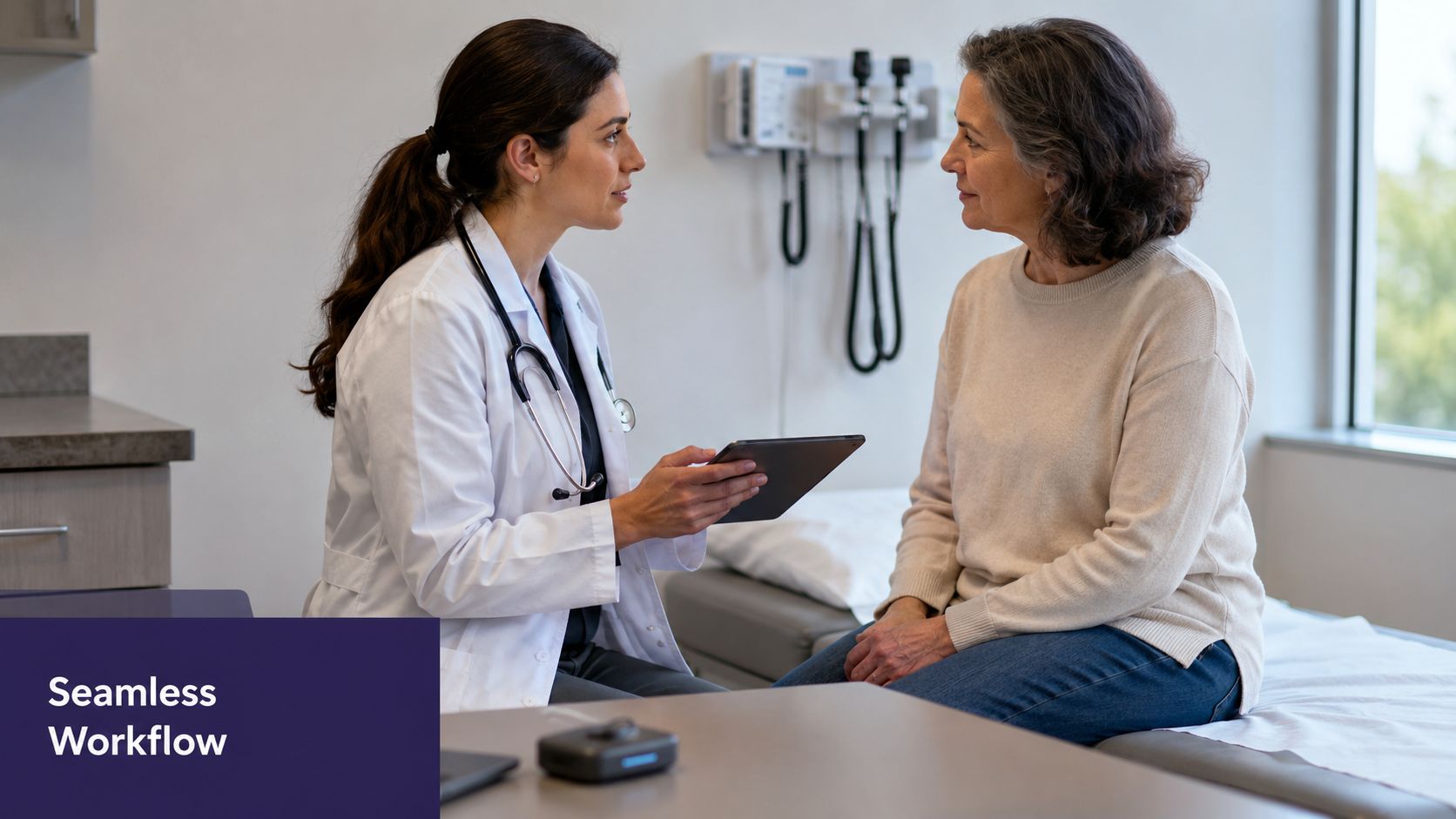
A typical visit with ambient scribing
In operational use, ambient scribe systems often generate a draft note within 1 to 2 minutes after the encounter ends, which supports immediate clinician review, according to AssemblyAI's overview of ambient scribe workflows.
A clean workflow usually looks like this:
- The visit starts with consent and device setup. The clinician or staff member confirms the patient is comfortable with the recording workflow.
- The conversation proceeds normally. The doctor doesn't dictate line by line. The point is to let the visit sound like a visit.
- The draft appears soon after the encounter. That timing matters because the details are still fresh in the clinician's mind.
- The clinician edits before signoff. Here, essential clinical judgment is still exercised.
That last step is the one too many organizations underestimate. If the clinician has no protected moment to review the note, the technology can just move work around instead of reducing it.
The job shift that makes or breaks adoption
Ambient tools change the physician's role. Instead of writing from scratch, the clinician reviews, corrects, and approves. Some doctors love that shift right away. Others hate editing machine-written prose and would rather type their own note because it feels faster and safer.
Both reactions are reasonable.
I usually see four workflow truths emerge during pilots:
- Fast review beats delayed review: If clinicians wait until the end of the day, they lose the context that makes editing efficient.
- Short visits are not always easier: High-volume, repetitive encounters can work well, but only if the note style is tight and predictable.
- Complex visits need discipline: Behavioral health, multilingual visits, heavy counseling, and visits with family members in the room often need closer review.
- Training matters more than people expect: Clinicians need guidance on how to speak naturally, how to correct drafts efficiently, and what errors require extra caution.
For practices thinking about implementation details, Simbie's page on EMR system integration is useful later in the selection process, especially if your main concern is where the drafted note lands and how it enters the chart workflow.
What works and what doesn't
What works is treating ambient scribing as a workflow redesign. What doesn't work is dropping software into clinic and assuming everyone will “figure it out.”
The best users are not the ones who trust the tool most. They are the ones who review it the fastest and the most consistently.
That's the operational habit worth building.
The real benefits beyond just saving minutes
Most ambient AI medical scribe marketing starts with time saved. I think that's too narrow. Minutes matter, but they are not the whole story, and in some settings they are not even the main story.
The better question is whether the tool improves the quality of clinical work. Does it reduce the mental drag of documentation? Does it cut after-hours charting? Does it let the clinician stay present with the patient without paying for that presence later at night?
Burnout is the metric that actually matters
A 2025 multicenter study found burnout fell from 51.9% to 38.8% after 30 days of using an ambient scribe, with lower after-hours documentation time, according to this multicenter study on ambient scribes and clinician burnout.
That finding lines up with what I've seen on the ground. Clinicians rarely get excited by “documentation efficiency” as an abstract concept. They care that they can finish clinic with less residue left in their head. They care that charting doesn't spill into family time. They care that the note no longer competes so aggressively with the patient for their attention.
Why the second-order effects matter more
The strongest ROI often sits in second-order effects:
- Lower cognitive load: The clinician no longer has to track every detail while also driving the conversation.
- Better listening during visits: Eye contact and follow-up questions improve when typing drops.
- Less friction after clinic: The note is closer to finished while the visit is still fresh.
- More stable morale: Small daily relief can matter more than a dramatic but rare efficiency gain.
This is also where leadership can go wrong. Some organizations save documentation time and then immediately fill that time with more visit volume or more inbox work. In that setup, the technology may still improve notes, but it won't necessarily improve the clinician's day.
If you reclaim time and then refill every minute, don't be surprised when burnout barely changes.
Time savings can be real and still be modest
That nuance matters. A tool does not need to erase charting to be worth buying. It may be enough that it reduces the intensity of documentation and cuts after-hours work. In practice, that can have more value than a bigger headline number with no real change in work conditions.
The mistake is treating ambient scribing like a stopwatch contest. The better frame is this: a good system gives the clinician back attention first, then time.
Navigating the serious risks and liability questions
Ambient AI scribes can help a lot, but they can also introduce the wrong sentence into the wrong chart at the wrong moment. That is the risk leaders need to face directly. A note that sounds polished can still be wrong, incomplete, or misleading.

The error modes are not theoretical
A recent review warns that AI scribes can misrecognize, omit, or hallucinate clinical content, and that moving from narrative drafting into structured EHR fields raises safety and governance risks. The same discussion notes that a Cleveland Clinic deployment involving over 4,000 providers emphasized patient consent and clinician review before finalizing notes, as covered in this discussion of efficiency gains, burnout uncertainty, and governance risks in ambient AI medical scribes.
Those risks show up in several ways:
- Misrecognition: The system hears the wrong medication, symptom, or timeline.
- Omission: It leaves out a negative finding, counseling point, or plan detail that matters.
- Hallucination: It inserts content that sounds plausible but was never said.
- Field contamination: Structured data entry can turn a drafting error into a downstream problem for coding, reporting, or future care.
This is why I push back when buyers say, “If the transcript is pretty good, we're fine.” No. The note can still fail clinically even if most of the words are correct.
Liability still lands on the clinician and the organization
No ambient scribe changes the basic rule of charting. The signing clinician is still responsible for the accuracy of the note. If a draft misses an allergy discussion, changes a medication instruction, or records a diagnosis that wasn't assessed, the risk does not stay with the software.
That means every implementation needs a written governance framework, not just user training.
At a minimum, that framework should cover:
- Consent rules: Who must consent and how staff document it.
- Review standards: Which parts of the note require direct clinician verification every time.
- High-risk encounter rules: Specialty visits, interpreter-mediated encounters, noisy settings, and coding-sensitive documentation may need tighter controls.
- Escalation paths: How clinicians report recurring output problems and who investigates them.
- Audit practice: Someone needs to review note quality over time, not just during launch week.
For teams evaluating privacy and compliance questions, Simbie has a page on HIPAA-compliant AI scribe requirements that can help shape your vendor checklist.
Where I tell clinics to be strict
I'm generally more conservative in these situations:
“Do not auto-trust the polished note. Read it like a legal document and a clinical handoff, because that's what it becomes once you sign it.”
I'd be especially careful with multilingual visits, sensitive behavioral health discussions, specialty consults with dense assessment logic, and any workflow where note content feeds coding or discrete EHR fields. Ambient scribing can still be used there, but review cannot be casual.
The safe posture is not fear. It is supervision.
How to choose a vendor and implement the change
At 7:10 p.m., the physician is still editing notes from a full clinic day. The question is not whether an ambient AI scribe can shave off a few minutes, but rather whether it improves the quality of documentation work enough to reduce after-hours charting without creating new accuracy and liability problems.
That is why vendor selection should be treated as a clinical operations decision. A polished demo proves very little. I want to see what the product does in actual visits, with your clinicians, your templates, your specialty language, and your EHR constraints. I also want to know how the vendor handles failure. If a draft is wrong, incomplete, or awkwardly placed in the chart, does the clinician catch it quickly, or does the software create a new layer of cognitive work?
A 2026 randomized trial of LLM-powered ambient AI scribes found that Nabla users saw a 9.5% reduction in time-in-note and reported improved clinician experience measures, including higher Mini-Z scores and lower burnout-related scores, according to this randomized trial of ambient AI scribe performance in clinical practice. That is a useful benchmark. Ask vendors for evidence on clinician experience, editing burden, and note quality, not just speed.
Ambient AI scribe vendor evaluation checklist
| Evaluation Criteria | What to Ask | Why It Matters |
|---|---|---|
| Clinical note quality | How does the product perform in my specialty, with my note style, and in complex visits? | Fluent writing can still miss the assessment logic, symptom timeline, or plan details that matter clinically. |
| Review workflow | Where does the draft appear, how fast can the clinician edit it, and what does final signoff look like? | If review takes too much effort, clinicians stop trusting it and burnout relief disappears. |
| EHR integration | Does it fit our charting process, support the fields we use, and avoid duplicate documentation steps? Review the vendor's approach to EHR integration for ambient AI scribe workflows before you pilot. | Integration problems are one of the fastest ways to lose adoption. |
| Security and governance | How is data handled, who has access, and what controls exist for auditing, consent, and retention? | Ambient tools capture sensitive conversations. Privacy review and operational controls need to be built in from the start. |
| Vendor transparency | Can the vendor show known failure patterns, implementation support, and a plan for monitoring output after go-live? | A credible vendor is candid about weak spots and helps the clinic address them. |
How I'd run the rollout
Start small.
A narrow pilot with interested clinicians usually gives cleaner feedback than a broad launch across a tired, skeptical group. Early users should be credible with their peers, willing to document what goes wrong, and close enough to frontline work to spot whether the tool is reducing burden or just shifting it.
A practical rollout usually includes these steps:
- Pick a defined pilot group: Start with a small number of clinicians in one specialty or a limited set of visit types.
- Define success before launch: Track editing time, after-hours charting, note acceptance, and clinician experience, not just note volume.
- Test with real complexity: Include some routine visits, but do not evaluate the product only on easy follow-ups.
- Audit note quality weekly: Review omissions, factual errors, plan distortion, and whether the output matches the clinician's reasoning.
- Refine workflow fast: Fix template issues, insertion points, and review friction during the pilot instead of waiting until full deployment.
- Set limits on use: Exclude encounter types that create too much risk or too much cleanup.
The implementation mistake I see most often is treating ambient AI like a software toggle. Clinics buy licenses, hold one training session, and assume the tool will settle into practice on its own. It usually does not. Adoption rises when clinicians see that the draft lands in the right place, matches how they think, and shortens the workday. It falls when they have to hunt for text, rewrite plans, or clean up errors after every third patient.
If you want one example of a product category fit, Simbie AI is one option that offers voice-based healthcare documentation and admin automation with EHR connectivity. It belongs in the comparison set if you are evaluating ambient listening plus related workflow functions, but it should be judged by the same operational and clinical standards as any other vendor.
A good buying process is disciplined and a little skeptical. The best outcome is not the fastest rollout. It is a tool that clinicians keep using six months later because it improves the work, lowers documentation fatigue, and stays inside a governance model the organization can defend.
Is an ambient scribe right for your practice?
An ambient AI medical scribe is a good fit when documentation burden is clearly hurting care, morale, or both. It is a weaker fit when leadership wants a fast productivity win but has no appetite for governance, training, or note review discipline.
I'd say yes faster if your practice has physicians doing heavy after-hours charting, clinicians who want to be more present during visits, and operational leaders willing to treat this as a clinical workflow decision. I'd slow down if the organization is looking for near-autonomous documentation, has weak privacy review, or expects the software to solve burnout by itself.
A simple test before you buy anything
Run a one-week audit before scheduling vendor demos.
Track:
- After-hours charting: Ask each clinician to log when charting spills past clinic.
- Visit types with the most note pain: Some specialties and encounter types will surface quickly.
- Editing burden in current workflow: Find out whether the bigger problem is writing from scratch, switching screens, or late-day backlog.
- Tolerance for review: Some clinicians will gladly edit drafts. Others won't.
That short audit gives you something better than hope. It gives you a baseline, and without a baseline it's hard to know whether an ambient scribe is fixing the right problem.
If your numbers and your clinicians point to documentation as a daily drain, start a pilot. Keep the scope tight. Put governance in writing. Review the notes carefully. Then decide based on what changed in real clinic work, not on what looked good in a demo.
If your practice is exploring ambient documentation and broader voice-based automation, Simbie AI is one option to review. The practical next step is simple: compare its workflow, integration approach, review controls, and note quality against your current process and at least a few other vendors, then test it in a small pilot before rolling anything out widely.