
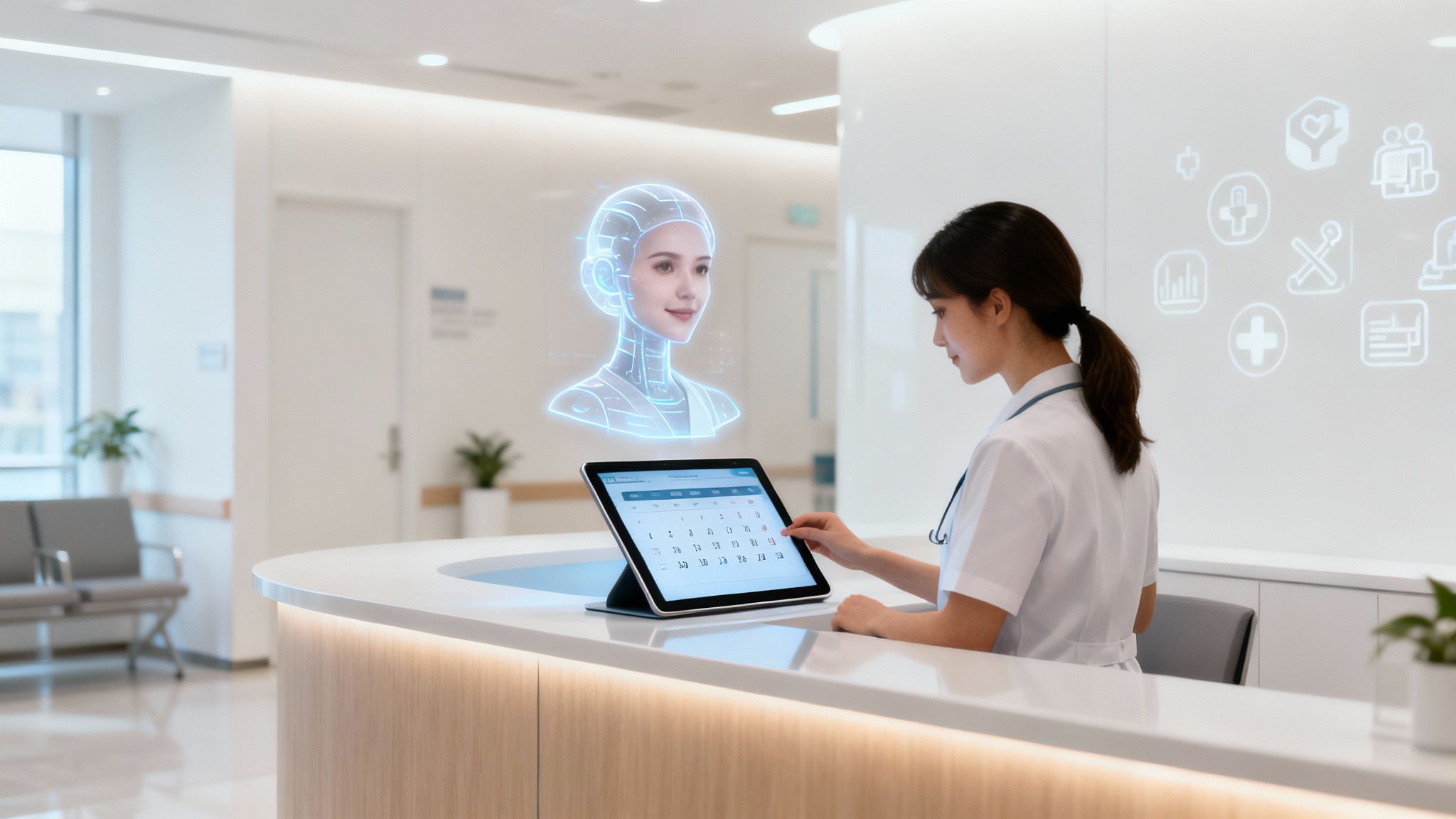
Picture your front desk on its busiest day. Now, imagine it never sleeps, every single call is answered on the first ring, and your best people are free to focus entirely on the patients standing right in front of them. That's the powerful reality an AI receptionist for medical office brings to the table. This isn't just an answering service; it's a purpose-built system using conversational AI to handle patient intake, scheduling, and routine questions, 24/7. It’s the end of hold music as we know it, and the beginning of a more efficient, patient-centric practice.
The End of Hold Music: Your First Look at AI Receptionists
For most medical practices, the front desk is a constant juggling act. Phones are ringing off the hook with appointment requests and prescription refills. Staff are trying to manage complex scheduling puzzles while verifying insurance information, all while patients in the waiting room need assistance. It's a proven recipe for staff burnout, missed calls, and a rocky start to the patient experience. The frustration is real; patients often wait an average of four to five minutes just to get a human on the line—a small eternity when you're busy or not feeling well.
This is precisely the bottleneck an AI receptionist is engineered to eliminate. It serves as a digital front door, capable of managing hundreds, or even thousands, of calls simultaneously. No patient ever gets put on hold, and every inquiry is handled with immediate attention and consistency.
Beyond a Simple Answering Service
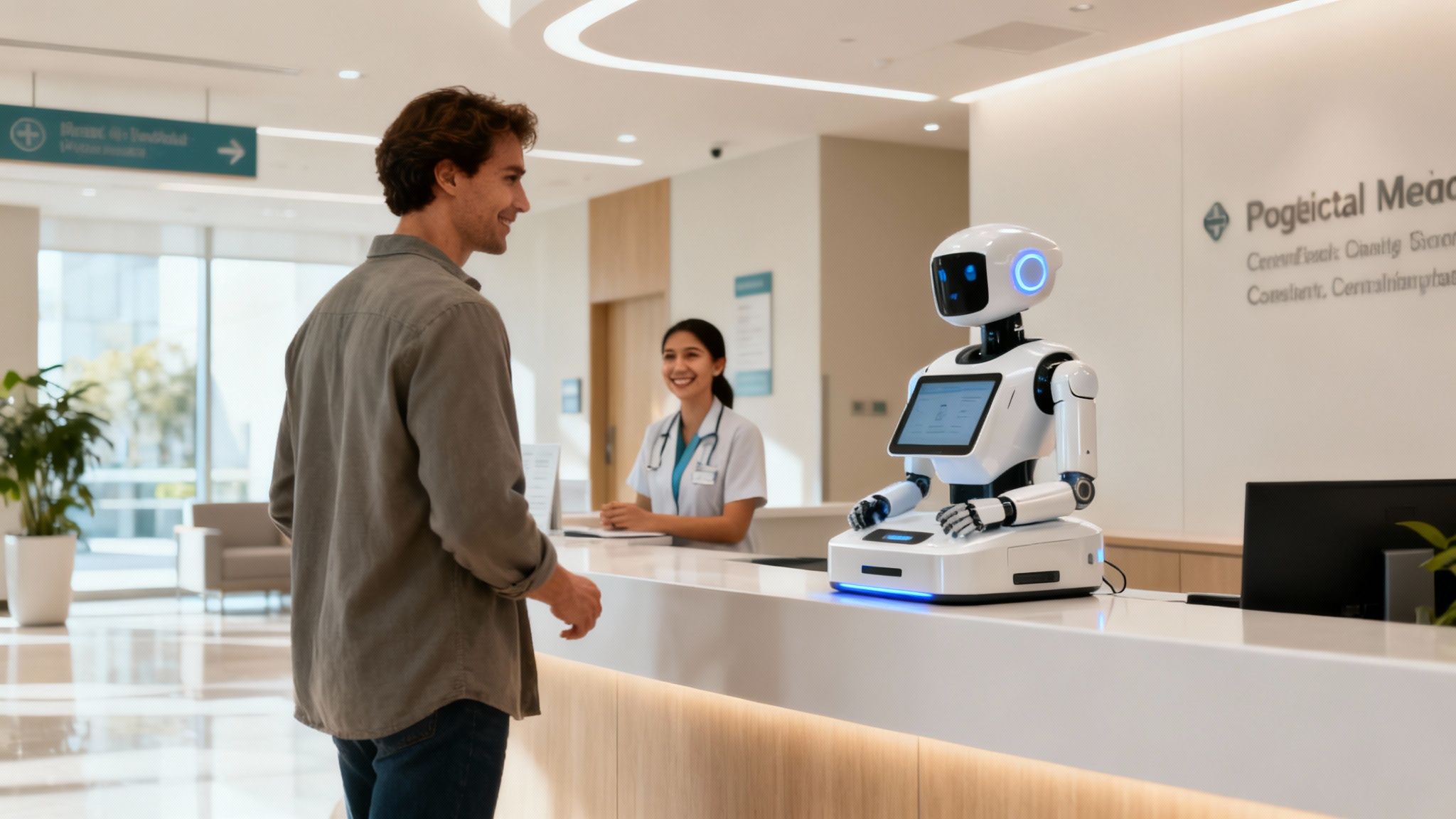
Let's be crystal clear: this technology is light-years beyond your standard "press one for appointments" phone tree. Those old, rigid IVR systems are a source of immense frustration for callers. An AI receptionist is fundamentally different. It uses advanced voice recognition and natural language processing (NLP) to actually understand what a person is saying in their normal conversational tone and respond intelligently and empathetically.
Think of it less as a robot and more like a highly efficient, endlessly patient administrative assistant. Its primary job is to take the immense administrative weight off your team's shoulders by flawlessly handling the routine tasks that constitute the vast majority of your inbound calls.
An AI receptionist is an advanced, artificial intelligence-powered system designed to handle the administrative and communication tasks usually managed by human receptionists. Unlike traditional receptionists who work specific hours, these AI systems provide 24/7 support, ensuring continuous patient access.
As you become more familiar with this technology, it’s helpful to understand where it fits within the modern healthcare ecosystem. Many practices already utilize human medical virtual assistants for remote administrative help. The real game-changer with AI is the unparalleled scale and automation; it can handle a limitless volume of calls instantly and simultaneously, a feat a human team simply cannot match. This allows practices to grow without proportionally increasing front-desk staff.
The Core Problems an AI Receptionist Solves
This technology isn't just a neat gadget; it directly targets and resolves some of the most significant operational headaches in healthcare, from a small private practice to a large, multi-location hospital system.
- High Call Volume Overload: It effortlessly absorbs the constant stream of calls for appointments, refills, and basic questions, so your staff doesn't drown in them and can focus on higher-value work.
- After-Hours Communication Gaps: It provides patients with a reliable way to book a visit, request a refill, or get answers long after your office has closed for the day, improving access to care.
- Patient Frustration from Hold Times: Answering every call immediately and professionally makes a huge positive difference in patient satisfaction from their very first interaction with your practice.
- Administrative Inefficiency: By automating repetitive, time-consuming tasks, it frees up your skilled team to handle more complex patient issues, manage in-office needs, and give every patient their full attention.
By tackling these persistent challenges head-on, an AI receptionist paves the way for a more streamlined, efficient, and patient-focused practice.
How an AI Receptionist Reshapes Your Daily Workflow
Let's move beyond the abstract and talk about what an AI receptionist actually does day-to-day. This isn't just a fancy answering machine; it's a new, integrated member of your team that fundamentally changes the pace and focus of your front office. It takes over the repetitive tasks that tie up your valuable staff, freeing them to focus on the patients standing right in front of them and the complex issues that require human empathy and expertise.
Think about it: the AI’s real strength is handling the high-volume, predictable, but absolutely essential jobs with perfect accuracy. This single change allows your team to shift from a reactive state of juggling phone lines to a proactive one of delivering top-notch patient care. The whole vibe of the practice can change for the better, reducing stress and improving job satisfaction.
Core Functions That Drive Real Results
To see just how big of a difference this makes, let’s look at the core functions an AI receptionist handles around the clock. These are the workhorse features that deliver immediate, measurable improvements to your practice's efficiency and bottom line.
-
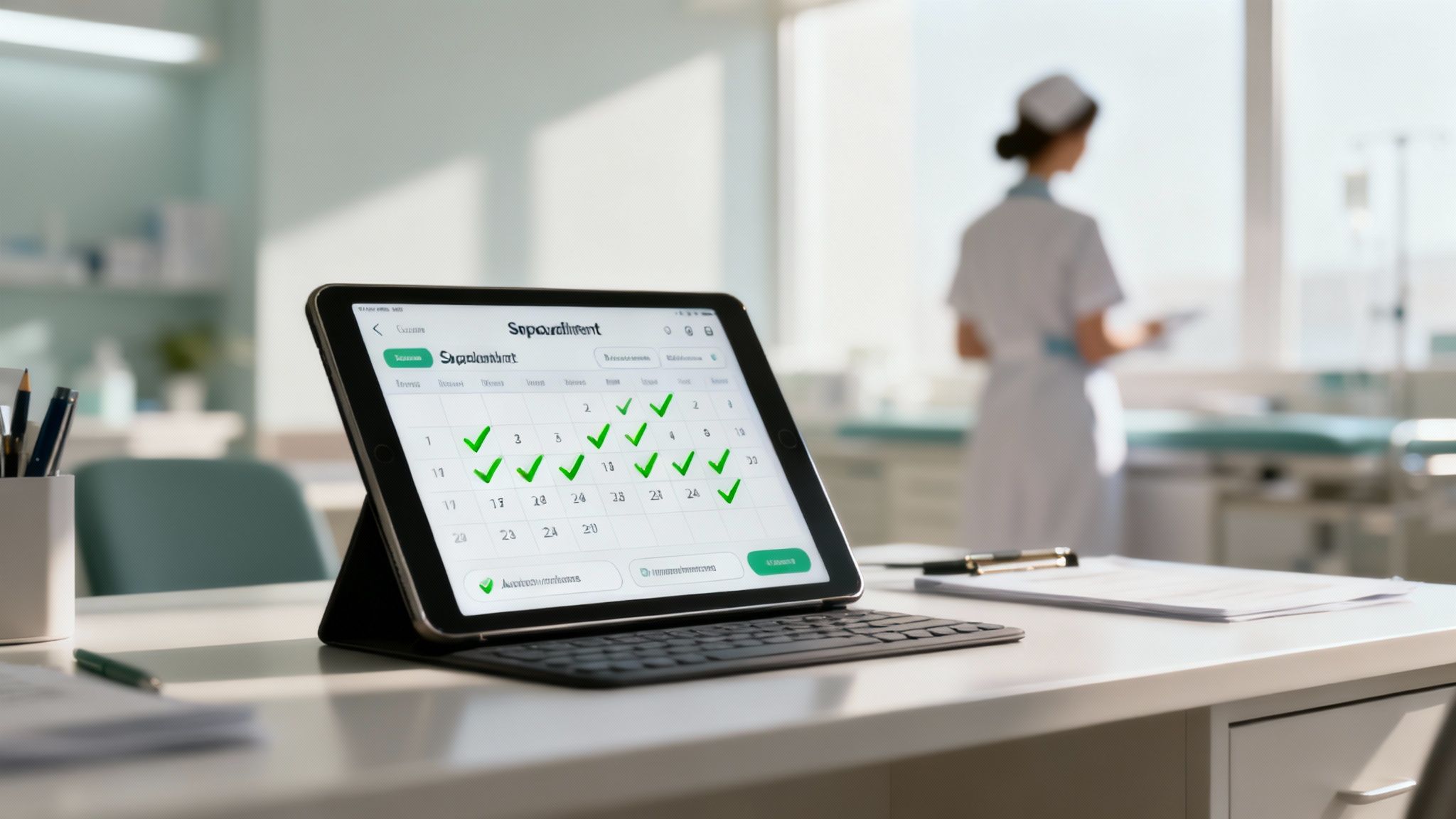
Smart Appointment Scheduling: The AI can book, reschedule, or cancel appointments directly inside your EMR. It understands natural language, so when a patient asks, "Do you have anything on Tuesday afternoon with Dr. Evans?" it can intelligently check the schedule and offer real-time, available options.
-
Automated Patient Reminders: We all know no-shows kill revenue and disrupt clinic flow. The AI sends friendly, conversational reminders by phone or text to confirm appointments, which can seriously slash your no-show rate and keep your schedule full.
-
Effortless Prescription Refills: Patients can call 24/7 to request a refill, even at 2 AM. The AI gathers all the necessary details—patient name, date of birth, medication, pharmacy—and sends the request straight to the appropriate clinical queue for review, minimizing errors and delays.
These automated tasks are the foundational building blocks of a much smoother, more reliable operation. If you want to see the bigger picture, you can learn more about how these pieces fit into a broader strategy for healthcare workflow automation. This is where the most significant time and cost savings are realized.
Going Deeper with Smart System Integration
A truly great AI receptionist does more than just schedule and remind. Its value multiplies exponentially when it starts interacting intelligently with your other systems to handle more complex jobs, making your entire front office smarter and more proactive.
A perfect example is real-time insurance verification. Before an appointment is even locked in, the AI can automatically check a patient's eligibility with their insurance provider. This simple, proactive step prevents those awkward and costly billing surprises down the line and ensures any coverage problems are sorted out long before the patient walks in the door.
Another game-changer is intelligent call routing. The AI is smart enough to discern the difference between a simple administrative question and a serious clinical concern.
A patient asking for your office address or fax number gets an instant, accurate answer. A patient describing symptoms like chest pain or shortness of breath is seamlessly and immediately transferred to a nurse’s line or emergency protocol, ensuring urgent needs get human expertise right away.
This smart filtering protects your clinical staff’s valuable time for the high-stakes conversations that truly require their skills. The difference this makes in operational efficiency is enormous. The table below breaks down just how different the workflow looks.
Comparing Manual vs AI-Powered Receptionist Tasks
This table illustrates the operational differences and efficiency gains when a medical office transitions from a traditional receptionist model to an AI-powered one.
| Administrative Task | Traditional Receptionist Process | AI Receptionist Process | Key Benefit of AI |
|---|---|---|---|
| Appointment Booking | Manually finds slots, handles back-and-forth calls, confirms details. Often results in hold times or phone tag. | AI offers available slots, books directly in EMR 24/7, sends instant confirmation via text or email. | Patient Self-Service & 24/7 Access |
| Patient Reminders | Staff member makes dozens of individual, time-consuming phone calls each day. | Automated, conversational calls/texts sent at optimal times, with options to confirm or reschedule. | Reduced No-Shows & Staff Time Savings |
| Prescription Refills | Takes down information, creates a manual task, and routes it to clinical staff, risking transcription errors. | Captures all required info, creates a structured, error-free request directly in the EMR queue. | Fewer Errors & Faster Turnaround |
| Insurance Verification | Manually checks payer portals, often right before the visit, creating last-minute issues. | Verifies eligibility automatically at the time of booking, flagging issues in advance. | Cleaner Billing & Reduced Denials |
| Basic Questions | Answers the same questions (hours, directions, policies) repeatedly throughout the day. | Provides instant, consistent, and accurate answers to thousands of common FAQs without human intervention. | Massive Time Savings & Staff Focus |
As you can see, the AI doesn't just do the same tasks faster; it fundamentally changes the entire process to be more proactive, efficient, and less prone to human error.
The numbers back this up. Some practices have successfully cut their patient no-show rates by as much as 70%. And even more impressively, these systems can achieve a 100% call answer rate—a huge jump from manual rates that can dip as low as 30% during peak busy times. These statistics point to a massive improvement in both patient access and operational consistency.
By taking over these crucial functions, the AI receptionist becomes the central hub for patient communication. It weaves itself seamlessly into your daily operations, creating a more organized, responsive, and efficient practice, and finally letting your team focus on what they do best: taking care of patients.
What This Really Means for Your Practice's Bottom Line
A smoother day-to-day operation is great, but let's be honest—for practice leaders, the decision to bring in an AI receptionist for medical office ultimately boils down to the numbers. You need to see a real, tangible return on investment (ROI), not just a little more convenience. The impact here is concrete and hits three key areas: direct cost savings, getting valuable time back for your team, and a noticeable lift in patient care quality and satisfaction.
This isn't about a minor software update. It's a strategic shift that delivers real financial and clinical wins. By handing off the repetitive, high-volume tasks that bog down your front desk, the technology quickly pays for itself and starts driving both revenue growth and patient loyalty.
Unlocking Significant Cost Savings
The first and most obvious win is cutting down on administrative overhead. When you hire a human receptionist, you're not just paying a salary. You're also covering benefits, payroll taxes, training, sick days, and vacation time. An AI receptionist, on the other hand, can manage a much larger workload for just a slice of that cost, operating 24/7/365 without a break.
This completely changes how you can approach staffing. Instead of constantly hiring to keep up with ringing phones, you can empower the great team you already have. Staff who were once chained to the phone can now be trained for higher-value roles—like patient advocacy, financial counseling, or care coordination—that directly impact patient experience and your practice's revenue cycle.
By automating routine administrative tasks, an AI receptionist can reduce a practice's operational costs by as much as 18%. This frees up budget and human resources for more critical clinical needs and patient-facing initiatives.
The math gets even better as your practice grows. Scaling up with a human team means adding more full-time salaries and benefits packages. Scaling with an AI receptionist is just a predictable and much smaller bump in your monthly subscription, making growth far more manageable and profitable.
The Power of Reclaimed Time
In a medical practice, time is your most precious, non-renewable resource. An AI receptionist literally hands you back hundreds of staff hours every single month by taking over thousands of routine calls. Think about the cumulative impact of not having to manually schedule appointments, send reminders one-by-one, or process endless refill requests.
This newfound time creates a positive ripple effect throughout your entire practice:
- Less Staff Burnout: Answering the same questions all day is a huge driver of burnout and turnover. Automating these calls lowers stress, boosts morale, and helps you retain your best people.
- More Focus on Patients in the Office: With the phones handled, your front desk staff can give their complete, undivided attention to the patients standing right in front of them, improving their experience and reducing check-in times.
- Better Back-Office Productivity: Free from constant phone interruptions, your team can finally tackle complex tasks like billing, insurance claims, and prior authorizations with fewer errors and far more efficiency.
The market for virtual receptionists is exploding for a reason—it’s projected to nearly triple from $3.85 billion to $9 billion by 2033. This boom is built on solid, demonstrable results. Studies have found a well-implemented AI can handle around 70% of routine medical calls from start to finish without any human intervention. You can dig into more of this data by exploring the rise of AI receptionists on ResonateApp.com.
Elevating Patient Care and Data Quality
A great patient experience isn't just a "nice-to-have." It's directly tied to patient retention, positive online reviews, and your practice's long-term reputation in the community. An AI receptionist starts improving that experience from the very first phone call.
You immediately eliminate frustrating hold times and give patients a convenient way to book appointments 24/7. This gets rid of two of the biggest frustrations patients face, leading directly to higher satisfaction scores. In fact, some clinics have reported a 15% increase in patient satisfaction just a few months after making the switch to an AI-powered system.
Beyond that, the quality of your practice's data gets a major upgrade. When an AI captures patient information—like a phone number, insurance ID, or preferred pharmacy—it’s entered directly and perfectly into the EMR every single time. This simple change drastically reduces the chance of manual typos or missed details, leading to cleaner patient records, fewer billing headaches, and ultimately, better-informed clinical decisions by your medical team. The result is a practice that not only runs like a well-oiled machine but also delivers a higher standard of care from the moment a patient reaches out.
Making Sure It’s Secure and Plays Well with Your EMR
For any medical practice, security and seamless integration aren't just nice-to-haves—they're absolute deal-breakers. When you start looking into an AI receptionist for medical office, the two biggest technical questions you need to answer are: "Is it HIPAA compliant?" and "Will it work with our EMR?" Get these wrong, and you're risking massive fines, patient privacy, and creating a workflow nightmare for your staff.
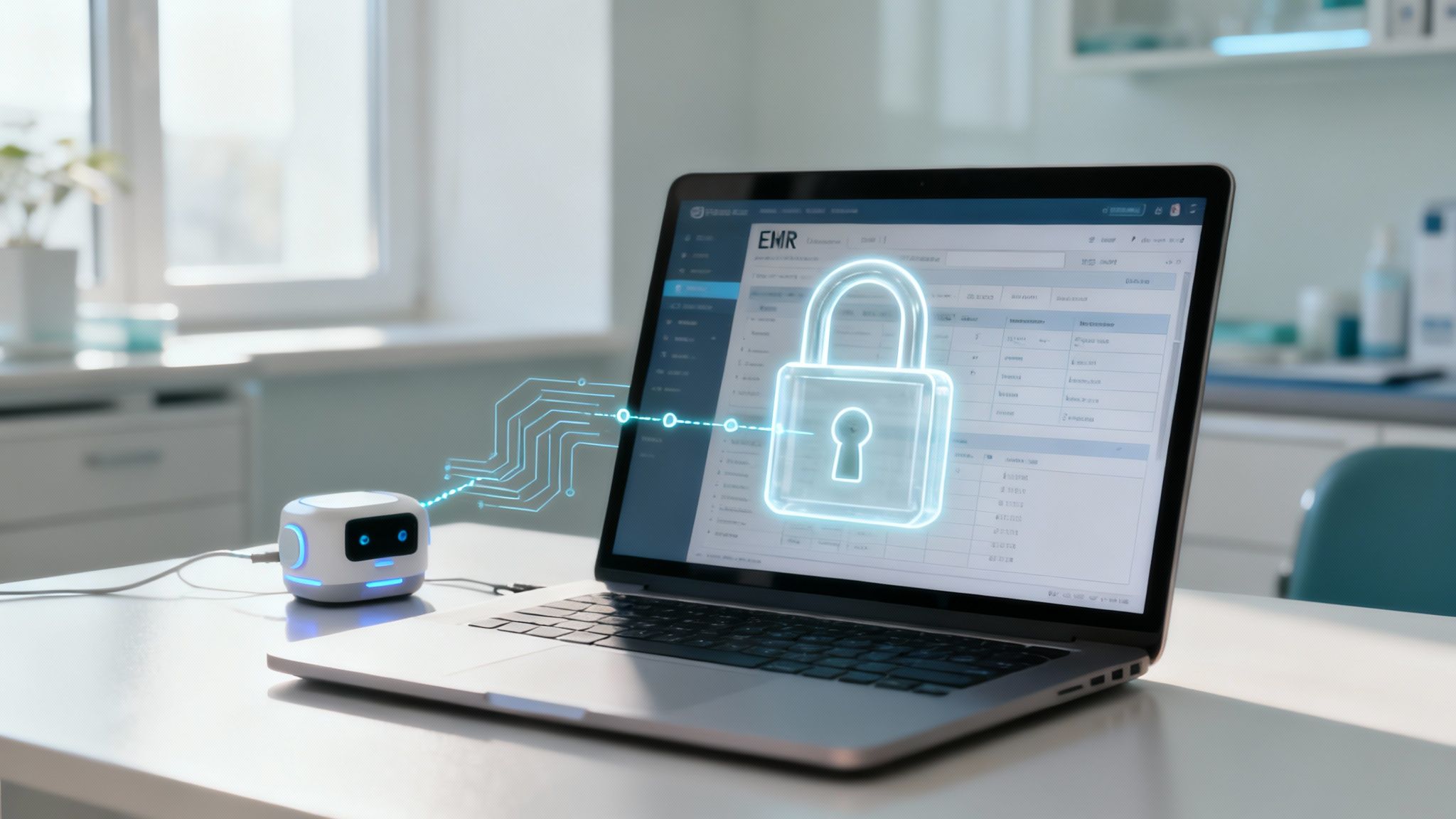
The good news is that top-tier AI platforms are built for healthcare from the ground up. These aren't just generic business tools with a medical skin thrown on top; they're designed specifically to handle Protected Health Information (PHI) with the highest level of security. It all starts with the basics, like end-to-end data encryption for every single call and transcript. This ensures every conversation between the AI and a patient stays completely private and secure, both in transit and at rest.
Ironclad Security and HIPAA Compliance
One of the first things you should ask any potential vendor for is a Business Associate Agreement (BAA). This is a non-negotiable legal contract. It holds the AI company to the exact same stringent standards of data protection that your practice must follow under HIPAA. If a provider hesitates or doesn't offer a BAA right away, that’s a massive red flag and you should walk away.
Beyond that, a truly secure system will give you granular control over who sees what. You should be able to set strict role-based access controls, deciding which team members can review call transcripts or listen to recordings. This creates a clear and unalterable audit trail, showing you exactly who has interacted with patient data and when. It’s also helpful to understand how different security frameworks operate in this space; this guide on HIPAA vs SOC 2 compliance is a great place to start your research.
The bottom line is simple: your patient data must be protected at every single step. A healthcare-grade AI receptionist isn't just an efficiency tool; it's a secure guardian of your patients' most sensitive information.
Your EMR as the Single Source of Truth
An AI receptionist that can't talk to your EMR is like having a front desk staff member who can’t access the appointment book. It's not very helpful and creates more work. The real magic happens with deep, bi-directional data flow, where the AI can both read information from and write new information back to your electronic medical records system in real-time. This is what truly eliminates tedious manual data entry and the costly human errors that come with it.
So, how does this work in practice? It’s a seamless two-way street:
- Reading Data: When a patient calls, the AI instantly looks at your EMR to check a doctor's real-time availability, see existing appointments, and pull up basic patient details for verification. It knows exactly which time slots are actually open without having to guess.
- Writing Data: As soon as a patient books that appointment, the AI writes the information directly back into the EMR schedule. It creates the event, links it to the right patient file, and updates the calendar for your entire team to see instantly.
This constant, reliable communication ensures your EMR remains the single, undisputed source of truth for everything related to your patients and schedule. No one has to listen to a recorded call and then manually type the appointment details into the calendar. That old, error-prone process is just asking for a typo or a double-booking. To see how this connection works across different platforms, check out this excellent EMR integration compatibility guide.
By insisting on a rock-solid, HIPAA-compliant foundation and deep EMR integration, an AI receptionist becomes more than just a fancy answering machine. It becomes a trusted, secure, and fully embedded part of your clinical workflow.
Your Practical Implementation Checklist
Bringing an AI receptionist for a medical office into your practice is a big, transformative move, but it doesn't have to be a chaotic one. A good, structured plan makes all the difference. Think of it less like a leap of faith and more like a well-mapped journey. By breaking the process down into manageable stages, you can launch smoothly, empower your team, and start seeing benefits for your patients right away.
This checklist is your roadmap, guiding you from that first "what if?" moment all the way to a fully deployed, optimized system that works seamlessly with your existing operations.
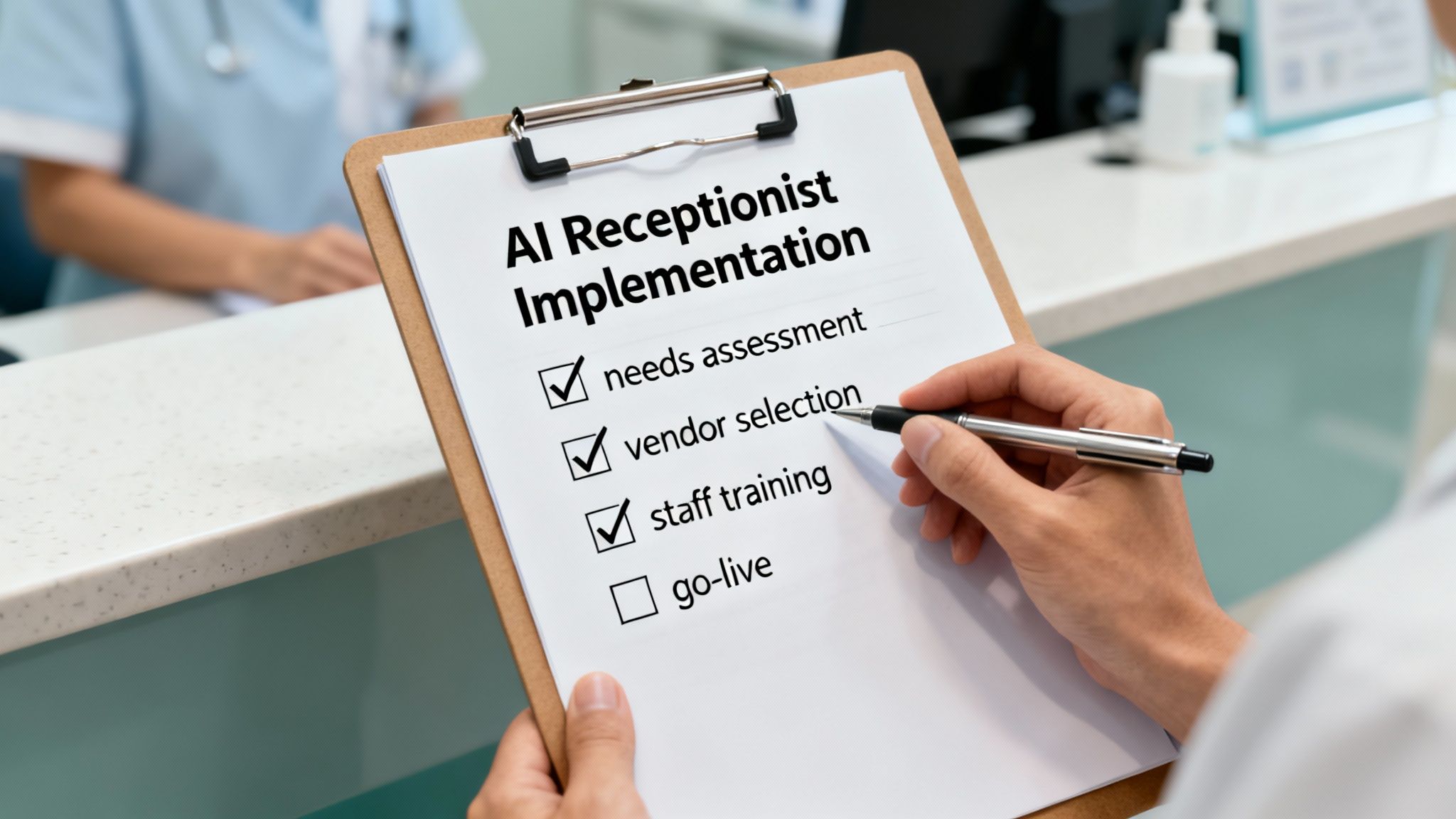
Phase 1: Define Your Goals and Scope
Before you even start looking at vendors, you need to know why you're doing this. What is the real, measurable problem you're trying to solve?
Start by pinpointing your biggest administrative headaches. Is your front desk constantly overwhelmed with scheduling calls? Are no-shows and last-minute cancellations eating into your revenue? Is your team just plain burned out from answering the same basic questions over and over again?
Getting crystal clear on these issues helps you set specific, measurable goals. Honestly, this first step is the most important—it ensures you end up with a tool that actually solves your practice's unique problems instead of just adding another layer of technology.
- Action 1: Assess Current Call Volume and Type: For a week, track every call your front desk handles. Sort them into buckets: new patient appointments, rescheduling, refill requests, billing questions, directions, etc.
- Action 2: Identify Key Tasks for Automation: Looking at your call data, decide which tasks are the best candidates for the AI to handle. Start with the high-volume, low-complexity, repetitive stuff. That's your low-hanging fruit for immediate ROI.
- Action 3: Set Success Metrics: What does success look like for your practice? Be specific. Maybe your goal is to "reduce patient hold times by 90%" or "cut appointment no-shows by 25% within three months" or "automate 80% of refill requests."
Phase 2: Select the Right Partner
Okay, now that you have your goals, you can start evaluating vendors. Not all AI receptionists are created equal. You need a partner who truly understands the medical world, especially when it comes to security, HIPAA, and deep EMR integration.
Get live demos from your top choices and show up with a list of pointed questions. Ask them about their HIPAA compliance program, which EMRs they have existing integrations with, and how they customize call scripts and workflows for a practice like yours.
Choosing a vendor is about more than just slick technology; it's about finding a real partner. You want someone who provides solid onboarding support, ongoing training for your staff, and a clear, unwavering commitment to healthcare's strict security standards.
For a more granular look at the process, our comprehensive guide on how to implement AI voice agents breaks down every technical and strategic step in detail.
Phase 3: Prepare Your Team and Technology
Implementation is a team effort. The ultimate success of your AI receptionist hinges on your staff’s buy-in and understanding of its purpose. It's crucial to frame the AI not as a replacement, but as an assistant—a powerful tool designed to free them up for more meaningful, patient-facing work that requires a human touch.
This is also when you get to the fun part: customizing the AI's personality and rules. You'll work closely with your chosen vendor to define how calls are handled, write scripts that match your practice's tone and voice, and set up clear, fail-safe rules for when a call needs to be handed off to a person.
Key Customization Steps:
- Develop Call Flows: Map out exactly how the AI should handle different scenarios. What questions does it need to ask to book a new patient versus a routine follow-up? How does it handle a cancellation?
- Define Escalation Triggers: Create a definitive list of keywords (like "emergency," "allergic reaction," or "suicidal") or complex situations that automatically and instantly route the call to a human.
- Conduct Staff Training: Hold dedicated sessions to walk your entire team through the new system. Show them how it works, how to check call logs and transcripts, and how to confidently and professionally take over an escalated call.
AI Receptionist Implementation Roadmap
To put it all together, here is a simple, phased roadmap. Following a structured plan like this helps turn a potentially complex project into a clear and predictable success.
| Phase | Key Actions | Success Metric |
|---|---|---|
| 1. Discovery & Goal Setting | Assess call volume, identify automation priorities, and define clear success metrics (e.g., reduce hold times by 90%). | A documented list of specific, measurable, achievable, relevant, and time-bound (SMART) goals is approved by practice leadership. |
| 2. Vendor Selection | Research vendors, request demos, check references, and verify HIPAA compliance and EMR integration capabilities. | A signed contract with a vendor that meets all technical, security, and support requirements. |
| 3. System Customization | Work with the vendor to build call flows, write scripts, and establish robust rules for human handoffs and emergency escalation. | The AI is fully configured to match the practice's specific clinical and administrative workflows and tone. |
| 4. Staff Training & Go-Live | Train all staff on the new system, conduct a small-scale pilot test with friendly patients or internal lines, and then officially launch the AI receptionist. | The team is confident using the system, and the AI is successfully handling live patient calls according to the defined protocols. |
| 5. Monitoring & Optimization | Review performance data weekly (e.g., call resolution rates, patient feedback, escalation frequency) and work with your vendor to make adjustments and continuous improvements. | The AI is consistently meeting or exceeding the initial success metrics defined in Phase 1, and new opportunities for automation are identified. |
By taking a methodical, phased approach, your medical office can get an AI receptionist up and running smoothly, improving efficiency and the patient experience from day one.
How AI Receptionists Adapt to Different Medical Specialties
An AI receptionist isn't a one-trick pony for general practice. Where it really shines is in its remarkable ability to adapt to the unique needs, specific terminology, and operational headaches of different medical fields. The underlying technology is the same, but the scripts, the workflows, and how it connects with your other systems are all fine-tuned to your specialty's specific challenges.
This flexibility is what turns an AI receptionist for a medical office from a simple tool into a core, strategic part of your team. Whether you're running a high-volume dental clinic, a sensitive mental health practice, or a complex orthopedic surgery center, the system can be precisely configured to handle the exact conversations and administrative tasks you deal with every single day.
Solving Niche Problems in Specialized Care
Every specialty has its own particular administrative bottleneck. In a busy dental office, the front desk might be drowning in appointment confirmations and insurance pre-authorizations. An AI can take over, handling thousands of these calls and texts a month, automatically confirming appointments and kicking off the insurance verification process. This frees up your highly-trained staff to focus on patients in the office, discuss complex treatment plans, and handle nuanced billing questions.
Mental health clinics face a completely different set of challenges, where patient privacy and immediate, gentle access are everything. For them, an AI receptionist provides a confidential, 24/7 first point of contact for people reaching out for help, often after hours when they feel most vulnerable. It can gently guide a new patient through sensitive intake questions and schedule that first critical appointment, all without the perceived pressure or judgment of a live conversation. It's a small change that can make a huge difference in lowering the barrier for individuals to seek essential care.
The real value of an AI receptionist is that it acts like a specialist, not just a generic answering machine. It learns the specific language and needs of your field and goes to work on your biggest operational pain points.
A Game-Changer for Complex Logistics
This specialized approach is crystal clear in a field like non-emergency medical transportation (NEMT), which provides essential rides for over 3.6 million Americans every year. These companies are juggling incredibly complex, round-the-clock schedules and have to meet strict compliance rules for Medicaid and Medicare.
An AI receptionist is a perfect fit here, effortlessly handling a constant stream of ride requests, sending out automated confirmations and reminders, and coordinating with drivers in real-time. As the NEMT industry continues to grow, providers who have already made the switch are seeing incredible results, with some reporting returns of 300% to 400% on their AI investment in just two years. It's a powerful case study, and you can see exactly why AI is reshaping NEMT logistics.
These real-world examples prove this technology is much more than a simple phone bot. It’s a dynamic, adaptable tool that delivers specific, targeted solutions no matter what corner of healthcare you're in.
Common Questions About AI Medical Receptionists
It’s completely normal to have questions when considering adding an AI receptionist for medical office to your practice. You want to be absolutely sure you’re making the right move for your staff, your patients, and your bottom line. Let's walk through some of the most common concerns we hear from practice leaders just like you.
"Will This AI Replace My Staff?"
Let's clear this up right away: the goal isn't replacement, it's reinforcement. Think of an AI receptionist as a powerful assistant for your team, not a substitute. It's about augmenting human capability, not eliminating it.
This technology is built to take on the high-volume, repetitive calls—the scheduling, the prescription refills, the routine inquiries—that often lead to staff burnout and take time away from more valuable work. By offloading those tasks, your skilled human staff are freed up to focus on what they do best: providing exceptional in-person care, navigating complex patient situations, handling difficult insurance issues, and managing clinical tasks that genuinely need a human touch. Their jobs become less stressful, more strategic, and more centered on meaningful patient interactions.
"What About Complex or Emergency Calls?"
Patient safety is non-negotiable, and any healthcare-grade AI is designed with that reality at its core. A well-trained AI receptionist knows its own limits and is programmed with strict, customizable protocols to spot potential emergencies or urgent clinical needs.
It actively listens for specific trigger words or phrases like "chest pain," "severe bleeding," or "trouble breathing." The moment one is detected, the system follows a pre-defined escalation path that you determine during setup. The call is immediately and seamlessly transferred to the right person, whether that's a triage nurse, the on-call physician, or a direct line to 911, with zero delay.
The AI acts as an intelligent filter, not a barrier. It quickly sorts routine administrative requests from urgent clinical needs, making sure emergencies get human attention faster and more reliably than ever before.
"Will My Patients Get Frustrated With a 'Robot'?"
This is a significant concern, especially for practices serving an older demographic or patients who are not tech-savvy. The good news is that modern conversational AI is a world away from those clunky, old, frustrating "press one for appointments" phone trees that everyone hates.
Today's systems use natural language processing (NLP), which means patients can speak in their normal voice, use conversational language, and interact just as they would with a person. The technology is smart enough to understand different accents, speaking styles, and even when someone pauses to think. Most importantly, for anyone who simply prefers talking to a person, the option to "speak with a member of our staff" is always made clear and easily accessible. No patient ever feels stuck, ignored, or forced to interact with the AI.
"Is This Going to Be a Nightmare to Set Up?"
Getting started is much simpler than most people imagine. The best AI providers are healthcare specialists who have made the setup and onboarding process incredibly straightforward, with a dedicated implementation team to guide you through every single step.
Leading platforms are built from the ground up to integrate smoothly and securely with major Electronic Medical Record (EMR) systems like Epic, Cerner, Athenahealth, and eClinicalWorks. Your AI partner will work hand-in-hand with you to customize everything from call scripts and workflows to routing rules and reporting dashboards. Most practices can be fully up and running in a matter of weeks, not months, and start seeing a positive impact almost immediately.
Ready to see how an AI receptionist can free up your staff and improve your patient experience? Simbie AI offers clinically-trained voice agents that handle your administrative tasks 24/7, so your team can focus on what truly matters. Schedule a demo today to learn more.