
Walk into any busy dermatology practice, and you'll hear it: the constantly ringing phone. Your front desk staff is stretched thin, juggling appointment requests, questions about cosmetic procedures, prescription refills, and check-ins all at once.
It’s an overwhelming environment. An AI receptionist isn't just a fancy answering service; I think of it as a dedicated digital team member. It works around the clock, handling all the routine administrative work so your staff can finally step away from the phone and focus on the patients standing right in front of them.
Why your dermatology front desk is so overwhelmed
The pressure on a dermatology front desk is unique. I’ve seen it in countless clinics. You're essentially running two businesses under one roof: a medical practice handling skin checks and complex conditions, and a cosmetic clinic offering elective procedures. This dual nature creates a relentless flood of calls, each with different needs and urgency.
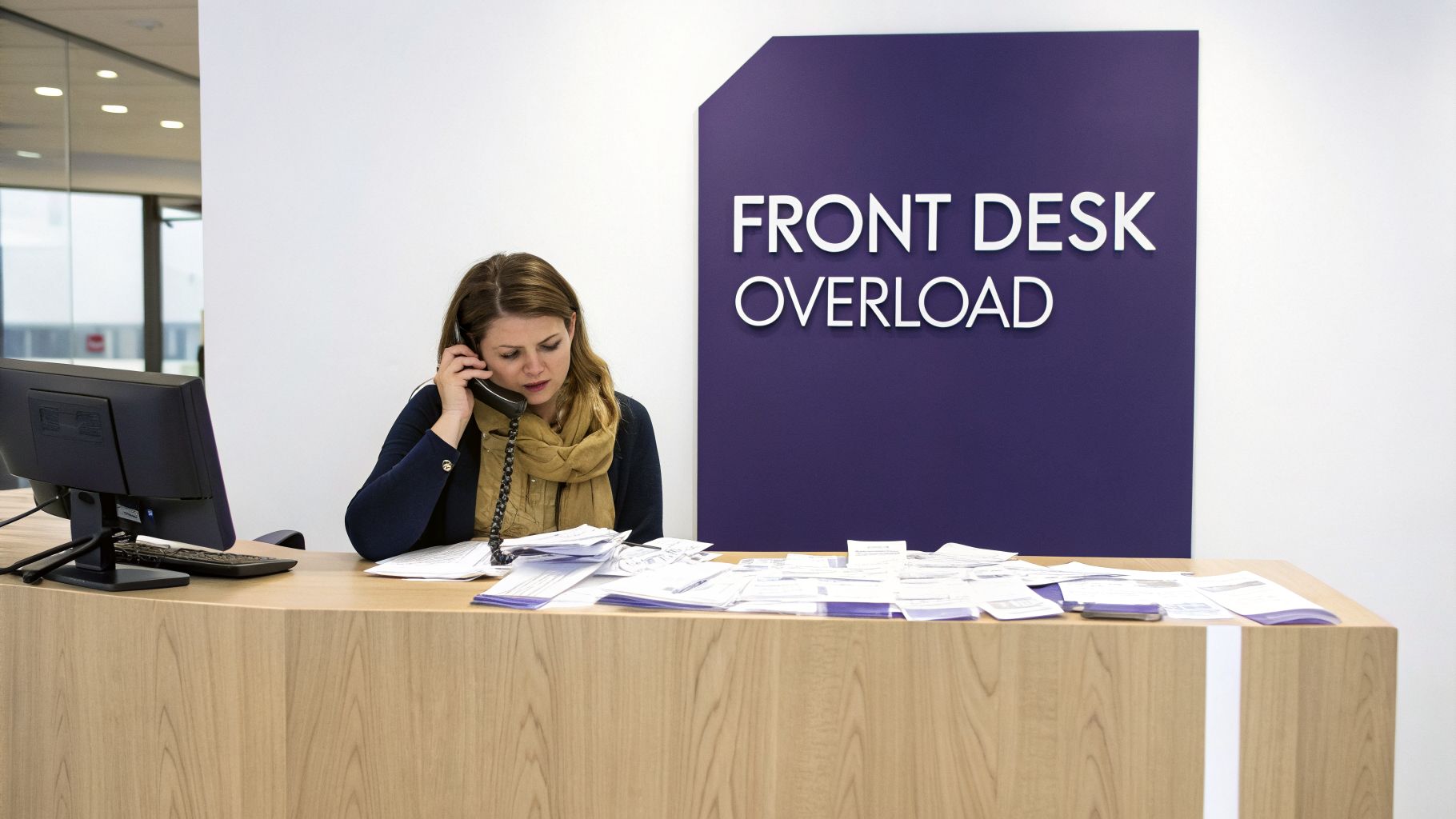
The result? Long hold times, a high rate of missed calls, and a completely burnt-out administrative team.
This isn’t just a feeling—it’s a major operational hurdle. Staffing shortages have become the number one pain point for medical groups. A 2026 MGMA survey found that a staggering 58% of practices see staffing as their biggest challenge, even more so than billing or insurance headaches.
This is precisely where an AI receptionist can make a real difference. I've worked with practices that have completely re-engineered their front office with this technology. They were able to free up their team to focus on higher-value work, like managing patient referrals and ensuring a smooth in-office experience. One group even saved over 40 admin hours per provider each week just by automating how they handled incoming documents. You can see more examples of how AI is fixing dermatology's efficiency crisis in practices today.
The true cost of front desk burnout
When your front desk team is constantly just trying to keep their heads above water, the negative effects are felt across the entire practice.
- The patient experience suffers: Long hold times and rushed conversations make patients feel unimportant and frustrated before they even see a doctor.
- Revenue leaks happen: Every call that goes to voicemail is a potential lost appointment. That could be a new patient needing a skin cancer screening or someone ready to book a high-value cosmetic treatment.
- Staff turnover spikes: Great receptionists are invaluable. But when they’re bogged down by repetitive, high-stress tasks, they burn out and leave. This forces you into a costly and time-consuming cycle of hiring and retraining.
To really see the difference, let's compare a day in the life of a traditional front desk with one supported by an AI receptionist.
Manual reception vs. AI reception in a dermatology clinic
This table breaks down how common daily tasks are handled in both scenarios, showing where the AI takes the pressure off your human team.
| Task | Traditional Human Receptionist | AI Receptionist |
|---|---|---|
| New Appointment Booking | Manually finds slots, collects all info over the phone, deals with back-and-forth scheduling. | Instantly offers available times, books directly into the EMR, and collects patient details via text/voice. |
| Answering FAQs | Answers the same questions repeatedly (hours, location, insurance, procedure costs). | Provides instant, accurate answers 24/7 via phone or text, freeing up the human receptionist. |
| Prescription Refills | Takes down the patient's name, DOB, and pharmacy, then creates a task for a nurse or MA. | Securely identifies the patient, verifies the request, and automatically routes it to the clinical team. |
| Call Routing | Listens to the patient's need and manually transfers the call, often placing them on hold again. | Understands the caller's intent (e.g., "billing question") and intelligently routes them to the right person or department. |
| After-Hours Calls | All calls go to a basic voicemail, creating a long list of messages to return the next morning. | Answers every call, books appointments, answers questions, and triages urgent messages for immediate follow-up. |
As you can see, the AI doesn't replace your staff; it helps them. By offloading the repetitive, time-consuming tasks, it allows your team to operate at the top of their game.
I've seen the change happen almost overnight when a practice adopts an AI solution. Calls get answered instantly, appointments are booked without manual work, and patient details are captured correctly, which brings a sense of calm and control back to the front office. It's about giving your skilled human team the support they need to focus on what they do best: patient care.
The core AI features your dermatology practice needs
Not all AI receptionists are built the same, especially when you're talking about a field as specific as dermatology. A generic business tool just won't cut it. You need a system that genuinely understands the day-to-day grind of a healthcare practice. From my experience helping clinics make this switch, the features that really move the needle are the ones that attack your biggest administrative headaches head-on.
When I advise a clinic, we look past the basic "answers the phone" sales pitch. We have to. The real value comes from specific capabilities that give you immediate, noticeable relief.
Essential AI capabilities for dermatology
The right AI receptionist for a dermatology practice should have a very particular skill set, tailored for your unique mix of medical and cosmetic services. Think of it like hiring a new front-desk coordinator; you'd be looking for a very specific resume, not just a warm body.
Here are the non-negotiable features I always tell practices to look for:
- 24/7 voice-based appointment management: This is table stakes. Your AI has to be able to book, reschedule, and cancel appointments over the phone at any time of day. This is how you capture the patient who finally gets a free moment at 9 PM on a Sunday. It also slashes no-shows by sending out reminders and letting patients confirm or cancel with a quick text or voice response.
- Automated patient intake and triage: For dermatology, this is a huge advantage. The AI needs to be smart enough to ask the right questions. Does the patient need a medical check for a suspicious mole, or are they interested in a cosmetic consult for laser hair removal? Getting this right from the first call means patients are booked with the correct provider for the right amount of time, which prevents a world of scheduling chaos down the line.
A well-designed platform can juggle all these different patient needs through a clean, simple interface, showing just how versatile a modern AI system can be.
Advanced features that save hours
Booking is just the beginning. A truly effective AI goes further by automating the most mind-numbing back-office work that drains your staff's energy.
The goal is to automate the predictable so your people can handle the unpredictable. The AI should field the 80% of routine calls, freeing up your team for the complex 20% that requires a human touch.
Things like intelligent prior authorization and prescription refill requests are massive time-savers. A good AI can kick off these processes by gathering the necessary patient info, submitting the initial request, and even keeping an eye on its status. This feature alone can give you back dozens of staff hours every single week. If you want to dig deeper, you can explore how an AI medical receptionist handles these workflows.
Finally, direct EMR/EHR integration is non-negotiable. The AI must be able to read and write information directly into your patient records. Without that, you’re just swapping one manual task for another—copying data from the AI into your EMR. True integration stops data entry errors and makes sure the patient information your AI gathers is instantly and accurately available to your clinical team.
How an AI receptionist directly boosts practice revenue
When practices ask me about the ROI of an AI receptionist, my answer is simple: just look at your missed calls. An AI receptionist for a dermatology practice isn't just a fancy tool for efficiency; it’s one of the most direct ways to increase your revenue. From my own work helping clinics get this technology up and running, the biggest and fastest financial win comes from one simple change: answering every single call.
Think about how many thousands of dollars walk out the door with every unanswered ring. With a 24/7 AI system, that problem disappears overnight. Every call gets answered, every time. This is more than just plugging a leak; it's about actively creating new revenue streams, especially when your office is dark.
Capturing high-value cosmetic leads
For practices that offer cosmetic services, this is where an AI receptionist truly shines. Imagine a potential patient, scrolling online at 9 PM on a Tuesday. They get inspired to finally do something about their sunspots and decide to call you about laser treatments. If that call goes to voicemail, their motivation fizzles, and they'll likely click on the next competitor they find. That high-value lead is gone for good.
An AI receptionist, however, can catch that call. It can answer their basic questions with your pre-approved responses and book a consultation right then and there. It seizes that moment of high intent and converts a fleeting thought into a confirmed appointment on your books.
We've seen practices significantly increase their cosmetic consultation bookings this way. The AI secures the lead while the interest is hot, which is something a voicemail simply cannot do.
This is a major advantage in the competitive world of aesthetic dermatology. One report I saw showed that clinics using these systems can book 40% more cosmetic consultations a month. The AI uses smart, procedure-specific scripts to guide callers, ensuring those premium leads never get lost in voicemail purgatory. You can learn more about how AI is boosting cosmetic dermatology leads on intellivizz.ai.
Optimizing your schedule for maximum revenue
Beyond just bringing in new business, an AI receptionist also works behind the scenes to make your existing schedule more profitable. It’s a master at managing your cancellation waitlist.
Here’s how it works:
- Fills last-minute openings: A patient cancels their appointment for tomorrow morning. Instead of your staff scrambling to fill the spot, the AI instantly and automatically texts or calls patients on the waitlist to offer them the opening.
- Increases provider utilization: This automated backfilling keeps your providers busy and minimizes unpaid downtime. A full schedule means higher productivity and, ultimately, more revenue for the practice.
These two functions—capturing every single lead and keeping the schedule packed—add directly to your bottom line. You end up with more appointments booked and more revenue generated, all without adding a single person to your payroll.
Calculating the ROI for your practice
As a practice manager, the first question on your mind is probably, "What's the real ROI?" I get it. When you're looking at any new investment, the numbers have to make sense.
Figuring out the return on an AI receptionist is actually pretty straightforward. We can start with the most obvious metric: direct cost savings.
A full-time human receptionist can cost anywhere from $35,000 to $50,000 a year in salary alone. Once you factor in benefits, payroll taxes, training, and the occasional cost of turnover, that number climbs even higher. An AI solution is just a fraction of that cost. Plus, it can handle a dozen calls at once, something no human can do.
Staffing shortages and burnout are constant headaches in dermatology. Your human team works set hours and can only take one call at a time, which means every missed call after 5 PM is lost potential. An AI receptionist solves that. You can find more insights on how AI delivers massive time and cost savings at deepcura.com.
Beyond just salary savings
But the true value of an AI receptionist for a dermatology practice goes way beyond just trimming your payroll. It’s about generating new revenue and creating a more stable, efficient operation.
Think about the value of appointments you’re currently missing. I've seen practices fill just four extra appointment slots a week with their AI, at an average of $200 per visit. Do the math—that’s over $40,000 in new revenue every year. This comes from capturing calls that come in after hours and instantly filling last-minute cancellations without anyone on your team lifting a finger.
From my experience, most dermatology practices see a positive ROI within just a few months. The financial impact is felt almost immediately, not just in cost reduction but in new revenue captured.
To get a clearer picture of your specific situation, you can use a simple worksheet like the one below.
Calculate your practice's potential ROI
This table will help you estimate the financial return you could see by adding an AI receptionist to your practice. Just plug in your own numbers to get a rough idea of the annual value.
| Metric | Calculation/Example | Your Estimated Annual Value |
|---|---|---|
| Front Desk Salary & Benefits | Annual salary + ~25% for benefits, taxes, etc. (e.g., $40,000 + $10,000 = $50,000) |
$ |
| Revenue from Recovered Appointments | # of new appointments per week X average visit value X 52 weeks (e.g., 4 x $200 x 52 = $41,600) |
$ |
| Reduced No-Show Rate Savings | # of no-shows prevented per month X avg. visit value X 12 months (e.g., 5 x $200 x 12 = $12,000) |
$ |
| Admin Time Saved (Translated to Value) | Hours saved per week X staff hourly rate X 52 weeks (e.g., 15 hours x $22/hr x 52 = $17,160) |
$ |
By adding up your estimated values and subtracting the annual cost of the AI service, you'll have a solid projection of your net financial gain.
The hidden financial benefits
And then there are the financial benefits that are harder to track but just as real. Reducing staff burnout has a significant dollar value. Every time you have to replace and train a front-desk team member, it costs you thousands in lost productivity and recruitment expenses.
By automating the repetitive, draining tasks—like appointment scheduling and prescription refill requests—your skilled staff can focus on the work that matters most: helping the patients right in front of them.
This shift dramatically improves job satisfaction, which means lower turnover and a more experienced, efficient team. We've actually published a deeper analysis of this, and you can learn more about the ROI of AI voice agents in our article. The real return is a powerful combination of direct savings, new revenue, and a healthier, more productive practice.
Your implementation checklist for a smooth rollout
Bringing an AI receptionist into your dermatology practice is much simpler than it sounds, but a little planning goes a long way. To make sure the transition feels seamless for both your staff and your patients, I always walk practices through a few key steps.

A successful launch isn’t about flipping a switch and turning everything on at once. It’s about being strategic and solving your biggest problems first.
Step 1: Pinpoint your biggest headaches
First things first, you need to get crystal clear on what problem you're trying to solve. Is your front desk constantly overwhelmed with prescription refill calls? Are you losing out on new cosmetic patients because no one is there to answer the phone after hours?
Sit down with your team and list your top three operational bottlenecks. It might look something like this:
- A high number of missed calls, which translates directly to lost revenue.
- The never-ending backlog of prior authorization requests.
- Staff spending far too much time scheduling simple follow-ups.
When you target your biggest pain points from the start, you can configure the AI receptionist for your dermatology practice to deliver an immediate, noticeable impact. This gives you a quick win and, just as importantly, shows your team the tool's value right out of the gate.
Step 2: Customize and train the AI
This is where you make the AI sound like your practice. You’ll want to work with your vendor to customize the call scripts so the AI’s voice and vocabulary feel like a natural extension of your team. It should know the difference between a "biopsy" follow-up and a "Botox" consultation and handle each with the right tone.
At this stage, you'll also map out the EMR integration. A proper setup ensures that when the AI collects new patient information, it flows straight into their chart—no more manual data entry.
My advice is to start with a small pilot. Don't go all-in from day one. For the first week, you could have the AI handle just one specific task, like taking calls from new patients who want to book their first appointment. This lets you iron out any kinks without disrupting your entire practice workflow.
Step 3: Prepare your staff for the change
Honestly, this is the most critical part of the whole process. Your team needs to see the AI as a tool that helps them, not something that replaces them. I like to frame it as a promotion: they are graduating from answering repetitive calls to managing more complex patient care and enhancing the in-person experience.
Show them how to use the AI's dashboard, review call transcripts, and take over when the AI needs to pass a call to a human. When your staff views the AI as a helpful new coworker, the whole rollout becomes a collaborative success.
Choosing an AI partner for HIPAA and EMR compliance
Picking an AI vendor is a huge decision for your dermatology practice. You aren't just buying a piece of software; you're bringing on a new partner that needs to understand the intricate world of healthcare.
The very first question I always ask is about HIPAA compliance. This is the deal-breaker.
Any potential partner must be willing to sign a Business Associate Agreement (BAA). This is completely non-negotiable. Without a signed BAA, you're exposing your practice and your patients' sensitive data to massive risk. A data breach is a clinical and financial catastrophe, so you have to ask for proof of their security measures upfront.
Ultimately, you need to be certain their system is a fully HIPAA compliant communication platform.
Evaluate EMR integration and AI quality
Once HIPAA is squared away, I dig into their experience with EMR integrations. A great partner will have a solid history of connecting with major systems like Epic or Cerner, but even better, dermatology-specific ones. Don't be shy—ask for case studies or to speak with practices just like yours.
You also need to assess the AI’s performance firsthand. How good is it, really? The true test is its voice quality and, more importantly, its ability to understand different accents and specific medical terms.
A true partner doesn't just sell you software and walk away. They work with you to configure, test, and fine-tune the system, ensuring it meets the unique needs of your dermatologists, staff, and patients.
Look for a vendor that provides real, ongoing support. As you get comfortable with what an AI receptionist for your dermatology practice can do, you'll naturally want to tweak scripts and adjust workflows. Having a responsive partner who can help you make those changes makes all the difference.
For a deeper dive, our team put together more resources on how to select HIPAA-compliant AI tools to help you make a confident choice.
Answering your top questions
When I talk with dermatology practices about bringing an AI receptionist on board, a few common questions always come up. These are great questions, and it's smart to be skeptical. Let's walk through some of the biggest concerns I hear and what my experience has shown.
Will patients get frustrated talking to a robot?
This is usually the number one worry, and it's a completely fair one. We’ve all been trapped in a terrible phone menu before.
But what we've found is that for straightforward tasks, patients really just want a fast, easy solution. When someone needs to book a follow-up or cancel an appointment, getting an instant answer from an AI receptionist for their dermatology practice is much better than sitting on hold for ten minutes.
The secret is a seamless handoff. If a patient's request gets complicated, or if they simply say, "I need to talk to a person," the AI should immediately route them to your front desk staff. The AI voices available today are also incredibly natural, a far cry from the choppy, robotic systems of the past.
How can an AI handle complex dermatology inquiries?
A well-designed AI isn't just a generic chatbot. It's trained specifically on dermatology workflows and language. You can build custom scripts that help it understand the difference between someone calling about a changing mole versus an inquiry about cosmetic fillers.
Based on key phrases, the AI can ask the right follow-up questions to figure out how urgent the call is.
Think of the AI not as a clinician, but as a highly-trained intake specialist. Its job is to gather the critical details and organize them perfectly, so by the time a request hits your clinical team’s desk, they have everything they need to make the right decision.
This initial triage makes your staff’s job much, much easier.
What happens if the AI gets something wrong?
No system is 100% foolproof, which is why a human-in-the-loop is non-negotiable. Any quality AI platform will include a dashboard where your team can review call transcripts and summaries.
If the AI is ever unsure about a caller's intent, it flags the conversation for a human to check. This is also a good time to mention that when you're looking at different vendors, you absolutely have to choose one that has deep expertise in building a HIPAA compliant call center to keep patient information secure.
This constant review process creates a powerful feedback loop. It not only ensures any slip-ups are caught right away but also helps the system learn and get smarter over time.
Ready to see how an AI receptionist can change your dermatology practice? At Simbie AI, we build clinically-trained voice agents that handle your administrative tasks so your team can focus on patient care. Learn more about Simbie AI.