

An AI medical receptionist is a smart software system designed to handle the patient communication and administrative work that normally falls on front desk staff. The key difference? It works 24/7 without a single break, fielding calls, booking appointments, and answering routine questions so your practice never misses a beat. This technology is not just about convenience; it's a strategic tool that directly addresses staff burnout, operational inefficiencies, and missed revenue opportunities, making it a critical component of modern practice management.
So, What Is an AI Medical Receptionist, Really?
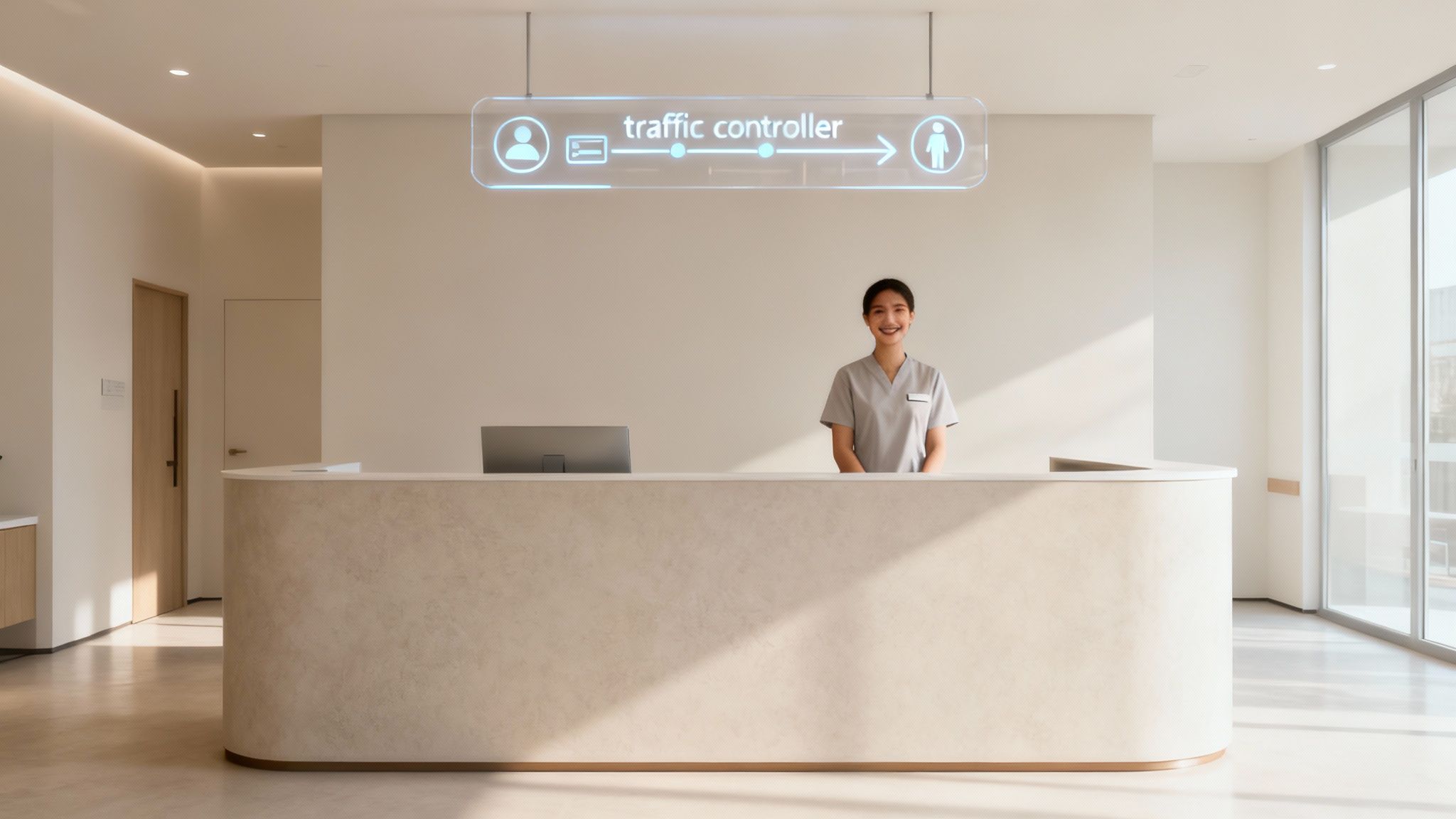
Think of your front desk like a busy traffic intersection. An AI medical receptionist is your clinic's digital traffic controller. It’s not just answering the phone—it’s intelligently directing the flow of patient communication and organizing tasks so nothing ever gets stuck in a jam. This system acts as a sophisticated digital extension of your team, capable of understanding context, handling complex queries, and performing tasks that traditionally required significant human effort.
This isn't just another automated answering service. It’s a genuine partner built to solve the real, nagging problems that bog down so many medical practices. We’re talking about the endless games of phone tag, the frustratingly long hold times during peak hours, and the common communication bottlenecks that drive both staff and patients crazy. By automating these interactions, the AI ensures a consistent, high-quality experience for every patient, every time.
The Problem It Solves
Let's be honest: the administrative load on healthcare staff is a massive source of burnout. Manual tasks like scheduling, sending out reminders, and answering the same questions over and over again eat up precious time—time that could be spent giving patients a better, more personal experience. This constant pressure not only affects staff well-being but also introduces a higher risk of human error in critical tasks like data entry and appointment booking.
An AI receptionist steps in and takes over these repetitive, time-consuming duties. This frees up your team to focus on the patients who are right there in the office. It’s a simple shift that does wonders for staff morale and dramatically improves the quality of your in-person care. Your skilled human staff can now handle more complex issues, like intricate insurance queries or providing comfort to an anxious patient, which are tasks where their empathy and expertise truly shine.
Essentially, this technology helps your practice run like a well-oiled machine by fixing issues like:
- Missed Calls and Lost Revenue: It answers every single call, even after hours, turning missed opportunities into booked appointments. Each missed call from a potential new patient is revenue lost to a competitor. The AI closes this gap entirely.
- Administrative Overload: It puts scheduling, intake forms, and reminders on autopilot, cutting down manual work significantly. This automation directly reduces the cognitive load on your staff, preventing burnout and improving job satisfaction.
- Patient Frustration: It gives patients instant answers and gets rid of hold times, making for a much better experience right from their very first call. A positive first interaction sets the tone for the entire patient journey.
By automating up to 70% of routine calls, AI receptionists tackle the chronic staff shortages and rising patient volumes head-on. This allows clinics to run more efficiently without burning out their teams.
A Growing Trend in Healthcare
The move toward this kind of technology is part of a much bigger shift in healthcare. The market for AI virtual receptionists is expected to hit $9 billion globally by 2025—that's a huge jump from $3.85 billion in 2024. What's driving this growth? An urgent need for smart solutions that can handle administrative work without having to hire more and more people in a competitive labor market. Healthcare providers are recognizing that technology is not a threat, but a vital tool for sustainability and growth.
These systems are powered by sophisticated conversational AI, utilizing Natural Language Processing (NLP) and machine learning to handle complex, back-and-forth conversations with surprising accuracy. They aren't just reading from a script; they're actually understanding patient intent and responding to what they need in a dynamic, human-like manner. If you're curious about the mechanics, learning about the core technology behind an AI-powered front desk can give you a better sense of how it all works to create a seamless patient experience.
How AI Receptionists Actually Change the Game in Your Practice
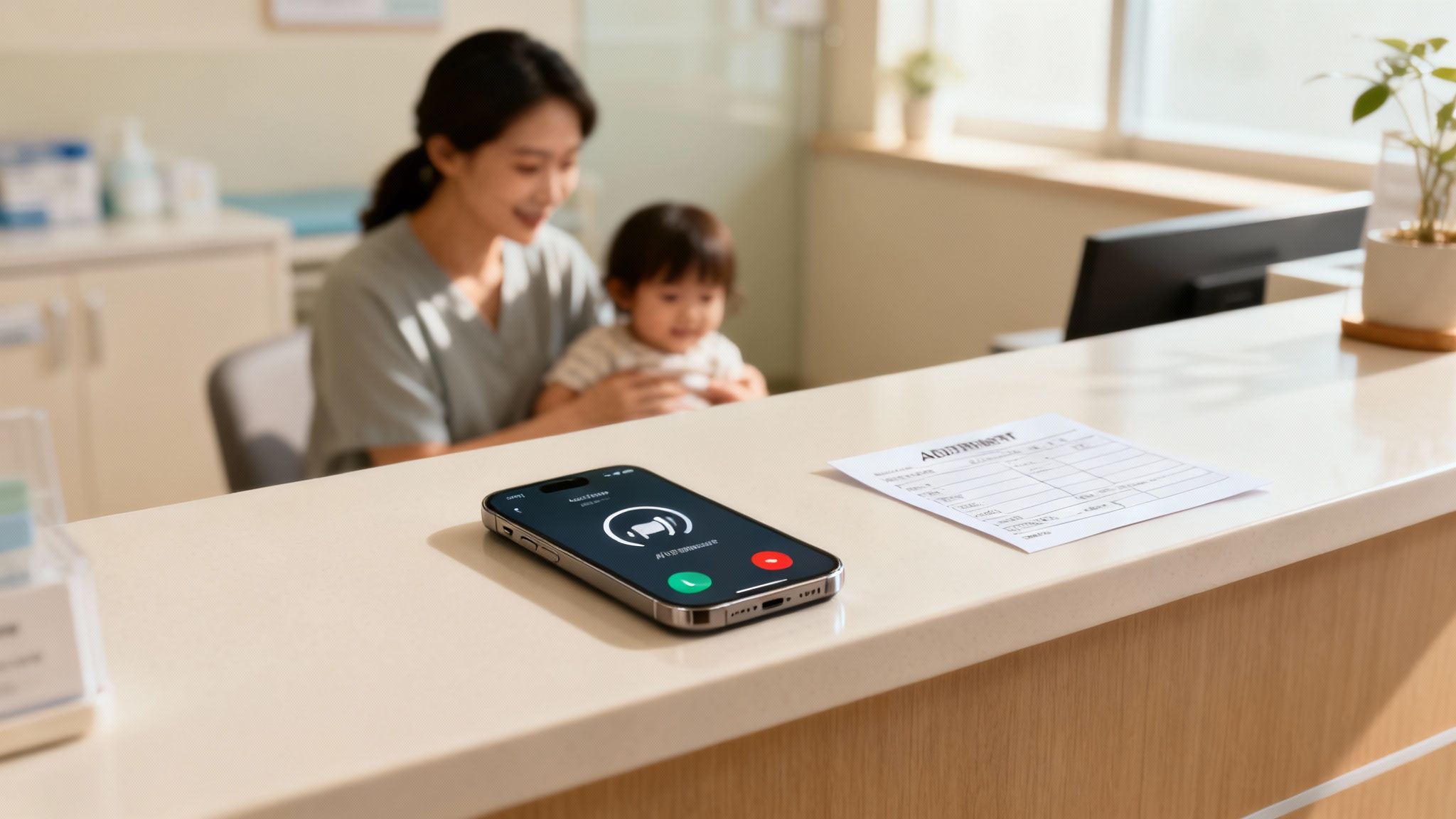
To really get what an AI medical receptionist does, you have to picture how it transforms the typical front-desk chaos into a smooth, orderly operation. This isn't just about picking up the phone. It's about taking on the specific, critical tasks that eat up your staff's time and drain their energy, ultimately revolutionizing the patient journey from the very first point of contact.
Think about a frantic parent calling at 8:05 AM because their child woke up with a high fever. Instead of getting a busy signal or being stuck on hold, they’re greeted instantly by an intelligent voice agent. The AI picks up on the urgency in their tone and keywords, scans the day's schedule for any last-minute cancellations or open slots, and offers an appointment right then and there. The whole thing takes less than a minute, providing immediate relief and a positive resolution.
That ability to handle high-stress, time-sensitive calls without missing a beat is a total game-changer for both patient happiness and clinic workflow. It demonstrates a level of responsiveness and efficiency that is often difficult for even the best-staffed practices to achieve consistently.
To give you a clearer picture, let's break down the core features of an AI medical receptionist and what they mean for your practice. These capabilities work in synergy to create a comprehensive administrative solution.
The following table provides a quick summary of these key capabilities.
AI Medical Receptionist Core Features at a Glance
| Core Capability | Function | Benefit to Practice |
|---|---|---|
| Intelligent Scheduling | Books, reschedules, and cancels appointments based on real-time provider availability and clinic rules. | Eliminates double-bookings, fills cancellation gaps automatically, and keeps schedules optimized for maximum revenue. |
| Automated Intake | Sends digital forms and reminders to patients via text or email before their visit, collecting necessary information. | Reduces staff workload, minimizes no-shows by over 70%, and ensures patient data is accurately captured and ready pre-visit. |
| EMR/EHR Integration | Connects directly to the practice's EMR/EHR to access and update patient records in real time. | Drastically reduces manual data entry, prevents costly errors, and streamlines clinical workflows for providers. |
| Prescription Refills | Verifies patient details and medication history to process routine refill requests automatically based on predefined protocols. | Frees up nurses and MAs from routine phone calls, reduces pharmacy callbacks, and ensures faster prescription turnarounds for patients. |
Each of these functions works together to create a system that handles the administrative burden, letting your human staff focus on what they do best: caring for patients with empathy and expertise.
Intelligent Scheduling and Appointment Management
Let's be honest, manual scheduling is a magnet for mistakes. Double bookings, missed cancellations, and tangled appointment calendars are just part of the daily grind. An AI receptionist puts a stop to all that by acting as a flawless, tireless calendar manager that operates with machine precision.
The system plugs directly into your practice management software. So when a patient calls to book a visit, the AI already knows every provider's availability, the different appointment types, and how long each one takes. It can book, move, or cancel appointments in real-time, without ever making a human error. It can even be programmed with complex scheduling rules, such as prioritizing new patients or ensuring specific appointment types are only booked with certain providers.
Here's a great example: a patient cancels their 2:00 PM appointment. The AI can automatically reach out to the next person on the waitlist and offer them the open slot via text message. This kind of proactive management keeps your schedule full and your revenue flowing, turning a potential loss into a gain without any staff intervention.
Automated Patient Intake and Communication
All those hours your team spends on pre-visit paperwork, insurance verification, and reminder calls really add up. An AI medical receptionist automates that entire process, saving dozens of staff hours every week and slashing your no-show rates. This proactive communication ensures patients are prepared for their visit and reduces day-of-visit delays.
A typical automated workflow looks something like this:
- Appointment Confirmation: Right after a patient books, they get a text or email with all the details, including a link to add the event to their personal calendar.
- Digital Intake Forms: A few days before the visit, the system sends a secure link to the intake forms. Patients can fill them out on their phone or computer, at their convenience, and the data is automatically pushed into the EMR.
- Appointment Reminders: The AI sends an interactive reminder 24-48 hours before the appointment, asking for a simple reply to confirm, cancel, or reschedule. If they need to reschedule, the AI can handle that in the same conversation.
This system ensures all the necessary information is collected and verified before the patient even walks through the door. It's a perfect example of effective customer service automation software that genuinely improves the patient experience while boosting operational efficiency.
An AI receptionist ensures that nearly 100% of calls are answered, a massive improvement over the live answering rates that can be as low as 30% in busy practices. This means no more missed opportunities or frustrated patients leaving negative online reviews.
Deep EMR and EHR Integration
The real magic happens when an AI medical receptionist integrates deeply with your Electronic Medical Record (EMR) or Electronic Health Record (EHR) system. This connection is what elevates the AI from a simple answering service to a true administrative powerhouse, allowing it to access and update patient information securely and accurately.
Think about a patient calling for a prescription refill. Instead of your staff having to stop what they're doing, place the patient on hold, and search the EMR, the AI can:
- Verify the patient's identity using multiple data points (e.g., name and date of birth).
- Pull up their file to confirm the medication, dosage, and last refill date.
- Check if a follow-up appointment is required before the refill can be approved, based on clinic protocols.
- Send the request straight to the provider's inbox for an electronic signature, with all relevant information attached.
This seamless flow of information gets rid of manual data entry, which is a huge source of clinical errors and staff frustration. For any practice looking to make its communication smarter, learning more about what an AI phone receptionist can do is a great next step. By plugging directly into your core systems, the AI truly becomes an extension of your clinical team, ensuring data consistency and accuracy across the board.
Measuring the Real Impact on Your Bottom Line
When you're looking at any new technology, it all boils down to one question: what’s the actual return on investment? Beyond the bells and whistles, an AI medical receptionist makes a strong business case by directly improving your practice's financial health. These aren't just abstract benefits; they show up as real, measurable gains in both revenue generation and cost savings.
It’s all about turning better operations into dollars and cents. When an AI fields every call, you start capturing revenue that used to vanish after hours or when the front desk was swamped. Every appointment it books is money in the bank, and every automated reminder helps lock in that revenue by cutting down on no-shows, which are a direct hit to your bottom line.
Driving Down Administrative Overhead
One of the first things you'll notice is a big drop in administrative costs. Just think about the sheer volume of hours your team spends on repetitive work—answering the same questions over and over ("Are you accepting new patients?"), scheduling appointments, and manually typing in patient information from paper forms. An AI medical receptionist takes over these tasks, freeing up your staff for work that truly requires a human touch and critical thinking.
This isn't about replacing people; it's about empowering them and optimizing your most valuable resource. Instead of being tied to the phone, your team can focus on complex patient needs, wrestle with tricky insurance claims, and create a welcoming, supportive in-person atmosphere. You end up with a more efficient, less stressed-out team, which means lower staff turnover and fewer hiring and training headaches. This strategic reallocation of human capital is a core benefit of automation.
The efficiency gain is huge. By automating the bulk of front-desk tasks, practices can see up to a 60% reduction in administrative overhead. That translates to significant savings and lets you put your talented staff where they can make the biggest difference in patient care.
Maximizing Revenue Through Efficiency
Beyond cutting costs, an AI receptionist is a serious tool for growing your revenue. It works around the clock, 24/7/365, making sure you never miss a patient call again. That constant availability is a game-changer for booking new patients who might have otherwise called a competitor after finding your office closed or your lines busy.
Here’s how it directly boosts your income:
- Zero Missed Calls: It answers every single call, day or night, weekends and holidays. Inquiries that once went to a full voicemail box are now converted into scheduled appointments in real time.
- Reduced No-Show Rates: Smart, interactive reminders can slash the number of no-shows, which are a notorious drain on revenue for any practice. A single no-show for a specialist can represent hundreds of dollars in lost revenue.
- Optimized Scheduling: The AI can intelligently fill last-minute cancellations by instantly reaching out to patients on your waitlist, keeping your providers' schedules full and productive. This turns lost time into billable time.
Practices that bring these systems on board see impressive results. We're talking up to a 30% increase in administrative efficiency and a drop in patient no-show rates by as much as 70%. These AI systems answer nearly 100% of calls, a world away from live receptionists who, during peak times, might only catch 30% of them. In fact, platforms like Sully.ai have shown a 14x return on investment for some practices, even doubling revenue in certain cases just by making sure no patient opportunity slips through the cracks. If you're curious, you can discover more insights about AI medical receptionists in healthcare.
Building a Strong ROI Model
Figuring out the ROI for an AI receptionist is pretty simple and data-driven. Start by getting a handle on your current numbers. How many calls does your front desk miss each day? What’s your current no-show rate and the average revenue per visit? How many hours does your team spend on manual scheduling and reminder calls?
Once you have that baseline, you can see how automation will move the needle. If an AI captures just two extra appointments a day or prevents a single no-show, it often pays for itself almost immediately. When you combine lower overhead from reduced administrative work with increased revenue from more appointments and a more productive staff, the financial argument becomes crystal clear. It's a strategic move for any practice that's serious about sustainable growth and profitability.
Keeping Patient Data Safe with AI

In healthcare, patient privacy isn’t just a nice-to-have—it's the law, and a fundamental ethical obligation. So when you think about bringing an AI medical receptionist into your practice, the first question on your mind should absolutely be about data security. Handing over Protected Health Information (PHI) to any new technology demands complete trust that it meets the strict standards of the Health Insurance Portability and Accountability Act (HIPAA).
The good news is that any AI platform worth its salt is built with security at its core from day one. It's not an afterthought. Think of it less like putting a strong lock on a regular door and more like building a bank vault—every single part, from data transmission to storage, is designed for maximum protection. These systems use multiple layers of security, both technical and procedural, to make sure patient data stays locked down and confidential at all times.
The Cornerstones of AI Data Security
Protecting patient information isn't a one-and-done task; it’s a constant, multi-layered effort. The best AI receptionist providers build a fortress around your data using several key security measures that make compliance part of their DNA. These are not optional features; they are foundational requirements for operating in the healthcare space.
These safeguards all work in concert, ensuring that every interaction—from a simple appointment request to a detailed new patient form—is handled with the highest level of security.
Here are the non-negotiable security features you should look for:
- End-to-End Encryption: This technology essentially scrambles all data into a secret code the moment a patient speaks or types, and it stays that way during transmission and at rest. Even if someone managed to intercept the data, it would be completely unreadable and useless without the decryption key.
- Secure, HIPAA-Compliant Data Centers: All patient information has to be stored in highly secure, SOC 2-certified facilities. These data centers are physically protected with measures like biometric access and 24/7 monitoring, and they go through regular, rigorous audits to prove they meet strict HIPAA regulations.
- Role-Based Access Controls: This is a simple but powerful concept. It means only authorized staff with a legitimate need can access specific patient information. It’s like giving out keys that only open certain doors, which stops people from seeing data that isn't relevant to their role and creates a clear audit trail.
One of the most critical pieces of this puzzle is the Business Associate Agreement (BAA). This is a legally binding contract where the AI provider formally agrees to protect your patients' PHI according to HIPAA law. If a vendor won't sign a BAA, walk away. It's a massive red flag and a non-starter for any healthcare practice.
Beyond the HIPAA Baseline
HIPAA compliance is the starting line, not the finish line. A truly trustworthy AI platform goes further, constantly scanning for new threats and staying on top of cybersecurity best practices. In an era of increasing digital threats, a proactive stance on security is essential. After all, protecting patient data means having a proactive defense against threats like those you see when understanding the rising threat of infostealer malware.
The system should also give you detailed audit trails that log every single time patient data is accessed or changed. This kind of transparency is vital for accountability and for proving compliance if you ever face an audit. It’s a digital paper trail showing who saw what and when, adding a crucial layer of oversight. To learn more about how this works in practice, you can check out our complete guide to HIPAA-compliant AI tools.
By picking a partner that takes these security measures seriously, you can bring an AI receptionist into your practice and feel confident that both your patients' privacy and your practice's reputation are protected.
Your AI Implementation Playbook

Bringing an AI medical receptionist into your practice might feel like a massive project, but with a structured approach, it's more manageable than you think. The best way to approach it is with a clear, strategic plan. Think of it less as a complex tech overhaul and more like hiring and training a new, incredibly efficient team member who needs to be integrated thoughtfully into your existing workflows.
A successful rollout starts long before you ever sign a contract. It all begins with a hard look at your practice's daily struggles, identifying specific pain points, and figuring out exactly what you need this technology to do. This upfront work is what separates a smooth, impactful transition from a frustrating, costly one.
First, Figure Out What Your Practice Actually Needs
Before you even start looking at demos, take a step back and perform a thorough assessment of your own operations. Where are the real bottlenecks? Are missed calls a constant headache leading to lost revenue? Are your staff buried in manual data entry, leading to errors and burnout? Pinpointing these specific challenges will give you a clear mission for your AI.
Start by asking yourself these key questions:
- What are the top 3-5 administrative tasks that consume the most staff time and cause the most frustration?
- What is our average daily call volume? How many calls do we miss during peak hours and after closing?
- What EMR/EHR system are we using, and does it have a modern API for easy integration?
- What's a realistic budget for this kind of software, considering both the monthly fee and the expected ROI?
- What specific outcomes do we want to achieve (e.g., reduce no-shows by X%, increase new patient bookings by Y%)?
Having these answers gives you a solid foundation and a scorecard to judge different AI platforms, ensuring you're solving your actual problems, not just buying new tech for the sake of it.
Choosing the Right AI Partner, Not Just a Vendor
Once you know what you’re looking for, it’s time to find the right company to partner with. And I use the word "partner" intentionally. You are not just buying software; you are integrating a core communication system into your practice. Not all AI receptionists are built the same, so it's critical to do your homework and vet potential providers thoroughly.
Look for a provider with a proven track record in healthcare. They need to understand the unique demands of a medical office, including complex scheduling rules, patient privacy, and the importance of an empathetic tone. Ironclad HIPAA compliance is non-negotiable. A great partner will be invested in your success, offering solid onboarding, training, and ongoing support, not just selling you software and disappearing.
The move toward AI in healthcare is picking up speed. In the U.S., over 60% of outpatient clinics are now looking into or actively using these tools. Why? The results speak for themselves. Practices often report a 50% drop in missed calls within the first three months and see administrative costs fall by up to 30%. By handling nearly 80% of front desk work, these systems free up your team and fix common patient frustrations like endless hold times. If you want to dig into the numbers, you can learn more about AI receptionist adoption trends.
Your Step-by-Step Implementation Checklist
A good plan turns a big project into a series of simple, achievable steps. Use this checklist to guide you from initial consideration to a successful launch and beyond.
-
Set Clear Goals: Using your initial assessment, define specific, measurable, achievable, relevant, and time-bound (SMART) goals. For example, aim to "cut patient no-shows by 20% in the first quarter" or "automate 90% of prescription refill requests within six months."
-
Get Your Staff on Board Early: This is a big one. Change management is crucial. Introduce the idea to your team from day one. Frame it as a tool that will support them by taking over the tedious, repetitive tasks, freeing them up for more engaging and important patient-facing work. Their buy-in is everything.
-
Schedule Vendor Demos: Pick your top 2-3 choices and see them in action. Come prepared with a list of scenario-based questions about EMR integration, how you can customize scripts, their security protocols, and how they handle edge cases.
-
Map Out the Technical Setup: Work directly with the vendor to plan the integration with your phone and EMR systems. Get a clear timeline, understand the technical requirements, and figure out what, if anything, your team will need to do.
-
Customize Scripts and Workflows: The AI should sound like it belongs in your practice. Tweak the voice, tone, and scripts to match your brand and make sure the call flows are logical and intuitive for your specific patient population.
-
Train Your Team: Make sure your staff knows how the system works, how to use the dashboard to monitor it, and—crucially—how and when to step in for a seamless human handoff.
-
Let Your Patients Know: A heads-up goes a long way. A simple announcement on your website, a small sign in the waiting room, or a line in your appointment reminders can explain how the new system will give them a better experience with faster service, anytime they call.
"The most successful AI implementations happen when the technology is seen as a tool to empower staff. When the team understands it's there to help them do their jobs better, resistance disappears and they become champions of the change."
Vendor Evaluation Checklist
Finding the right AI partner is the most critical step. This checklist will help you compare your options and ask the right questions to ensure you find the perfect fit for your practice's unique needs.
| Evaluation Criterion | Key Questions to Ask | Importance (High/Medium/Low) |
|---|---|---|
| Healthcare Experience | Does the vendor specialize in healthcare? Can they provide case studies from practices like mine? Do they understand clinical workflows? | High |
| EMR/EHR Integration | Does it offer seamless, bidirectional integration with my current EMR system? What does that setup process look like and what is the cost? | High |
| HIPAA Compliance | How do they ensure data security and privacy? Will they sign a Business Associate Agreement (BAA)? Can they provide compliance documentation and audit reports? | High |
| Customization | Can I customize call scripts, workflows, and the AI's voice to match my practice's brand? How easy is it for my staff to make changes without vendor help? | High |
| Core Capabilities | Does the system handle all our key needs (scheduling, intake, refills, etc.)? Does it support multiple languages if needed? What is its accuracy rate? | Medium |
| Training & Support | What kind of onboarding and training is provided for my staff? What are their support hours and typical response times? Is support included or an extra fee? | Medium |
| Pricing & ROI | What is the pricing model (per call, per provider, flat fee)? Are there any hidden setup or integration fees? Can they provide a detailed ROI projection? | Medium |
| User-Friendliness | How intuitive is the dashboard for my staff to use? Can we easily monitor call logs, listen to recordings, and pull performance metrics? | Low |
Using a structured checklist like this ensures you make a decision based on data and your practice’s specific needs, not just a flashy sales demo. It’s the foundation for a successful and valuable long-term partnership.
Your AI Receptionist Questions, Answered
Bringing any new technology into your practice, especially one that interacts directly with patients, naturally comes with a lot of questions. When we're talking about your front desk—the very first point of contact—it's completely normal to have concerns about how an AI medical receptionist will perform in real-world, high-stakes scenarios. Patient trust is paramount, and any new system must enhance, not hinder, that trust.
Let's walk through some of the most common questions and concerns that practice managers and clinicians bring up. My goal here is to give you direct, clear answers to help you feel confident about how this technology actually works in a busy medical office.
How Does the AI Handle an Emergency Call?
This is, without a doubt, the most important question. The answer comes down to smart, built-in safety protocols. A well-designed AI medical receptionist isn't just a simple answering machine; it's programmed with sophisticated triage logic. It actively listens for specific keywords and phrases that signal a potential emergency, like "chest pain," "can't breathe," "severe bleeding," or "allergic reaction."
The moment the AI detects one of these trigger words, its standard script goes out the window. It immediately follows the emergency protocol you've configured. That could mean instantly transferring the call to a live staff member, routing it to a designated on-call provider's line, or instructing the patient to hang up and dial 911 immediately. This process is instantaneous and removes any ambiguity.
This built-in safety net ensures that automation never gets in the way of urgent care. The system is designed to recognize its limits and hand off critical situations to a human expert without a moment's delay.
It's crucial to understand that the AI isn't making a medical diagnosis. It’s simply acting as a first line of defense, identifying a potential crisis based on predefined rules and making sure the patient gets to the right level of care as fast as possible. This is a non-negotiable feature for any AI system used in healthcare and should be thoroughly tested during implementation.
What Does an AI Receptionist Typically Cost?
There's no single price tag for an AI medical receptionist. The cost really depends on the provider you go with, the specific features you need, your EMR integration requirements, and the number of calls your practice handles. The good news is that most vendors use a subscription-based Software-as-a-Service (SaaS) model, so you aren't looking at a huge upfront capital investment.
Generally, you'll see pricing structured in one of two ways:
- Per Provider Per Month: A flat monthly fee based on how many clinicians are in your practice. This is simple and predictable.
- Usage-Based: A plan tied to the number of calls handled or the total minutes used each month. This can be more cost-effective for practices with fluctuating call volumes.
For a small, single-provider office, a basic plan might start at just a few hundred dollars per month. Naturally, for larger clinics or health systems with higher call volumes and more complex workflows, that cost will be higher. Always ask about implementation fees, training costs, and any additional charges for EMR integration.
The key is to look at this as an investment, not just another line-item expense. Many practices see a significant return, with some reporting a 14x ROI or even higher. When you add up the money saved from eliminating staff overtime, capturing revenue from calls you used to miss, and cutting down on costly no-shows, the system often pays for itself very quickly.
How Difficult Is It to Integrate with Our EMR System?
Integration is a huge piece of the puzzle, and its difficulty really depends on the AI vendor and your specific Electronic Medical Record (EMR) or Electronic Health Record (EHR) system. The best part is that the leading AI receptionist companies have already put in the work on this front because they know it's essential for providing value.
They've built seamless, ready-to-go, API-based integrations with all the major EMR platforms like Epic, Cerner, Allscripts, and Athenahealth. If your practice is already on one of these systems, the setup is often a smooth, plug-and-play process that causes very little disruption to your daily workflow and can be completed in a matter of weeks.
Now, if you use a smaller, more specialized, or legacy EMR, the integration might require a bit more custom development. This should be one of the very first things you ask about when vetting potential vendors. Get a list of their current EMR integrations and have them walk you through their process for connecting to new systems. A solid, two-way (bidirectional) integration is what really unlocks the full power of the AI, allowing it to both read from and write to the patient record.
Can We Customize the AI's Voice and Scripts?
Absolutely. In fact, you should not only expect it but demand it. Customization is a standard, essential feature. You are definitely not stuck with a generic, robotic voice that sounds out of place and alienates your patients. The goal is to create an experience that feels natural and aligned with your practice's brand.
Most platforms give you a whole range of options to make sure the AI feels like a true part of your team:
- Voice and Accent: You can usually pick from a library of high-fidelity, AI-generated voices—male and female, with different tones and accents—to find one that perfectly matches your practice's vibe and patient demographic.
- Language Support: Many systems are multilingual right out of the box, which is a huge help for serving diverse patient communities and improving health equity.
- Script Tailoring: Most importantly, you have granular control over the conversation. You'll work with the vendor to customize the greeting, the questions the AI asks, the information it provides, and the overall flow to align with your exact clinical workflows and communication style.
This level of control ensures your patients have a professional, welcoming, and consistent experience every time they call. The AI becomes a reliable extension of your staff, speaking in a voice your patients will come to know and trust, enhancing their overall perception of your practice.
Ready to see how an AI-powered voice agent can transform your practice? Simbie AI offers a clinically-trained, HIPAA-compliant solution that automates front-desk tasks, reduces staff burnout, and enhances patient care.