
In the dynamic world of healthcare, the term "AI medical assistant" is rapidly moving from a futuristic concept to a practical, indispensable tool. So, what exactly is an AI medical assistant? Think of it less like a science-fiction robot and more like a highly efficient virtual team member. It’s a sophisticated software solution designed to take over the repetitive, time-consuming administrative and clinical tasks that bog down a healthcare practice. From handling an endless stream of patient calls and scheduling appointments to managing data entry and sending reminders, it lightens the load for your staff, streamlines operations, and ultimately enhances patient care.
The Hidden Costs of an Overwhelmed Front Desk

If you run a busy medical practice, you know the scene all too well. Phones are ringing nonstop, your team is trying to check in one patient while handling paperwork for another, and hold times keep creeping up. This isn't just a stressful day at the office; it's a silent drain on your practice's bottom line and a major contributor to staff attrition. An overwhelmed front desk is often the epicenter of operational inefficiency, leading to a cascade of negative consequences that impact both your team and your patients.
The sheer volume of administrative work is staggering, and your front desk staff is right in the middle of it, often juggling multiple tasks simultaneously under immense pressure. This kind of high-pressure environment is a fast track to staff burnout, which is a significant driver of high turnover rates in the healthcare industry. Finding, hiring, and training new staff is not only expensive but also disruptive to the practice's workflow. The financial bleeding doesn't stop there. Every call that goes unanswered or is sent to voicemail is a potential appointment—and therefore revenue—lost forever. Patients who can't get through are likely to seek care elsewhere, leading to patient leakage and a damaged reputation.
From Bottleneck to Well-Oiled Machine
This is where an AI medical assistant comes in, acting as a powerful force multiplier for your existing team. The goal isn't to replace your talented and empathetic staff but to augment their capabilities, freeing them from the monotonous tasks that cause those frustrating bottlenecks. Picture a system that can answer hundreds of calls at once, so no patient ever has to be put on hold again or hear a busy signal. Imagine a world where your staff isn't pulled in a dozen different directions, but can instead focus their energy on providing a high-quality, personalized experience for the patients right in front of them.
An AI assistant helps shift your front desk from a constant state of putting out fires to a calm, proactive hub focused on patient care. It handles the routine stuff, letting your team apply their skills to more complex patient issues and in-person interactions.
The difference this technology can make is like night and day, transforming the core of your administrative operations. By automating the predictable, your practice can become more adaptable, efficient, and patient-centric.
- Before AI: Your team is drowning in calls for appointments, refills, and simple questions. Patients get frustrated with long waits and the inability to reach someone, and your practice loses business from calls you just can't get to in time. Staff morale plummets under the weight of an unmanageable workload.
- After AI: The AI works 24/7, instantly booking appointments, handling refill requests, and answering common questions over the phone. This frees up your staff to give their full attention to the patients in front of them, cut down on in-office wait times, and deliver a better, more compassionate care experience.
At the end of the day, a capable AI front desk solution turns a major operational headache into a source of real, measurable efficiency and revenue growth. It allows your skilled team to get back to what they do best: taking care of people.
How an AI Medical Assistant Actually Works
So, what’s really going on behind the curtain of this transformative technology? It’s best to think of an AI medical assistant not as a simple chatbot or a pre-recorded menu, but as a dedicated digital team member powered by advanced artificial intelligence. It’s powered by sophisticated tech like Natural Language Processing (NLP) and Machine Learning (ML), which gives it the ability to actually understand and interpret human language—whether someone is speaking on the phone or typing a message. This allows for natural, two-way conversations that feel intuitive to the patient.
At its heart, the AI assistant runs on pre-programmed workflows meticulously built to tackle specific healthcare administrative tasks. When a patient calls and says, "I'd like to book an appointment with Dr. Smith for next Tuesday afternoon," the AI instantly recognizes that intent. From there, it taps directly into your practice's scheduling software, analyzes Dr. Smith's availability, offers suitable time slots, and confirms the booking, all in real-time. No human intervention is needed for this entire interaction, freeing up staff for more complex duties.
The growth in this sector is staggering, reflecting a clear market need. The global market for AI virtual assistants in healthcare hit $677.93 million in 2023 and is on track to explode to an estimated $9,295.63 million by 2030. This isn't just a fleeting trend; it’s a direct response to what patients and providers want and need. A solid 72% of patients are now comfortable using voice AI for routine tasks like scheduling appointments and managing prescription refills. You can find more details about the growth of AI in healthcare on techmagic.co.
Automating the Entire Patient Journey
An AI medical assistant isn't just a one-trick pony focused solely on scheduling. Its capabilities extend across the entire patient lifecycle, from their first point of contact all the way to post-visit follow-ups. Think of it as an orchestra conductor, seamlessly coordinating all the moving administrative parts to create a smooth, consistent, and hassle-free experience for your patients and a more efficient workflow for your staff.
It all starts with patient intake. Before an appointment, the AI can proactively reach out to patients to gather essential medical history, confirm insurance details, and guide them through completing all the necessary forms digitally. This information flows directly and accurately into the patient’s electronic medical record (EMR), which means less time spent on clipboards in the waiting room and more valuable time for meaningful clinical interaction during the visit.
But the AI’s work doesn't stop there. It continues to provide value throughout the patient's entire journey with your practice.
- Appointment Management: It handles scheduling, rescheduling, and cancellations 24/7. A patient can call at 10 PM on a Saturday to move an appointment without ever hitting voicemail, ensuring the appointment slot is captured and the schedule remains full.
- Intelligent Reminders: The system sends out automated, personalized reminders via text or a friendly, conversational phone call, which drastically cuts down on costly no-shows and late cancellations.
- Prescription Refills: Patients can request a prescription refill just by talking to the AI. It verifies the prescription details against the patient's record, checks eligibility, and sends the request straight to the physician for final approval. It’s all done without anyone on your administrative team having to touch it, reducing a significant daily workload.
By taking over these predictable, high-volume tasks, the AI medical assistant frees up administrative staff to handle more complex patient needs, such as navigating complicated insurance issues, coordinating specialist referrals, or providing in-person support to anxious patients.
Comparing Manual Tasks to AI Automation
This table contrasts traditional administrative tasks with the streamlined process managed by an AI medical assistant, highlighting key efficiency gains and improvements in accuracy. The difference becomes stark when you compare the old, labor-intensive way of doing things to the new, automated approach.
| Task | Traditional Manual Process | AI Medical Assistant Process |
|---|---|---|
| Appointment Scheduling | Staff member spends 5-10 minutes on the phone, manually searching the EMR for open slots, often putting the patient on hold. | AI finds and confirms an appointment in under a minute, directly integrating with the EMR schedule, 24/7. |
| Patient Intake | Patient fills out paper forms in the waiting room; staff manually enters data into the EMR, introducing the risk of typos. | AI sends a digital link for forms ahead of time; data is automatically and accurately synced to the EMR. |
| Refill Requests | Patient calls, leaves a message, staff transcribes it, manually creates a task, and sends it to the clinician for approval. | Patient makes a voice request, AI verifies it against the EMR, and the request is queued directly for the doctor's review. |
| Appointment Reminders | Staff spends hours each day making reminder calls, a repetitive and often fruitless task if patients don't answer. | Automated reminders are sent via the patient's preferred method (call/text), with options to confirm or reschedule instantly. |
An AI doesn't need breaks, never has a bad day, and can juggle hundreds of simultaneous tasks with perfect accuracy. This kind of consistent, reliable performance makes a real, measurable difference in how smoothly a practice runs and the quality of the patient experience.
Weaving AI into Your EMR System
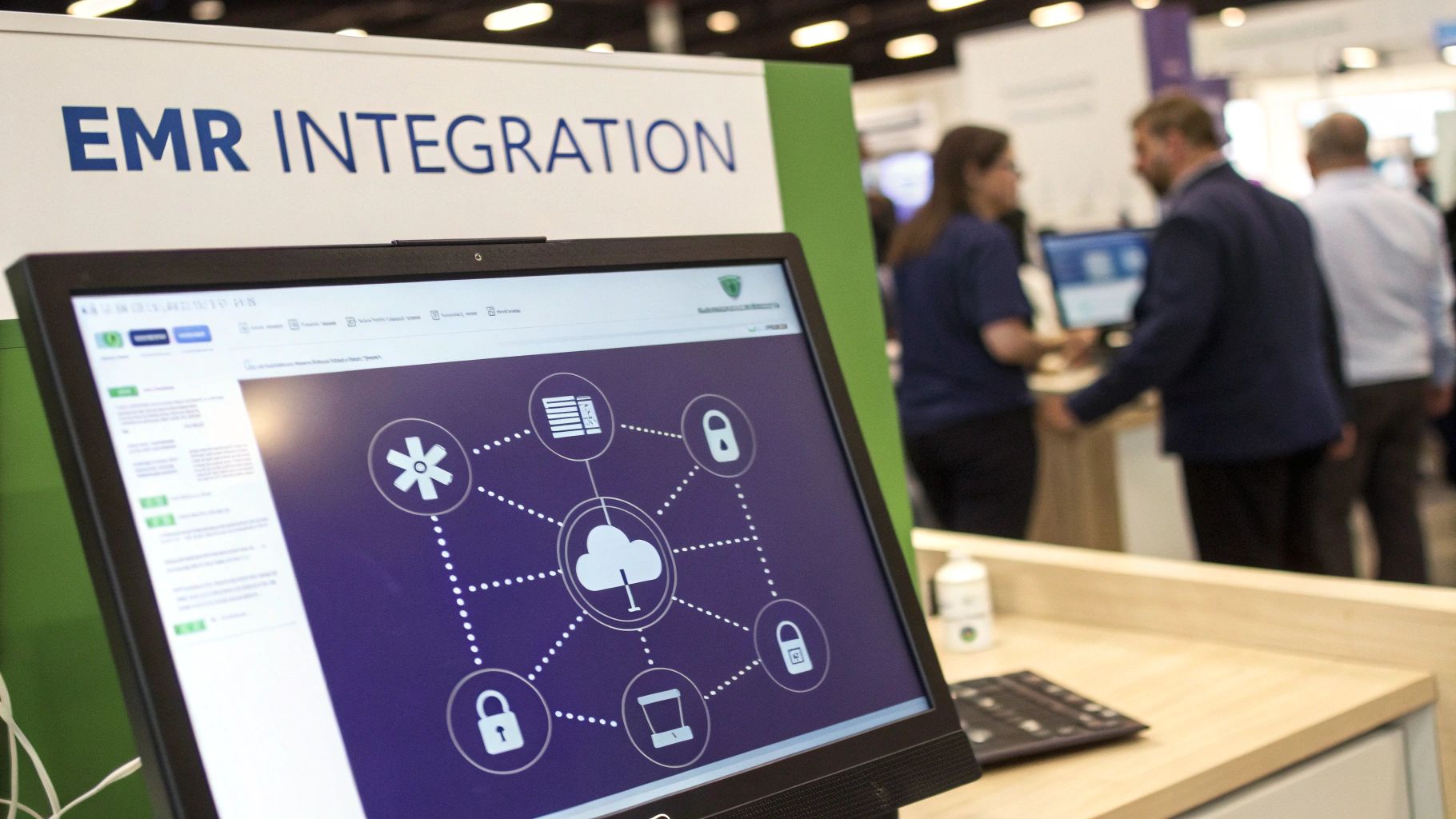
Whenever you bring new technology into a clinical environment, two critical questions pop up immediately: Will it play nicely with our current setup, and is it secure? A well-designed AI medical assistant is engineered to answer a resounding "yes" to both. It’s not meant to be another software silo that creates more work and fragments data; it should feel like a natural, seamless extension of your Electronic Medical Record (EMR) system. The quality of this integration is perhaps the single most important technical factor to consider.
Think of it like building a secure, two-way digital bridge. The AI assistant communicates directly with your EMR via APIs (Application Programming Interfaces), letting it pull patient records, check provider schedules, and log conversations without anyone on your team lifting a finger. So, when a patient calls to schedule a visit, the AI looks at the EMR in real-time, finds an open slot that matches the patient's request and the provider's availability, and books it on the spot. No manual entry or double-checking is needed.
This direct, bidirectional connection is huge for cutting down on human error and administrative busywork. Every detail—from a newly updated phone number to a quick note about a prescription refill request—gets logged right away in the correct patient file. This keeps your data clean, consistent, and up-to-date, freeing your team from the mind-numbing task of double-entry and reducing the risk of costly mistakes. For a closer look at how this all connects, check out our guide on https://www.simbie.ai/integration-with-emr/.
Earning Trust Through HIPAA Compliance
Of course, none of this seamless integration matters if the data isn't secure. Patient privacy is paramount in healthcare, which is why any AI medical assistant worth its salt has to be HIPAA-compliant from the ground up. This isn’t just a marketing promise; it’s a fundamental architectural commitment to protecting sensitive patient information at every single turn. This compliance must cover not only the technology itself but also the operational procedures of the vendor.
A truly integrated AI acts like a trusted part of your clinical workflow, adhering to the same strict security and privacy rules you already have in place for your EMR system and your staff.
This kind of robust security is built on a few core, non-negotiable principles:
- End-to-End Data Encryption: All patient information is scrambled and rendered unreadable, whether it's moving between the AI and your EMR (data in transit) or just sitting on a server (data at rest). This makes it completely useless to unauthorized eyes.
- Secure Cloud Infrastructure: Top-tier AI tools run on secure, HIPAA-compliant cloud platforms (like AWS, Azure, or Google Cloud) that have multiple layers of physical and digital security and are constantly monitored for emerging threats.
- Strict Access Control and Auditing: User permissions are locked down on a need-to-know basis, so only the right people can see patient data. Everything is tracked, creating a clear, immutable audit trail of who did what, and when, which is essential for compliance.
For practices, this also means staying on top of evolving regulations like data privacy compliance and Australian data privacy laws or GDPR in Europe, ensuring all patient data is handled with the utmost care and in accordance with all legal requirements.
Growing with Cloud-Based Power
The market for conversational AI in healthcare is booming, and for good reason. It was valued at $13.68 billion in 2024 and is expected to surge to an incredible $106.67 billion by 2033. A big reason for this explosive growth is the shift to cloud-based systems, which are projected to hold a dominant 55.5% market share by 2035.
Cloud-based AI tools offer robust, EMR-integrated solutions that scale effortlessly with your practice, slash manual errors, and keep your administrative operations running 24/7 without the need for expensive on-premise hardware. This flexible, scalable model gives your clinic the power to grow and adapt without being held back by its technology.
Figuring Out the Real Return on Your Investment

Smoother workflows and happier staff are great, but the real story of an AI medical assistant for any practice manager is ultimately told in dollars and cents. When evaluating new technology, it's essential to see a clear, demonstrable line from the initial investment to a healthier bottom line. This isn't just about wishful thinking; the return on investment (ROI) is a real, calculable outcome driven by significant cost savings, huge boosts in operational efficiency, and new revenue capture.
The first and most immediate place you'll see an impact is in administrative overhead. Think about the endless cycle of phone calls for scheduling, refills, and simple logistical questions. By automating these high-volume, low-complexity interactions, practices can cut down the time staff spend on the phone by up to 60%. This isn't about replacing people. It's about reallocating their valuable time to higher-value work that truly serves patients and directly contributes to revenue generation, like following up on unpaid claims or discussing high-value treatment plans.
And there's a less obvious, but equally important, financial benefit: this shift away from repetitive, high-stress work is a powerful antidote to staff burnout. When your team can focus on meaningful patient conversations instead of juggling phone lines, job satisfaction goes up, and costly employee turnover goes down. Reducing turnover saves thousands in recruitment and training costs per employee.
Turning Missed Calls Into Real Revenue
Every single call that goes to voicemail is a missed opportunity. It's potential revenue walking out the door and often into the arms of a competitor. An AI medical assistant is on the clock 24/7/365, making sure no call ever gets missed again. It can handle a practically unlimited number of calls simultaneously, capturing appointments and patient inquiries that you'd otherwise lose completely, especially during peak hours or outside of business hours.
Let’s break down what that actually means for your practice’s top line:
- Zero Patient Hold Times: Patients get an immediate, professional response every time they call. No more frustrating hold music or endless ringing, which means they're far less likely to hang up and call the clinic down the street.
- 24/7 Scheduling: Patients can book appointments whenever it's convenient for them, whether it's late at night after the kids are in bed or early on a weekend morning. This keeps your schedule full and maximizes provider utilization.
- Automated Follow-ups and Recalls: The AI can handle appointment reminders and proactive recall prompts for annual check-ups or follow-up visits. This is a proven way to slash your no-show rate and keep patients engaged in their care, ensuring a steady stream of appointments.
Suddenly, your front desk goes from being a potential cost center and bottleneck to a powerful, automated revenue-generating machine that never sleeps.
The market for this technology is absolutely exploding for a reason. It's projected to jump from US$1,806.74 million in 2024 to an incredible US$29,630.51 million by 2032. That phenomenal growth is being driven by the urgent need to automate tasks in a field where administrative work can eat up as much as 40% of a team's day, representing a massive opportunity for efficiency gains.
A Real-World Example: A Mid-Sized Clinic's Turnaround
Let's make this tangible with a common scenario. Picture a mid-sized specialty clinic with five providers. They were drowning. Their two receptionists were trying to manage over 150 calls a day, which meant long hold times, a voicemail box that was always full, and a talented team on the verge of complete burnout. Patient complaints about access were rising.
Before the AI Assistant:
- Average Hold Time: 4 minutes (often longer during peak times)
- Daily Missed Calls: 25-30 (that's a lot of lost appointments and frustrated patients)
- Staff Time on Phone: Nearly 6 hours per receptionist, every day, on repetitive tasks.
- No-Show Rate: A painful 18%, costing the practice tens of thousands in lost revenue annually.
After bringing in an AI medical assistant, things changed—fast. Within just three months, the AI was handling about 80% of their inbound calls, taking care of all the scheduling, refill requests, and routine questions without human intervention. If you want to dig deeper into the numbers behind such transformations, you can learn more about the ROI of AI voice agents in healthcare.
Three Months After Implementation:
- Average Hold Time: 0 minutes. Every call is answered instantly.
- Daily Missed Calls: 0. Every patient inquiry is captured.
- Staff Time on Phone: Down to about 1.5 hours per receptionist (and only for complex, high-value issues).
- No-Show Rate: Dropped to just 7% due to automated, interactive reminders.
By automating the simple stuff, the clinic captured an estimated 15 new appointments every single week from calls they would have otherwise missed. Just as importantly, their front desk team was finally free to focus on giving great in-person service, proactively managing the schedule, and tackling tricky insurance verifications. It's a crystal-clear example of how this technology delivers a powerful, multi-faceted return, boosting both the balance sheet and the quality of patient care.
A Roadmap for Getting It Right
Bringing an AI medical assistant into your practice is more than just a software installation—it's a strategic initiative that involves changing the very rhythm of your day-to-day operations. Success isn't just about the technology itself; it's about people, process, and planning. A thoughtful, human-centered implementation plan is what makes the difference between a tool that truly empowers your team and one that just creates more friction and frustration.
The crucial first step has nothing to do with technology. It starts with an honest, thorough assessment of your current practice workflows. Where are the real bottlenecks? Are you drowning in phone calls for appointment scheduling? Is your no-show rate through the roof? Is your staff burning out from the endless cycle of manual data entry? Are patients complaining about long hold times?
Nailing down these specific pain points helps you set clear, measurable goals for what you actually want the AI to fix. This simple but vital act of defining the "why" frames the AI as a genuine solution to real, recognized problems, not just another piece of software to learn. It builds a solid business case for the change and gets everyone, from the front desk to the clinical providers, on the same page from day one.
Getting Your Team on Board
Once you know what you're trying to solve, it's time to bring your team into the conversation early and transparently. Let's be honest: the fear that "AI is here to take our jobs" is real and completely understandable. The best way to handle this is to meet it head-on with clear communication and a focus on augmentation, not replacement.
Reframe the conversation immediately and consistently. The AI medical assistant isn't here to replace anyone; it's here to reduce their stress and make their jobs more rewarding.
Show them exactly how it helps. Walk them through a demo of how it can take over the mind-numbing, repetitive tasks like appointment reminders and routine prescription refill requests. This frees them up to focus on the more rewarding, uniquely human side of their jobs—like helping a confused, elderly patient in person, navigating a tricky insurance issue that requires critical thinking, or simply having the time to offer a warm, unhurried welcome to everyone who walks in. The goal is a less chaotic, more fulfilling workday for everyone.
A phased rollout can make this transition feel much more manageable and less intimidating:
- Start Small: Kick things off with a pilot program focused on one single, high-impact task, like automating appointment scheduling for one provider. This lets the team see a quick, tangible win with very little disruption to their established routines.
- Ask for Feedback (and Listen to It): Make it clear that you want their honest input. What’s working? What feels clunky or confusing? Involving them directly in the process makes them feel like valued partners in the solution, not just subjects of an experiment.
- Build on Success: Once everyone is comfortable and sees the benefits firsthand, you can gradually roll out other features, like automated patient intake, reminder campaigns, or prior authorizations, building momentum and confidence along the way.
The real aim here is to build a culture where your team sees the AI as their partner—a powerful digital assistant that handles the tedious, robotic stuff so they can shine at the parts of the job that require empathy, expertise, and a human touch.
Setting Up Rules for Human Oversight
As capable as a modern AI assistant is, it isn't perfect, nor should it operate in a vacuum. It works best when it has a safety net—and that net is your experienced clinical and administrative staff. You absolutely have to establish clear, unambiguous rules for when a human needs to step in. This is non-negotiable for ensuring patient safety and maintaining the highest quality of care.
Think of it like creating a detailed operational playbook for how your staff and the AI will work together as a hybrid team. This playbook needs to spell out the handoff process in black and white, leaving no room for interpretation. For example, if a patient ever uses keywords like "chest pain," "severe bleeding," or "trouble breathing," the AI must be programmed to immediately and seamlessly escalate the conversation to a live person or direct the caller to dial 911.
Here are a few key protocols to put in place from day one:
- Clinical Triage Triggers: Work with your clinical leadership to make a definitive list of clinical symptoms, specific keywords, or complex insurance questions that automatically flag a conversation for immediate human intervention.
- Regular Spot-Checks and Quality Assurance: Have a designated person on your team regularly review conversation transcripts and logs. This ensures the AI is performing accurately, communicating professionally, and interacting with patients in a way that consistently reflects your practice's values and brand.
- Clear Handoff Pathways: Define exactly who gets an escalated call (e.g., a nurse, a front desk lead) and what specific information the AI needs to pass along to ensure a seamless, stress-free transition for the patient. The patient should never feel like they are being bounced around.
This structured, safety-first approach keeps your practice running with maximum efficiency while ensuring your skilled clinical team always has the final say in matters of patient care and well-being.
How to Choose the Right AI Medical Assistant
Picking an AI medical assistant is a significant strategic decision. This choice will have a lasting impact on your practice's operational efficiency, your staff's daily experience, and how patients feel about their care. With a growing number of vendors in the market, it’s easy to get bogged down in technical jargon, flashy feature lists, and slick sales presentations. The trick is to have a clear, structured evaluation framework so you can find a tool that not only solves today's headaches but can also adapt and scale as your practice grows.
The very first thing to look at is how well the AI plays with your existing Electronic Medical Record (EMR) system. This is a make-or-break factor. A truly useful assistant needs to do more than just sit on the surface; it has to integrate deeply and bidirectionally. That means it should be able to both read and write information directly into your EMR in real-time, completely cutting out the manual data entry that eats up so much of your staff's valuable time.
Core Technical Evaluation
Before you even think about discussing pricing or signing a contract, you have to get under the hood and rigorously check out the core technology. A flimsy or shallow technical foundation will cause nothing but persistent headaches for your team and your patients. Asking the right, detailed questions upfront will tell you if a vendor’s technology is actually built for the complex realities of a modern medical practice.
Here's what to dig into with any potential vendor:
- EMR Integration Depth: Go beyond a simple "yes, we integrate." Does the AI have both read and write access to the necessary fields? Can it actually book appointments directly on the schedule, save patient messages to their chart, and put intake data right where it belongs in the EMR without a human having to copy and paste anything?
- Conversational Intelligence: This is about more than just following a simple script. Is the AI smart enough to understand clinical terminology and patient slang? Can it pick up on a patient's tone (e.g., frustration, urgency) and grasp the context of the conversation to know when it's appropriate to escalate a call to a live person? Test it with complex, multi-part requests.
- Scalability and Reliability: Think about the future. Will this system keep up as your practice gets busier or adds new locations? Ask about their infrastructure, uptime guarantees (Service Level Agreements), and how the system handles sudden spikes in call volume. How easy is it to add new providers or clinic locations without having to start the setup process from scratch?
A powerful AI medical assistant doesn’t just follow a script; it understands context. Its ability to differentiate between a routine scheduling request and a patient expressing urgent symptoms is what separates a helpful tool from a potential liability.
Security and Compliance Checklist
In healthcare, security isn't just a feature; it's a fundamental requirement. An AI platform will be handling a massive amount of Protected Health Information (PHI), so you absolutely have to put compliance and security first in your evaluation. This must include a deep dive into the vendor’s security architecture, their policies and procedures, and the level of support they provide to their clients.
When selecting an AI medical assistant, a critical factor is its adherence to data protection regulations. A practical guide to AI GDPR compliance can illuminate these complex international requirements, which often set the standard for data privacy best practices.
Use this checklist to steer your conversations with vendors and demand specific answers:
- HIPAA Compliance and Certifications: Don't just take their word for it—ask for their formal HIPAA compliance documentation and whether they will sign a Business Associate Agreement (BAA). Do they have other reputable, third-party security certifications like SOC 2 Type II or ISO 27001? These show a serious, audited commitment to protecting data.
- Handoff Protocols and Safety Nets: What happens when the AI gets stuck or encounters an emergency keyword? There needs to be a seamless, instant, and reliable handoff to a real person on your team, especially for anything that sounds urgent or clinically complex. How is this configured and tested?
- Customer Support Model and Partnership: What kind of help do they offer when things go wrong? Is expert support available 24/7? Will you get a dedicated customer success manager who actually gets to know your practice's specific workflows and goals? This is the difference between buying a product and gaining a technology partner.
Making the right choice is about finding that sweet spot between cool, innovative features and the rock-solid, non-negotiable essentials of deep integration, enterprise-grade security, and dedicated, responsive support. This disciplined approach will help you find a true partner that can help your practice thrive for years to come.
Frequently Asked Questions About AI Medical Assistants
Thinking about bringing an AI medical assistant on board is a big decision, and it’s completely normal to have a few questions. This is a new way of working, after all, and it's wise to be thorough. To help clear things up, here are some straight, practical answers to the questions we hear most often from practice managers, physicians, and front desk staff.
This isn't about technical jargon; it's about giving you the real-world information you need to understand how this tool actually fits into the daily operations of a busy clinic and what impact you can realistically expect.
Will This AI Replace My Front Desk Staff?
This is usually the first question people ask, driven by a common misconception about automation, and the answer is a clear and simple no. The entire point of a modern AI medical assistant is to support your human team, not replace them. Think of it as a powerful tool designed to empower your staff by taking over the repetitive, high-volume, and often thankless tasks that lead directly to burnout and high turnover.
Your skilled team gets a much-needed break from the constant, relentless phone calls for routine appointment bookings or prescription refills. Instead, they can focus their unique human skills on the work that really needs a human touch—like navigating complex insurance questions that require critical thinking, helping a distressed patient with a billing issue, or creating a genuinely welcoming and compassionate environment in your waiting room. The AI filters out the noise so your staff can focus on providing excellent care and building patient relationships.
How Long Does Implementation Take?
Getting up and running is probably faster and easier than you think. A good AI medical assistant is designed as a cloud-based solution that can plug into your existing setup without causing a major disruption to your ongoing operations. While every clinic is different, the process usually follows a pretty standard and predictable timeline.
- Initial Setup & EMR Integration: First, our technical team connects the system to your EMR. This is the foundational step and typically takes about 1-2 weeks, depending on your EMR provider.
- Customization & Training: Next, we work with you to fine-tune the conversational workflows to match your practice's specific protocols, provider preferences, and unique language. We also show your team the ropes in a few short sessions. This usually takes another 1-2 weeks.
- Go-Live & Optimization: Most practices are fully live and seeing benefits within 30 days of signing on. After that, we keep a close eye on performance metrics and make small, continuous tweaks to ensure everything is running as efficiently as possible.
The whole process is designed to be as low-impact as possible on your busy team. The goal is to get you to the good part—less phone tag, zero hold times for patients, and a happier staff—without a long, drawn-out, and painful setup process.
Can The AI Handle Emergencies?
This is a non-negotiable for patient safety, and the answer is that the AI is specifically programmed not to handle emergencies on its own. It's built with strict, multi-layered safety protocols to recognize when a situation is potentially urgent and requires immediate human clinical judgment.
It acts more like an intelligent, highly-trained gatekeeper than a decision-maker in these scenarios. If a patient mentions pre-defined keywords like "chest pain," "difficulty breathing," or "severe bleeding," the AI is designed to immediately stop the automated workflow and hand the call off to a live person at your practice or instruct the patient to dial 911, depending on the configured protocol. This ensures a human with clinical judgment always handles critical situations, without delay.
What Kind of Training Will My Team Need?
Today's leading AI platforms are built with user experience in mind. They are designed to be intuitive and easy to use. Your team won't need to be tech wizards or software engineers to use it; the system is designed to do the heavy lifting behind the scenes, presenting information in a simple, clear dashboard. The learning curve is surprisingly small.
Training is typically brief and focused on the essentials:
- How to navigate the main dashboard and see the interactions the AI has handled.
- What the handoff process looks and feels like when a complex call comes through to their line.
- How to make simple updates to call scripts or business hours if you ever need to.
Most teams feel confident and comfortable with the system after just a handful of brief, targeted training sessions. It’s a tool meant to make their jobs easier and less stressful, not another complicated piece of software they have to struggle to learn.
Ready to see how an AI medical assistant can free up your staff, boost your revenue, and improve patient satisfaction? Simbie AI offers a clinically-trained voice agent that handles scheduling, refills, and intake 24/7, so your team can focus on what matters most—your patients. Discover the difference Simbie can make for your practice.